
Opening a bank account in Georgia: how it works 2026
Opening a bank account in Georgia as a foreigner: the main banks, what you usually need, multi-currency accounts, and what to keep in mind.

A local bank account makes living in Georgia much easier: salaries and transfers, paying rent and utilities, a card for everyday spending and a multi-currency balance. Opening one as a foreigner is common, but it isn’t automatic anymore: every major bank now runs non-residents through a proper compliance check - where your money comes from, why you’re opening the account, why Georgia - and each bank sets and revises those rules on its own. This page compares what the banks actually publish, so treat it as a starting point and confirm the current requirements at the branch or in the bank’s own app chat before you go.


Do you need one at all?
Not everyone does. If you’re in Georgia for a few weeks, a foreign card (ideally one with no foreign-transaction fee) plus cash from an ATM covers most of daily life - restaurants, taxis, groceries and hotels all take cards or GEL without much friction. A local account starts paying off once you’re receiving a Georgian salary, signing a long-term lease that wants a local standing order, registering as an individual entrepreneur, or simply tired of your home bank’s foreign-transaction fees on every coffee. If that’s not you yet, it’s fine to wait and open one only once you actually need it - the paperwork below doesn’t get easier by doing it early.
The main banks
The two largest retail banks are Bank of Georgia and TBC - both have English-language apps, wide branch and ATM networks, and the most experience with foreign clients. Liberty Bank has the broadest rural network. Two smaller banks are worth knowing about too: Basisbank, backed by the Hualing Group - the same investor behind Kutaisi’s free industrial zone - runs nearly 40 branches and offers Visa and Mastercard personal accounts; a foreigner who already holds a Georgian residence permit generally has the easier route, while someone without residency goes through a longer document trail. Credo Bank is smaller again, built originally around micro and small-business lending, and has a reputation among expats for being more flexible with non-residents - though the bank itself does not publish a remote-opening route, so a promise of an account without a branch visit is something to verify with the bank first, not a given. For day-to-day life most newcomers still pick Bank of Georgia or TBC for the app and the support in English, but it’s worth comparing more than one before you commit, since each bank’s fees and paperwork differ. All of the banks above issue Visa and Mastercard, and their ATMs are everywhere in Tbilisi and Batumi, much thinner once you’re off the main tourist routes in smaller towns - carry a bit of cash if you’re heading somewhere rural.


What you usually need
- Your passport (and often a second ID document, or a photocopy left with the bank).
- Sometimes a local phone number for the app and one-time codes - see our SIM and internet guide.
- A short written statement of why you want the account and what you’ll use it for - TBC Bank, for example, has non-residents sign a declaration covering the purpose of the account and the transactions they expect to make, in addition to the passport check.
- Depending on the bank and your nationality, evidence of where your money comes from (a payslip, a foreign bank statement, a freelance contract), proof of address, or a longer compliance questionnaire.
- A processing fee at some banks if you don’t already hold an active account there: TBC charges 50 GEL to review a non-resident’s application from scratch, on top of any account-opening costs - and the bank states the fee is not refunded whatever its decision, so a refusal costs you the 50 GEL too.
Requirements vary by branch and change over time - ask ahead in the app chat or by phone before you go, and bring more documents rather than fewer. Bank of Georgia doesn’t publish a single English-language checklist for non-residents the way TBC does, which in practice means more depends on the branch and the officer you get; budget extra time and don’t be surprised if they ask for something not on any list.

Accounts, cards and apps
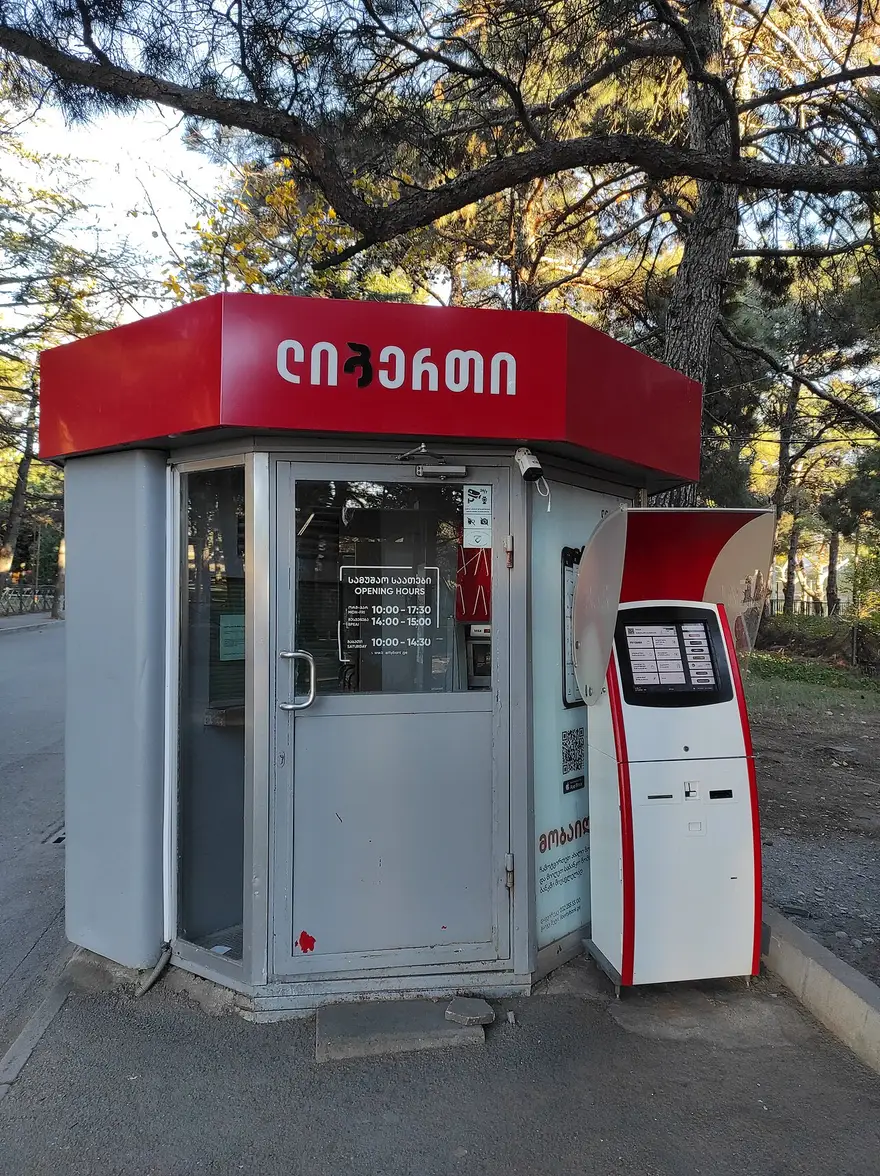
Accounts are typically multi-currency (GEL, USD, EUR and more in one profile), handy if you earn in one currency and spend in lari. You get a debit card, and the apps handle transfers, currency exchange, utility payments and standing orders. TBC’s card for non-residents, for instance, is a multicurrency debit card you can usually pick up the same day at a branch - but it’s built for spending inside Georgia, not as a card you’d rely on back home. International transfers (SWIFT) and services like Wise work with Georgian accounts, though incoming compliance checks can add a day or two, and larger or unusual transfers sometimes trigger extra questions from the bank before the money lands.
Lari isn’t pegged to anything, so it’s worth checking the rate before you move money: the National Bank of Georgia (NBG), the country’s central bank and the body that sets AML and know-your-customer rules for every licensed bank, posts an official reference rate daily - 1 USD was about 2.61 GEL and 1 EUR about 3.03 GEL on the day this page was last checked. NBG doesn’t open accounts for individuals itself; it regulates the banks that do, which is also why the paperwork above has been getting stricter across the board rather than at just one bank.


Why banks sometimes say no
A bank can decline a non-resident application without giving a reason, and it happens more than it used to. In practice it’s rarely about the passport itself - it’s usually one of these:
- No clear source of funds. “I work online” without a statement, invoice or contract to back it up reads as a red flag, not an explanation.
- No clear purpose. “Just in case” or “for travelling” is a weaker answer than “paying rent while I’m based here” or “receiving a local salary.”
- Nationality or country of residence. Compliance teams weigh this differently bank to bank, and it’s the one factor you can’t fix by bringing more paperwork - it’s worth asking a second bank rather than arguing with the first.
- A short, unclear answer in person. Officers make judgment calls; a calm, consistent story matters as much as the documents themselves.
If one bank turns you down, that doesn’t mean the next one will too - trying TBC, Bank of Georgia and Credo in turn is a normal, if mildly tedious, part of the process for some nationalities. There’s usually no formal appeal, and reapplying at the same bank a week later with the same story rarely changes the outcome; a different bank, or a clearer paper trail for your income, works better than persistence alone.
What to keep in mind
- Rules change. Account opening for some nationalities has become stricter - don’t rely on old chat advice or a friend’s experience from a year ago; confirm the current terms with the bank itself.
- Keep some cash. Georgia is increasingly card-friendly, but small cafés, markets and taxis often prefer cash.
- Exchange in the app or at licensed kiosks, not at random street stands.
- A residence permit isn’t required, but if you already have one (or a rental contract, or a local employer), bring the paperwork anyway - it rarely hurts your case and sometimes speeds up the compliance check.
Closing an account is usually simpler than opening one - a visit to the branch or a request through the app - but ask about dormancy fees before you leave the country for good; some banks quietly charge a small monthly fee on accounts that sit untouched, and it’s cheaper to close one properly than to find a negative balance built up months later.
Once you have a number and an account, the rest of settling in is easier: see the step-by-step how to move to Georgia, the full relocation guide, long-term rental, and the mandatory travel insurance needed to enter the country.
Read also

Relocation · 10 min read
How to move to Georgia 2026: relocation steps
Verified · September 1, 2026How to move to Georgia in 2026: legal stay, tourist insurance, bank, residence permit and the 183-day tax line. Checked 01.09.2026.

Relocation · 13 min read
Georgia work permit 2026: rules for the self-employed
Verified · July 23, 2026Georgia right to work: who needs it after the 2026 amendments, the 200 and 400 GEL fees, zero quotas, deadlines and fines. Checked 23.07.2026.

Relocation · 9 min read
Georgia Visa-Free by Nationality: 2026 Table
Verified · July 14, 2026How long can your nationality stay in Georgia visa-free? Full 2026 table: a year for most of the 96 listed countries, plus the e-Visa and visa cases.

Relocation · 11 min read
Georgia tax for sole traders: 1% small business, 0% micro
Verified · July 13, 2026Georgia sole trader tax: small business 1% on turnover up to 500,000 GEL, micro 0% to 30,000, plus VAT and the 183-day rule. Checked 13.07.2026.