
David Gareja from Tbilisi: how to get there and what to see
How to reach David Gareja from Tbilisi by tour, shuttle or car, about 70 km: the Lavra and Udabno monasteries, the road and the Azerbaijan border catch.
David Gareja sits about 70 km south-east of Tbilisi, and there are three ways to get there: a tour, the seasonal Gareji Line shuttle, or your own car - there’s no regular marshrutka to the monastery. The drive takes an hour and a half to two hours each way, and entry is free. There is one catch, though: part of the complex sits on the undelimited border with Azerbaijan, and the upper Udabno monastery is closed as of 2026.
Gareja deserves a day of its own. This isn’t another church in the greenery: hundreds of cells are cut straight into bare semi-desert, striped ochre hills run to the horizon, and there’s a silence you no longer get at busy Mtskheta. The road is easy enough, but the logistics and the border add wrinkles that send some visitors home having seen only half the site.
How to get there from Tbilisi
The key thing about Gareja is that public transport doesn’t run here. There’s no direct marshrutka from Tbilisi, buses reach the surrounding villages at best, and the last few dozen kilometres cross the steppe with no scheduled service. So the choice comes down to three options.
A tour is the simplest way if you don’t have a car. Gamarjoba Georgia Tours sells a scheduled group day out of Tbilisi from about $29 a person (seven hours with the Rainbow Mountains, food not included, ages 5-79), and Envoy Tours charges 130 GEL, about $50, with lunch included - but only on set days (Thursday on its tour page, Thursday and Sunday on its schedule), so check the date first. Group tours meet at a fixed point in town - Avlabari metro or the Envoy hostel - rather than at your hotel, and give you roughly an hour and a half to an hour and 45 minutes at the Lavra; hotel pickup and a longer stay are what a private tour adds. Prices are from each operator’s own site, checked 17.09.2026. It suits anyone who would rather not drive in the heat or work out the road on their own.
The Gareji Line shuttle is the budget classic for independent travellers. The minibus runs for a small fixed fare (around 40 GEL return), needs at least two passengers, and runs only in season. The operator’s own log has the 2025 season starting on 19 May, and the 2024 season ending as early as 7 September - so treat May to September as the reliable window and anything in October as a bonus you confirm first. It gathers by the Pushkin statue in the park near Freedom Square at 10:45, gives you about three hours to explore, and stops in Udabno village on the way back where you can eat. No booking: they take everyone who turns up and add minibuses if the group is large. Check their Facebook page a day or two ahead rather than any published end date, this one included - the closing date has moved around from year to year.
Your own or a hired car is the most flexible option. It’s about 70 km, the road is mostly paved almost all the way to the monastery, and only the final stretch near Udabno is gravel that’s best taken slowly after rain. A 4x4 is not needed for the basic trip, though it helps if you want to push further along the steppe tracks. It is easiest to arrange a car in advance in Tbilisi - see the car hire section for how. A taxi for the day costs more than the shuttle, but you decide when to leave and how long to linger at each stop.
If you’re driving, fill up and buy water in advance in Rustavi or Sagarejo: there is no petrol station or shop at the monastery, mobile signal drops out in places on the approach, so it is worth downloading the route offline in your sat-nav first. Parking is at the lower monastery; beyond that you go on foot, and the last few metres up to the Lavra are uphill.
Which one to pick depends on your pace and your party. A tour takes the logistics off your hands, but ties you to a group and a shared schedule: you will not linger an extra half hour at a cell you like or turn off along the way. The shuttle is the cheapest and leaves you on site under your own steam, but it only runs in season and boxes you into a fixed departure window. A car gives full freedom - leave at dawn before the heat, walk the Lavra at your own pace and be back in Tbilisi by lunch - and it works out reasonably if there are two or three of you splitting the hire and fuel. For a solo traveller with no licence the shuttle almost always wins on cost, and a tour on convenience.
The Lavra: the lower monastery
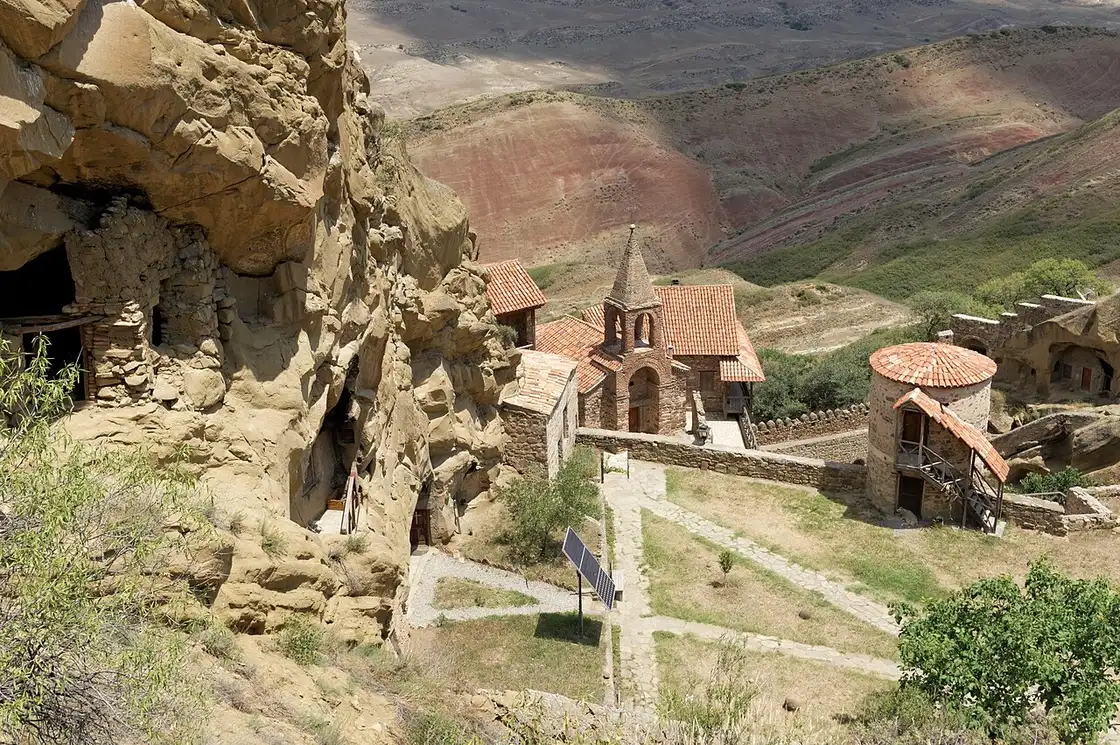
The heart of the complex is the Lavra, the first and main monastery. It’s what everyone who reaches Gareja sees, and it is the part that stays open to visitors. It was founded in the 6th century by David of Gareja, one of the thirteen Assyrian Fathers who came to preach Christianity; for more on the history and the saints, see the separate piece on the David Gareja monastery.
Inside there are cave cells, a chapel, wooden balconies over the drop, carved tombstones and a small courtyard at the foot of the cliff. A spring with drinking water runs by the monastery, and there is a visitor centre with a toilet and a church shop nearby. Because the monastery is active, a dress code applies: long trousers or a skirt below the knee, and covered head and shoulders for women. A scarf can usually be borrowed at the entrance, but don’t count on it - it’s easier to dress the part from the start.
An hour to an hour and a half is enough for the Lavra itself: walk the cells, climb the wooden stairs to the upper tiers, sit in the shade by the spring and pick out the old inscriptions on the tombstones. This is still a working monastery, not a museum, so keep your voice down and don’t photograph the monks without asking. There are noticeably fewer people here than at the popular stops near Tbilisi, and that’s half the pleasure.
Udabno and the ridge trail
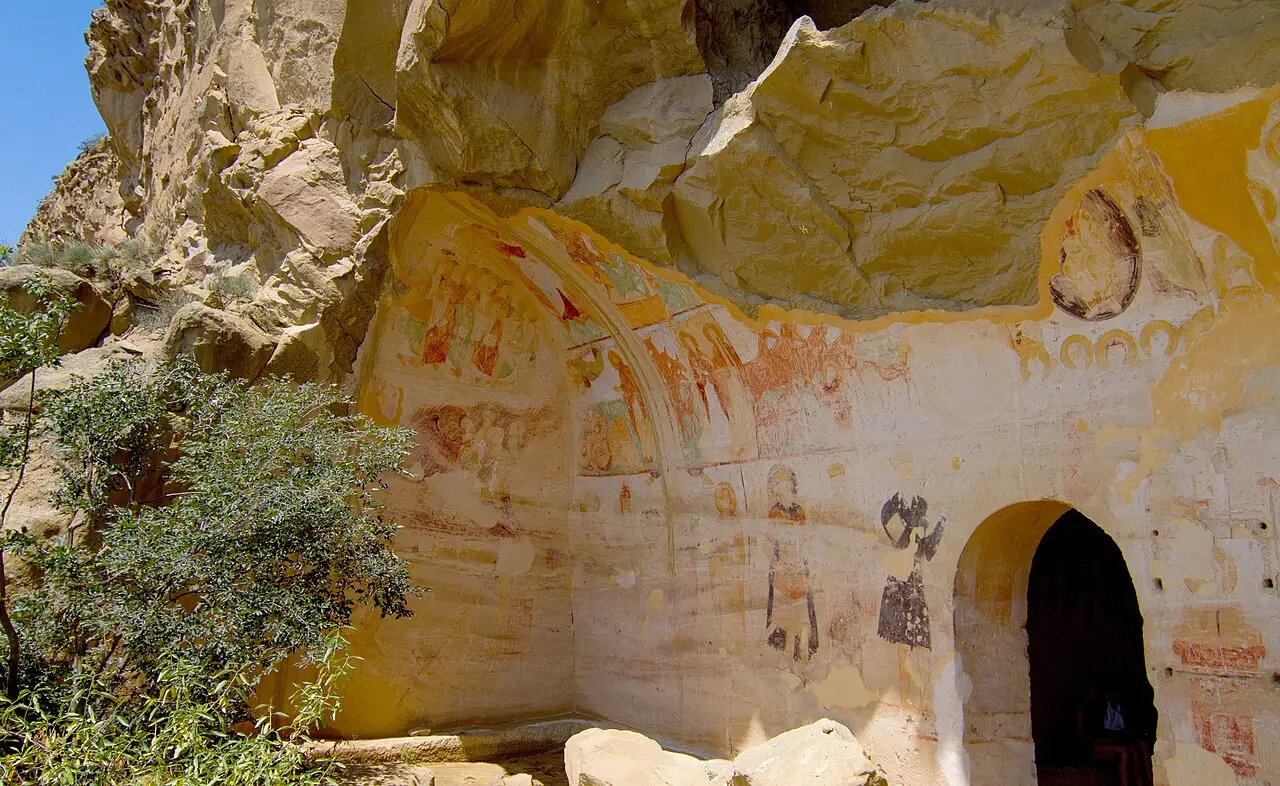
Above the Lavra, over the crest of the hill, lies Udabno - the upper cave monastery that many people come for. A trail runs up the open slope from the lower monastery, a loop of roughly three kilometres with not a single tree or patch of shade. At the top there are cave churches with medieval murals, including the famous frescoes from the age of Queen Tamar, and from the ridge the view opens over an endless semi-desert that already runs onto the Azerbaijani side.
The problem is that this climb is off limits right now. As of 2026 the trail to Udabno is closed, and reaching the upper frescoes is not possible - the reason is the border, which comes next. If Gareja means the Udabno murals to you above all, weigh the risk soberly: access can be closed, and then the trip is limited to the Lavra.
The Azerbaijan border: what to know
Gareja sits on exactly the stretch of the Georgia-Azerbaijan border that’s still not agreed. The shared border runs for almost 480 km, and about a third of it is undelimited - the monastery complex fell right into this disputed zone. For a traveller that is not an abstraction but a concrete restriction on the ground.
The dispute flared up in 2019, and since then access to the upper Udabno has been blocked by Azerbaijani border guards from time to time. There have been incidents where monks and tourists were turned back from the trail, and after clashes the climb was shut entirely. The lower Lavra is usually not affected - it stays open - but the upper monastery is open one day and not the next. If the trail is closed you are simply turned back at the edge of the Lavra grounds: there’s no arguing it, and no exceptions for people who came a long way.
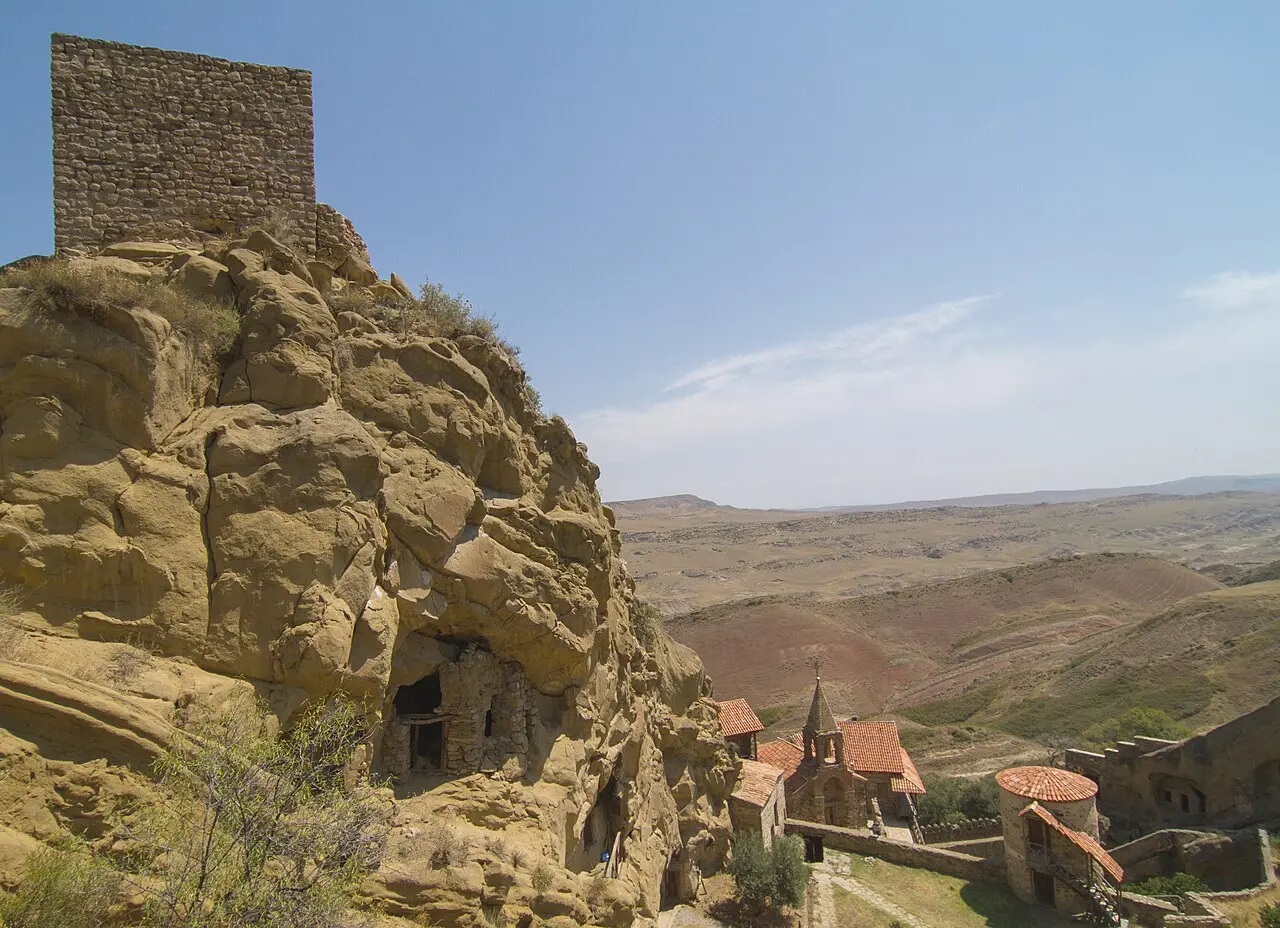
The practical takeaway: the status changes, and it is worth checking right before you leave. Ask your tour operator or look at recent traveller reports - no guide, this one included, can promise you an “open today”. The border guards decide on the spot, and it is wiser to assume you may not make it up to Udabno.
When to go and what to bring
This is semi-desert, and the climate is harsh: in summer it’s over thirty degrees with no shade at all. The best time is spring, from April to May, and autumn, from September to November, when it is cooler and the hills aren’t yet or no longer scorched pale. You can go in summer, but only early in the morning and with plenty of water.
Bring water and a hat - there’s nowhere to buy them on site, there are no cafes or restaurants at the monastery, and the nearest food is back in Udabno village along the road. Sunscreen and comfortable shoes help too: even without the climb to Udabno you walk a lot on uneven stone and open slope. The “from” budget on this route is a guide to the cheapest way to get there (the shuttle), before food, car hire and taxis.
What to keep in mind
- Distances and times are rounded guides; count on a full day for the drive and the Lavra, especially if you take the shuttle with its fixed schedule.
- The upper Udabno monastery is closed as of 2026; plan the trip so it makes sense without it, and check the current status before you leave.
- It’s an active monastery, so the dress code is compulsory; a scarf at the entrance is hit and miss, so it’s better to dress the part in advance.
- Set off early: organised groups roll in around midday, whereas in the morning both the Lavra and the steppe are emptier and less baking; driving yourself, aim to leave by nine.
- The trip pairs well with a look around Tbilisi before or after; if you are drawn to wine country, the Kakheti wine route is nearby. More plans are in the routes section.
Route day by day
- Days on the road
- 1
- Distance
- ≈70 km
- Budget from
- 40 GEL
- Best season
- April, May, September, October, November
The route at a glance
-
Tbilisi
Route startThe start, heading south-east through Rustavi and the Kakheti steppe. Set off in the morning: the drive and the visit take a full day.
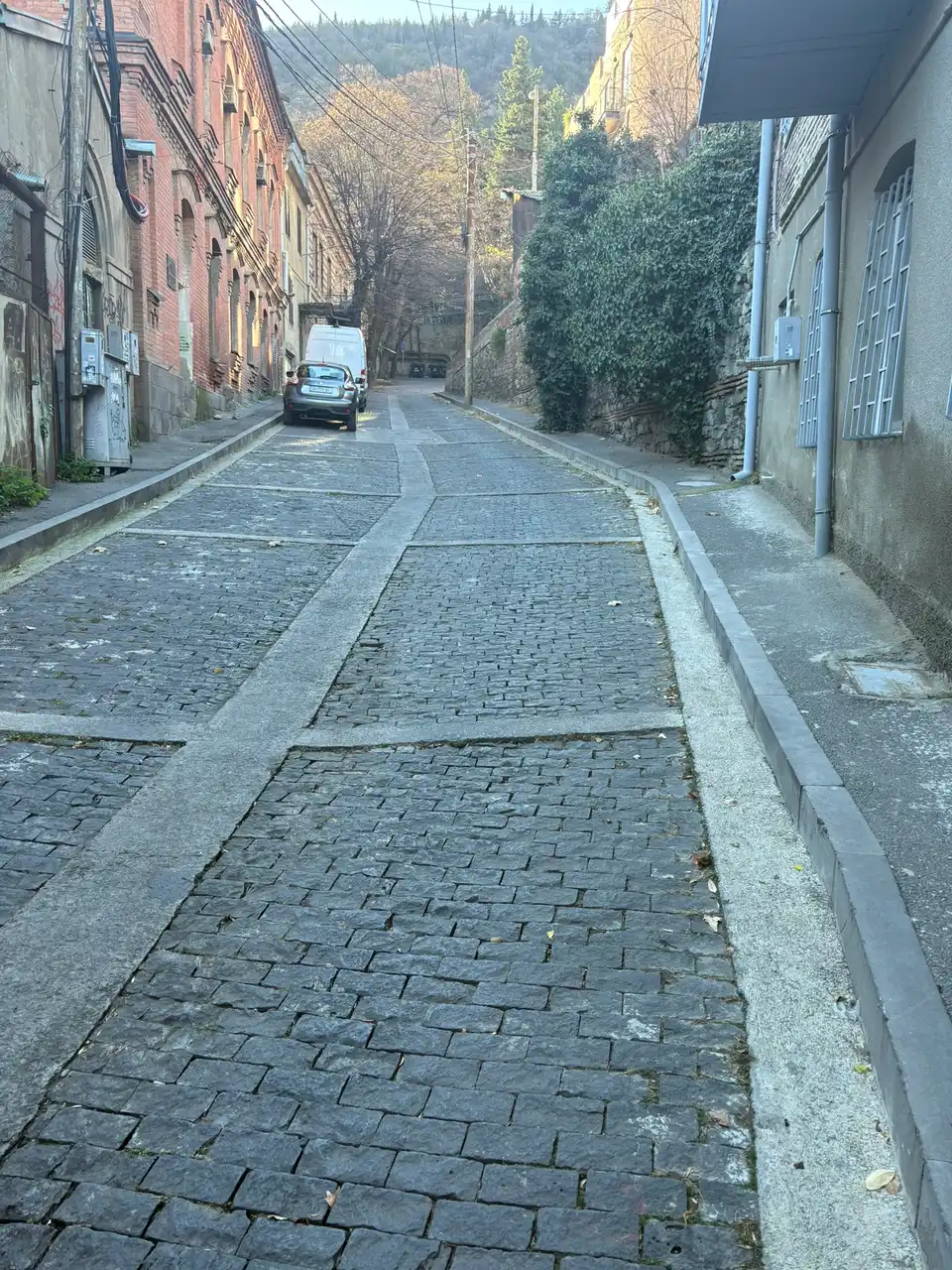
Photo: Georgia Guidebook -
Gareja semi-desert
55 km from the startstop ≈20 min
Striped ochre hills of the steppe along the road; tours stop near Udabno village for coffee or lunch. After this the short gravel section begins.
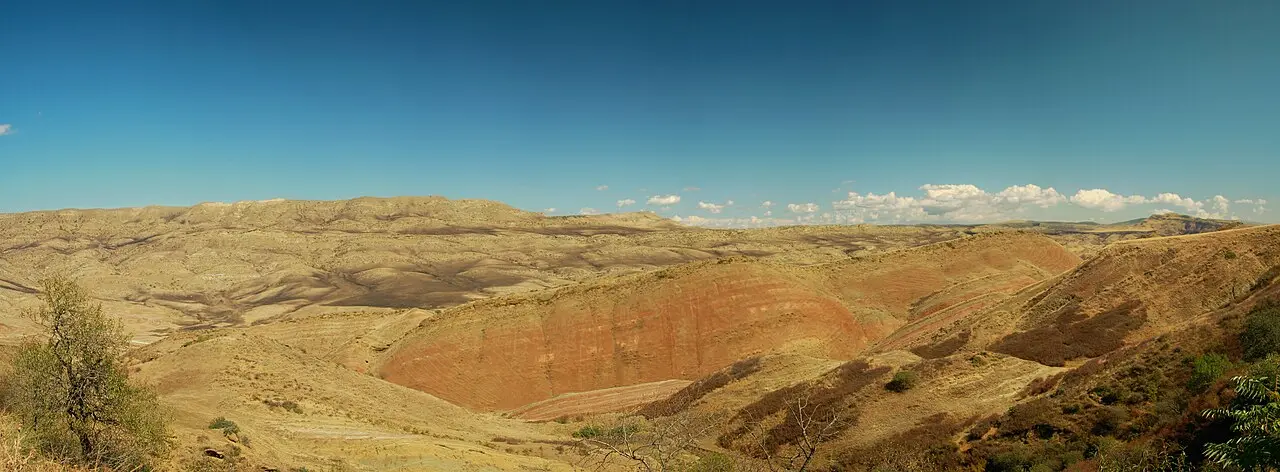
Photo: Vladimer Shioshvili / Wikimedia Commons, CC BY-SA 2.0 ( source) -
Lavra
70 km from the startstop ≈90 min
The main and only open monastery of the complex: cave cells, a chapel and a courtyard at the foot of the cliff. Active, dress code required.
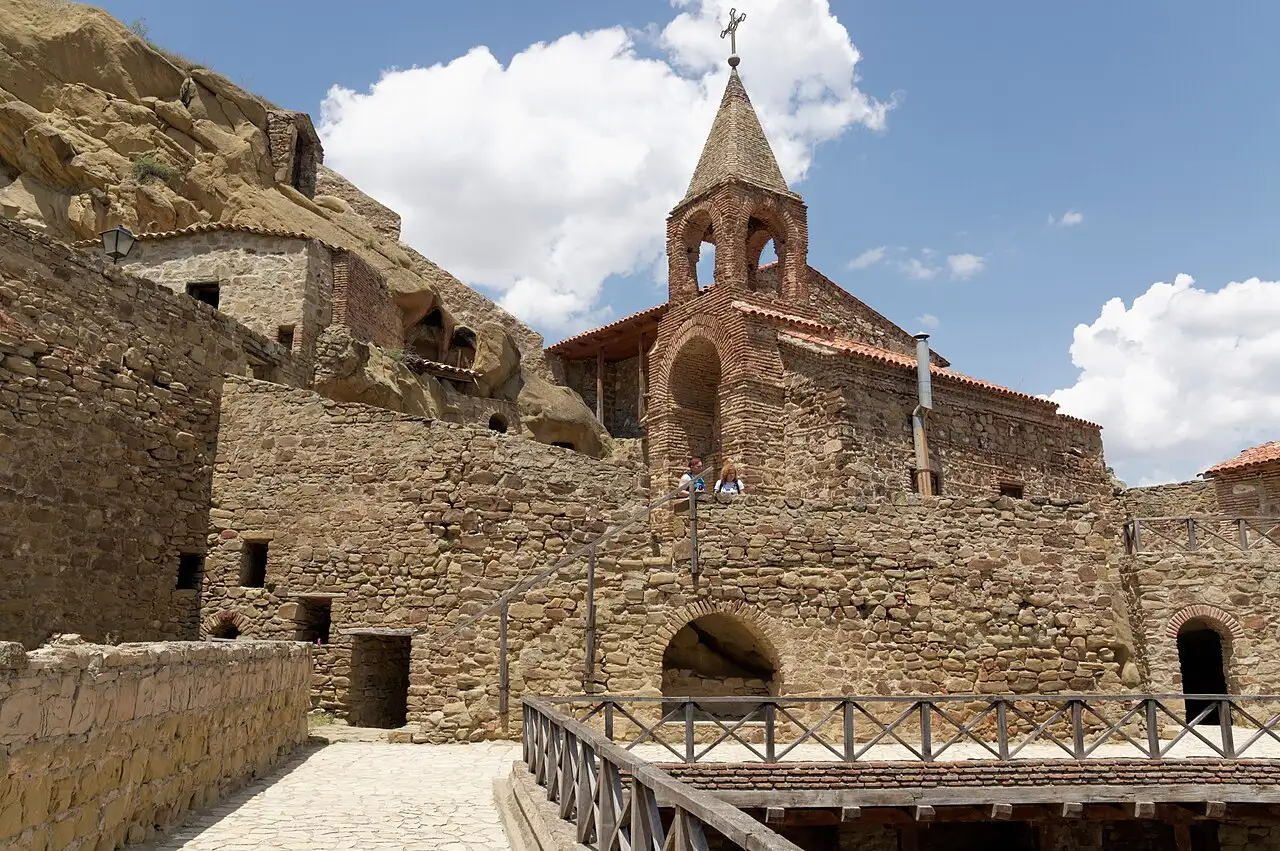
Photo: Vyacheslav Argenberg / Wikimedia Commons, CC BY 4.0 ( source) -
Udabno cave monastery
70 km from the startstop ≈60 min
The upper monastery on the ridge, a roughly 3 km climb on an open trail from the Lavra. Worth it for the frescoes, but closed as of 2026 because of the border situation - check before you go.
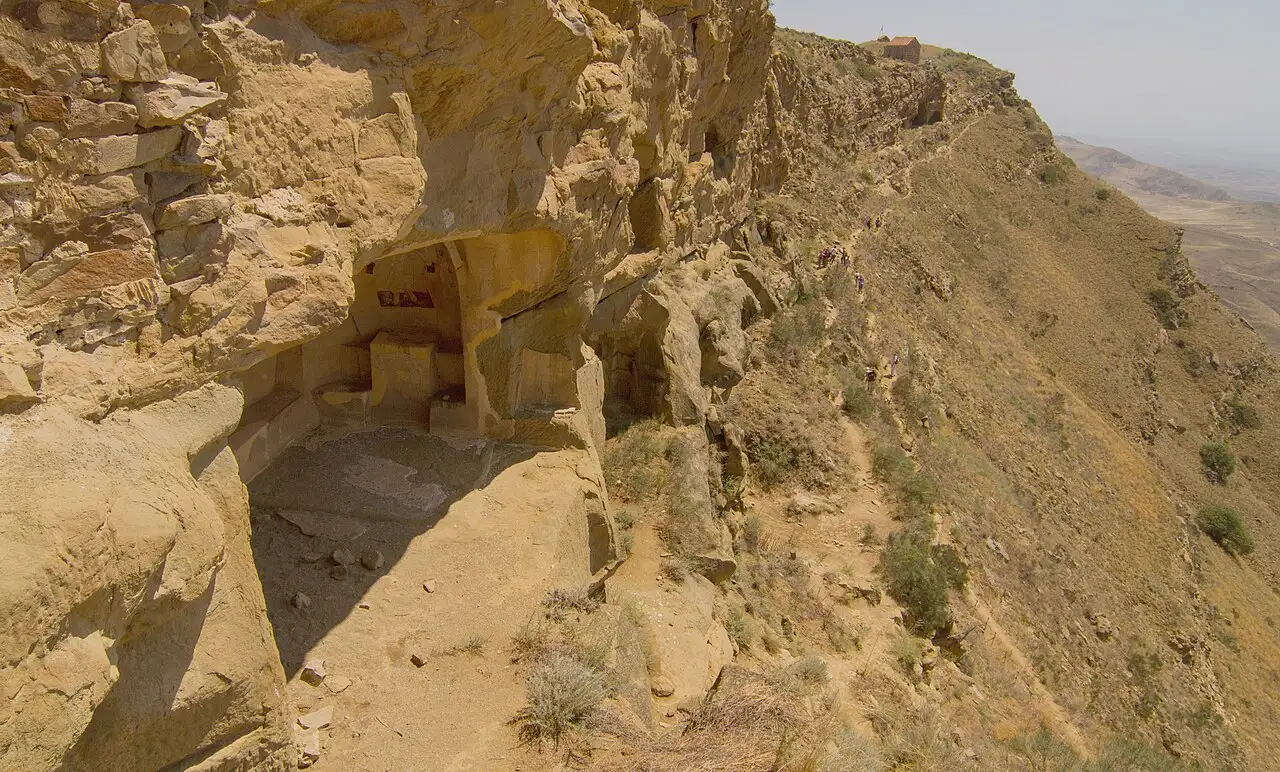
Photo: Jon Gudorf Photography / Wikimedia Commons, CC BY-SA 2.0 ( source)
Route map
The map with stops loads on click - to keep the page lightweight.
The map didn’t load. Check your connection and refresh the page.