
Batumi Botanical Garden: tickets, zones and best time
Batumi Botanical Garden 2026: what a foreign visitor pays, who gets in cheaper, the three parks and nine plant zones, the electric bus, buses 40 and 10.
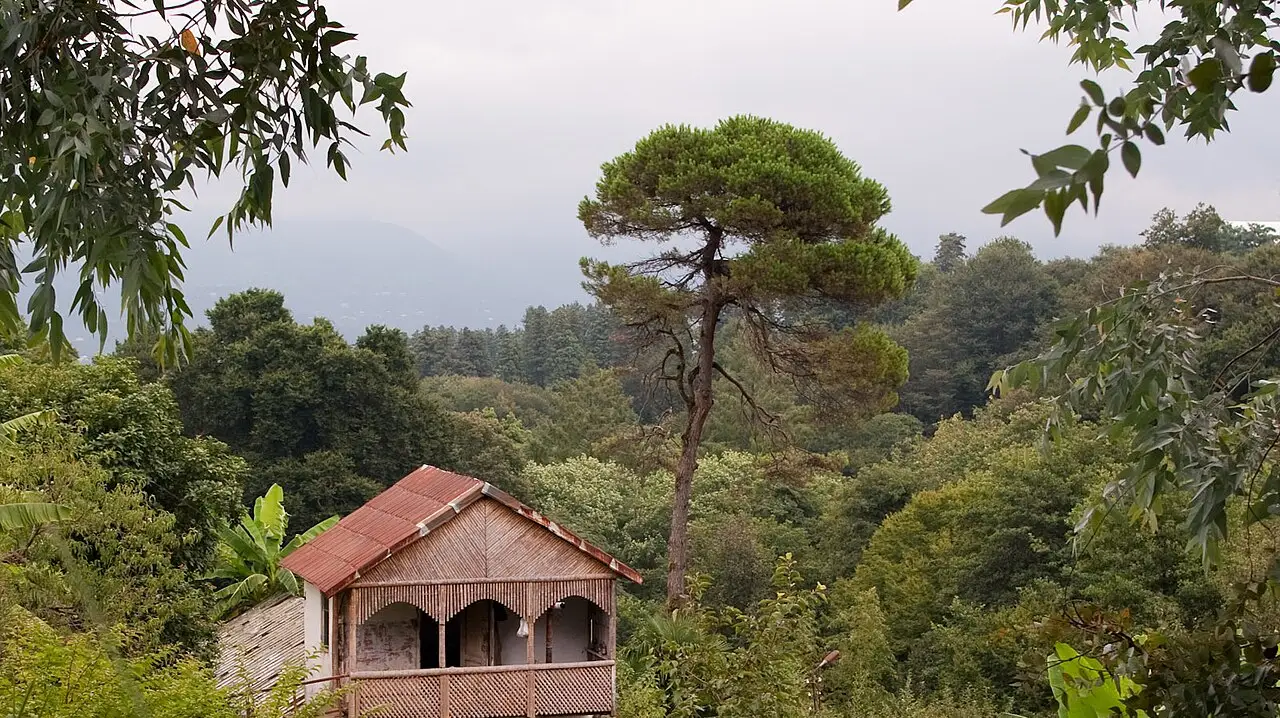
A foreign visitor pays 25 GEL at the gate of Batumi Botanical Garden, and the garden’s own site shows 09:00-18:30 (checked 24 October 2026). Give it two to three hours on foot: the grounds run to 108.7 hectares on Green Cape (Mtsvane Kontskhi), 9 km north of central Batumi, and climb from the shoreline to 220 metres. That climb is what most plans get wrong. The dolphinarium and the cable car each take about an hour; this is a half-day, and the garden treats itself as one, with a camping area and a wedding venue inside the fence alongside the plant collection. More than a hundred thousand people come every year.
Tickets, hours and getting around the grounds
Read the price list carefully, because every rate below 25 GEL carries a condition, and the condition is citizenship or residence rather than age. The 10 GEL ticket is for a citizen of Georgia or the holder of a Georgian permanent residence permit, with an ID. Students at 5 GEL means students of institutions accredited in Georgia who are Georgian citizens; pensioners at 5 GEL means Georgian citizens or permanent residents; schoolchildren at 2 GEL means schools accredited in Georgia. Free entry goes to preschool children, people with disabilities, orphans and to veterans of the Georgian armed forces - an American or British veteran pays the full 25 GEL. A foreign passport buys the 25 GEL ticket and nothing cheaper, so there’s no discount to negotiate at the window.
The garden publishes no online sale of its own; tickets are bought at one of its three ticket offices on the way in. Opening hours deserve a second look as well. The 09:00-18:30 above is what the garden’s site shows in late October 2026; in September it showed 09:00-19:00, so the closing time moves with the season - check bbg.ge before you plan a late-afternoon arrival.
Walking the whole site is a real climb, from sea level to 220 metres. If that isn’t your idea of a day out, the electric bus runs the main tourist route: 15 GEL for a foreign visitor, 5 GEL for a Georgian citizen or permanent resident, or 100 GEL to hire one privately for up to five people for an hour. On foot, budget 2-3 hours to take in a representative slice of the collection without hurrying.
You can also stay the night, in marked spots between 18:00 and 10:00. That costs 50 GEL per person for a foreign visitor and 25 GEL for a citizen or permanent resident, with the entrance ticket included in the figure.
Three parks, nine zones

The garden was founded by the botanist Andrei Krasnov and opened on 3 November 1912. It’s laid out as three connected parks - Upper, Lower and the Giorgi Gabrichidze Seaside Park closest to the water - and inside them the collection is divided into nine phytogeographical departments, which the garden lists in full: East Asian, Himalayan, Australian, New Zealand, North American, Mexican, South American, Mediterranean, and the Transcaucasian Humid Subtropics that this coast belongs to itself. Bamboo groves, Japanese maples, eucalyptus and palm avenues fill the paths between them, and an hour disappears inside a single zone without you meaning to give it one.
Nine zones spread over that much ground and that much climb is more than a short visit covers, so pick one or two and walk them properly. The alternative’s a fast loop that leaves you with photographs of paths and no memory of what grew beside them.


Sea views, free-entry days and seasons

The views are the second reason to come. Paths lead out to lookouts above the sea, and on a clear day the coastline runs for miles in both directions, with Batumi across the bay from the higher terraces.
The free-entry days are easy to misread, so here’s what they actually are. The director may admit citizens of Georgia and holders of a permanent residence permit, on production of an ID, free of charge on 1-2 January, 26 May, 1 June, Batumoba, and one day each of the camellia, bamboo, rose, fruit-and-citrus and strobile exhibitions. A foreign visitor who turns up on one of those dates still pays 25 GEL. The exhibition dates move from year to year and are announced in the garden’s own news, so a trip built around one needs checking first.
Season by season: flowering is heaviest in spring; summer sends you into the shade of the bamboo groves instead of the open terraces; and by autumn the paths are quieter while the evergreen part of the collection hasn’t lost its colour.


What to bring and what to expect
Shoes decide how far up you get: 220 metres of climb between the shore and the top of the collection, much of it out in the open between patches of shade, so sun protection and water earn their place in the bag even on a short visit. Bring cash for the ticket office. Anyone with small children or with limited mobility should book the electric bus into the plan from the start rather than deciding halfway up a slope - 15 GEL a head buys back the part of the day that hills would otherwise take.
Midday in July and August brings the strongest sun and the busiest paths, because it lines up with the peak of the beach season down the hill; come early and you get a cooler garden and thinner crowds on the main avenues at the same time. Big groups and anyone with a pram should fix a meeting point and a time before splitting up: 108.7 hectares across three parks will separate people for hours if the plan lives in one person’s head. And this is a plants-and-views day, not an animal one - if that’s what the children want, the dolphinarium and aquarium sit closer to the centre and fit a shorter window.
Photographers, plant people, beach days: who it’s for
A garden this size wants a free half-day, not the hour or two between the beach and dinner. With only a short window, the cable car or a walk through 6 May Park does more for you. Photographers and plant people get the most out of it, because nine zones across that much ground look nothing like one another instead of blurring into a single green space, and the sea views from the upper paths are hard to match on this stretch of coast.
If the trip is about beaches and nightlife, you can skip the garden without regret. And since nothing here runs to a show timetable, the decision can wait until morning: go if the day is clear and your legs are fresh. In peak season the size works in your favour: three parks and nine zones swallow a crowd in a way one promenade never will.
How to get there
The garden sits on Green Cape, north of Batumi, and it names two public routes to its own gates. Marshrutka No 40 leaves the Batumi Trade Center on Agmashenebeli Street every 15 minutes and runs daily; get off at the stop as you enter Chakvi, 300 m from the third ticket office, and the fare is 50 tetri. Bus No 10 leaves Zeda Gele Street every 40 minutes, also daily, and stops 100 m from the second ticket office, 80 tetri for the round trip. Those two fares come from the garden rather than from the carrier, so treat them as the order of magnitude and carry small change.
The coastal train is the route most guides name and the one to be careful with: the Georgian Railway general schedule has no suburban service stopping at Mtsvane Kontskhi, so don’t build a return around one. By car or taxi it’s 20-30 minutes, and that’s the option worth paying for if the garden shares a day with a beach afternoon in the city and you’d rather not read a coastal timetable. For more on getting around the coast, see beaches of Batumi and the coast and the transport section, and for the city itself, the Batumi guide.
Photos
On the map
The map loads on click - to keep the page lightweight.
The map didn’t load. Check your connection and refresh the page.
Admission and opening hours
- Admission price
- Foreign visitors 25 GEL. The lower rates are for Georgian citizens and holders of a Georgian permanent residence permit, on production of an ID: 10 GEL general, 5 GEL students and pensioners, 2 GEL schoolchildren. Free for preschool children, people with disabilities, orphans and veterans of the Georgian armed forces, with the relevant document.
- Opening hours
- The garden's own site shows 09:00-18:30 (checked 24 October 2026; it showed 09:00-19:00 in September); closing time moves with the season, so check bbg.ge before a late visit
The garden publishes no online sale of its own - tickets are bought at one of its three ticket offices. The electric bus along the main route costs 15 GEL for a foreign visitor and 5 GEL for a citizen or permanent resident. Allow 2-3 hours on foot.
Details checked: September 23, 2026
Read also

Entertainment · 11 min read
Cooking Classes in Tbilisi: What to Pick and What It Costs
Verified · October 17, 2026Khinkali and khachapuri classes in Tbilisi from 110 GEL: family home or food walk, prices from operators' own sites, kids, vegetarians, how to book.

Entertainment · 9 min read
Georgian Folk Shows in Tbilisi: Where to Go and Prices
Verified · October 19, 2026Georgian dance and polyphony in Tbilisi: Erisioni at the Sports Palace on 30 October 2026, Ethno Tsiskvili nightly, lari prices and what the dances mean.

Entertainment · 9 min read
Paragliding in Gudauri: tandem flights, prices, season
Verified · October 10, 2026Tandem paragliding in Gudauri: the three launch sites, summer and winter prices in lari, weight limits, insurance and what happens if the weather turns.

Entertainment · 13 min read
Tbilisi Nightlife: Techno Clubs, Bars and Door Rules
Verified · October 6, 2026Tbilisi nightlife in 2026: Bassiani, KHIDI and Left Bank, entry prices in lari, how registration and the door work, where to drink first and getting home.