
Jvari Monastery (Mtskheta): what to see and how to get there
The 6th-century Jvari Monastery above the confluence of the Kura and Aragvi near Mtskheta: what kind of church it is, why it is famous and how to reach it.
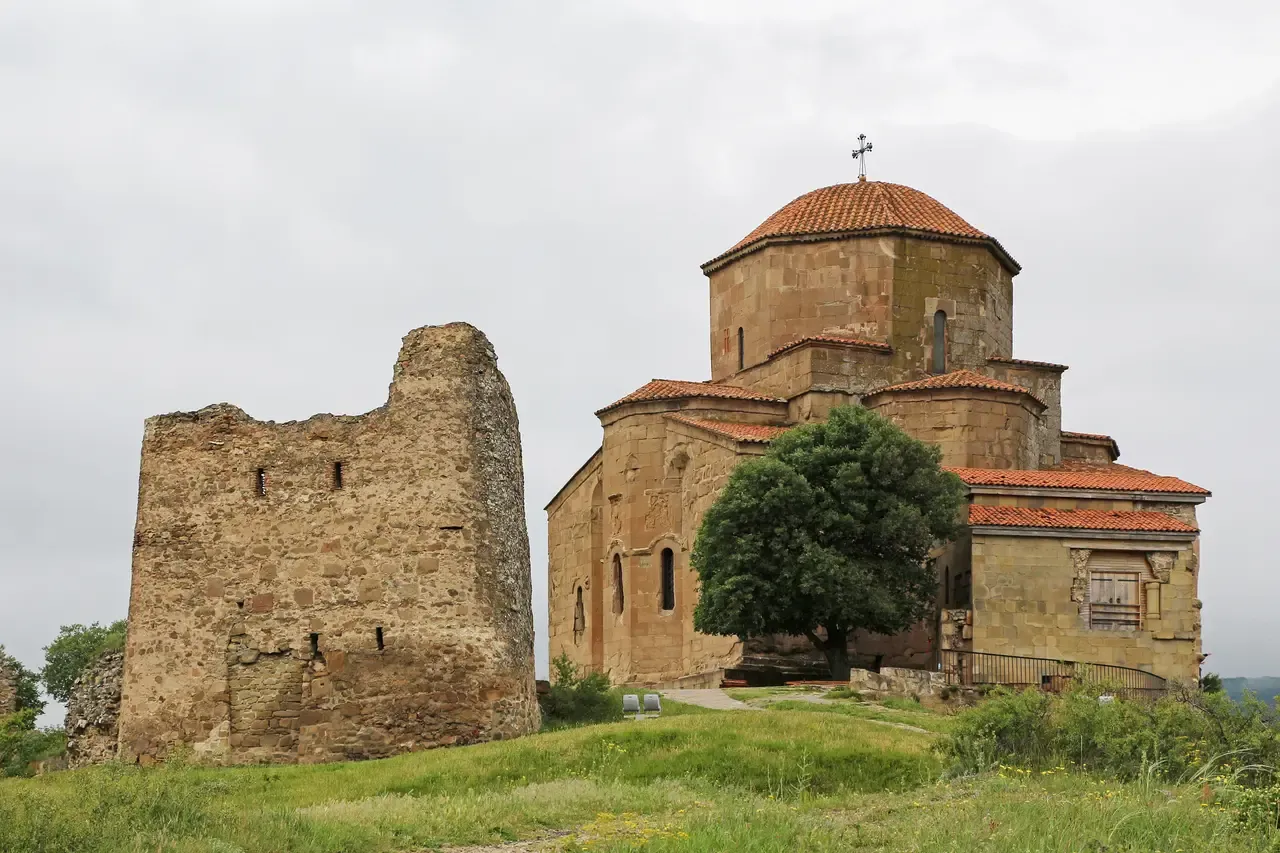
Jvari Monastery is a 6th-century Georgian Orthodox monastery, built around 590-605 on a mountaintop near Mtskheta, right above the confluence of the Mtkvari (Kura) and Aragvi rivers. It is a rare example of an early-medieval Georgian church that has come down to us almost unchanged. Since 1994 Jvari has been part of the UNESCO “Historical Monuments of Mtskheta” site.
Why the monastery is famous
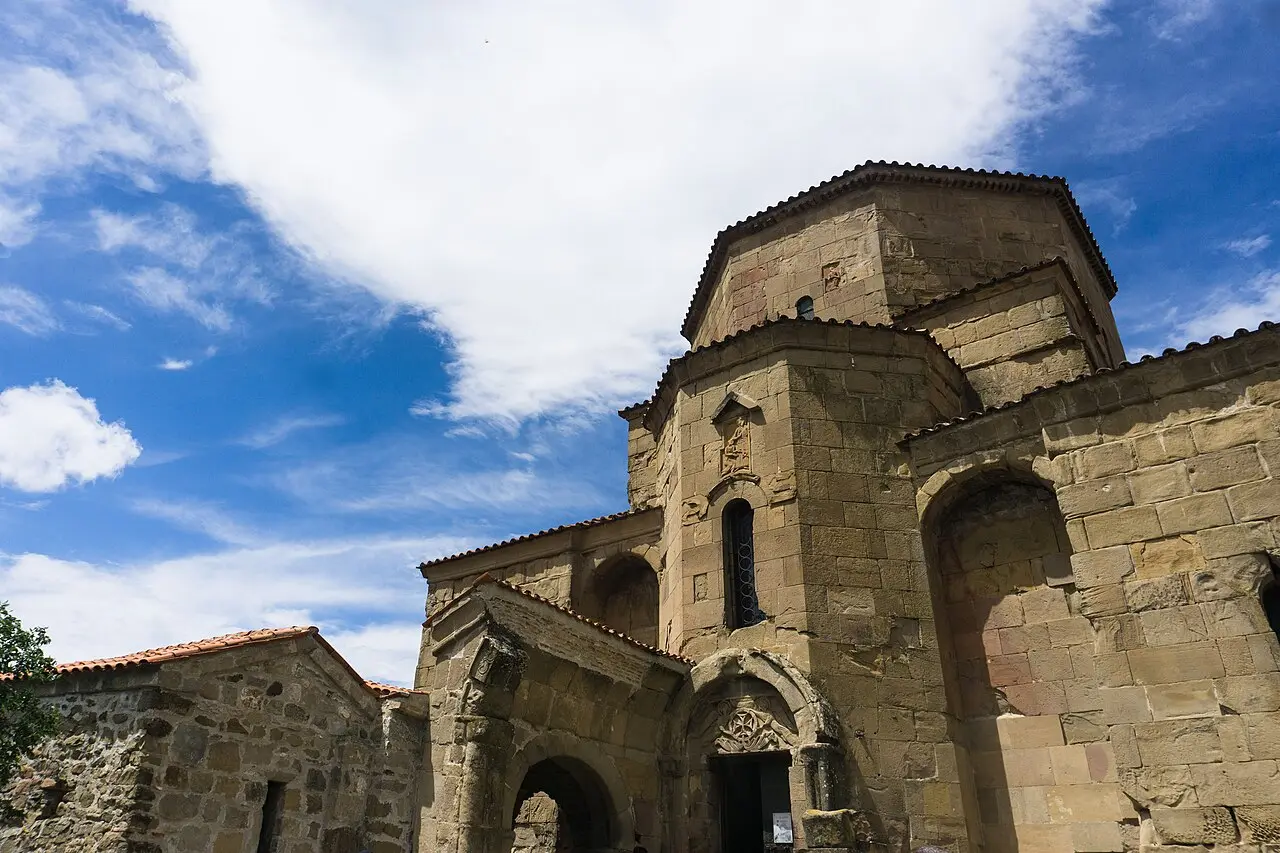
The main church of Jvari was built around 590-605 by the ruler of Kartli, the erismtavari Stepanoz I. By tradition the place itself is linked to St Nino, the enlightener of Georgia: it’s believed that she raised a wooden cross here on the site of a former pagan sanctuary, not long after King Mirian III converted to Christianity in the early 4th century and made it the kingdom’s religion. Hence the name of the monastery: “Jvari” means “cross” in Georgian, and the site was sacred long before either building we see today went up.
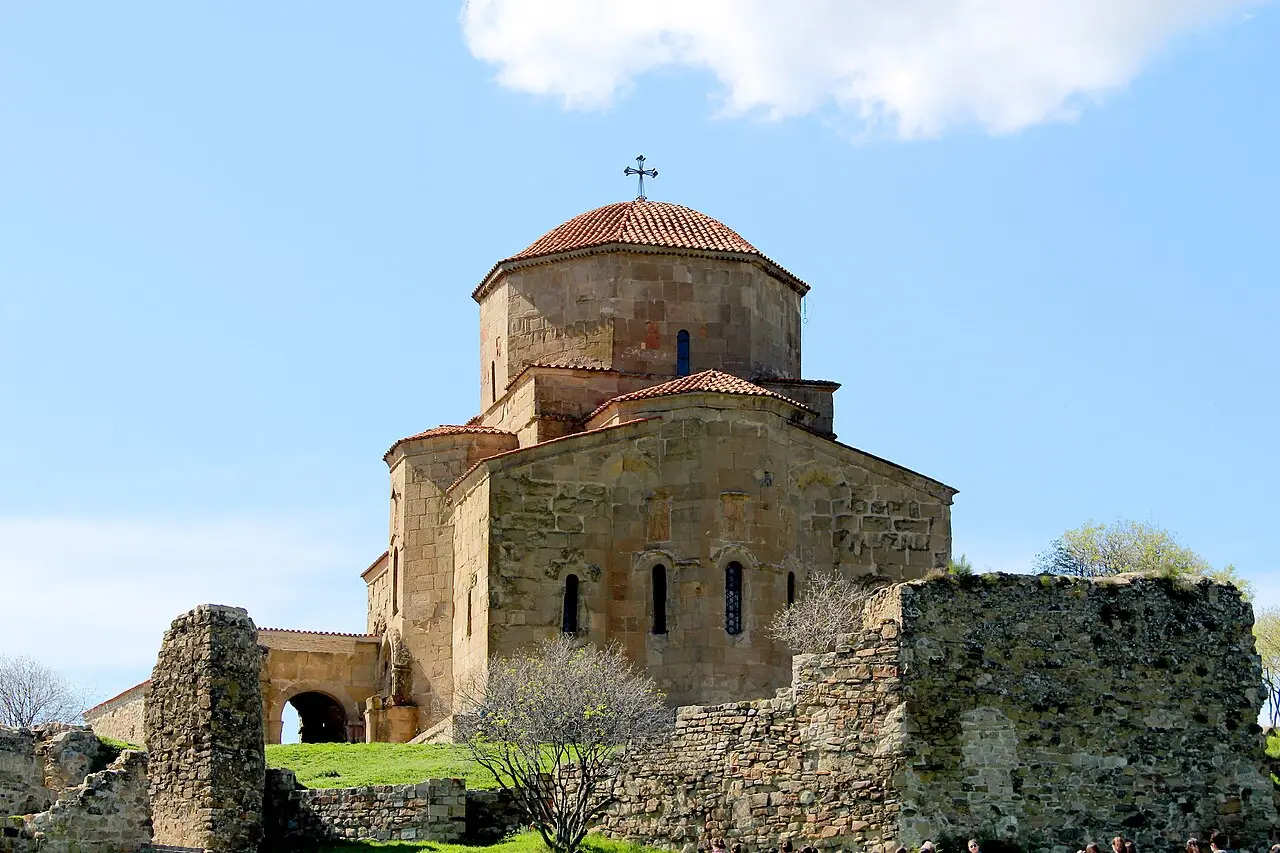
For Georgian architecture, Jvari isn’t just a monument but a model. Its plan gave rise to a whole “Jvari type” of cross-dome church, which went on to influence ecclesiastical building both in Georgia itself and in neighbouring Armenia. Only a handful of true Jvari-type buildings survive intact anywhere: the closest is Ateni Sioni near Gori, closely modelled on Jvari in the 7th century and still standing today, along with the larger of the two domed churches at Old Shuamta in Kakheti. That is exactly why Jvari, together with the other monuments of Mtskheta, was placed on the UNESCO World Heritage List. What you see today rises about 25 metres and covers a footprint of roughly 22 by 19 metres, but it doesn’t feel that compact from inside: the design is a tetraconch, a round core with four apses and four corner niches, and the dome rests directly on the walls rather than on internal pillars. There’s nothing blocking the middle of the church, so the space reads as one continuous room, larger than the footprint suggests.
The small church still standing beside it
What most visitors miss is that Jvari isn’t one building but two. Before Stepanoz I raised the large church, his father Guaram, another ruler of Kartli, had already built a modest chapel on the same spot, over the remains of St Nino’s original wooden cross, sometime around the mid-500s. Known as the Small Jvari, or Mcire Jvari, it still stands today against the north side of the main building rather than having been demolished or absorbed into it. It’s a plain cross-shaped room built from well-dressed stone blocks, and its curved eastern end once carried a mosaic; only a few small fragments of that decoration survive. Stepanoz I’s much larger church went up beside it once the smaller one could no longer hold the crowds coming to the site, and Georgia ended up with both generations of the family’s building work standing side by side, rather than one erasing the other.
It’s easy to miss on a quick visit, since most people arrive, circle the big church once for photos and head straight back to the car. Walk around to the north side deliberately and the small church is right there, low and plain next to its much taller neighbour - a useful reminder of how modest the very first version of this sacred site actually was, before Jvari became one of the most photographed buildings in the country.
What the carvings and inscriptions show
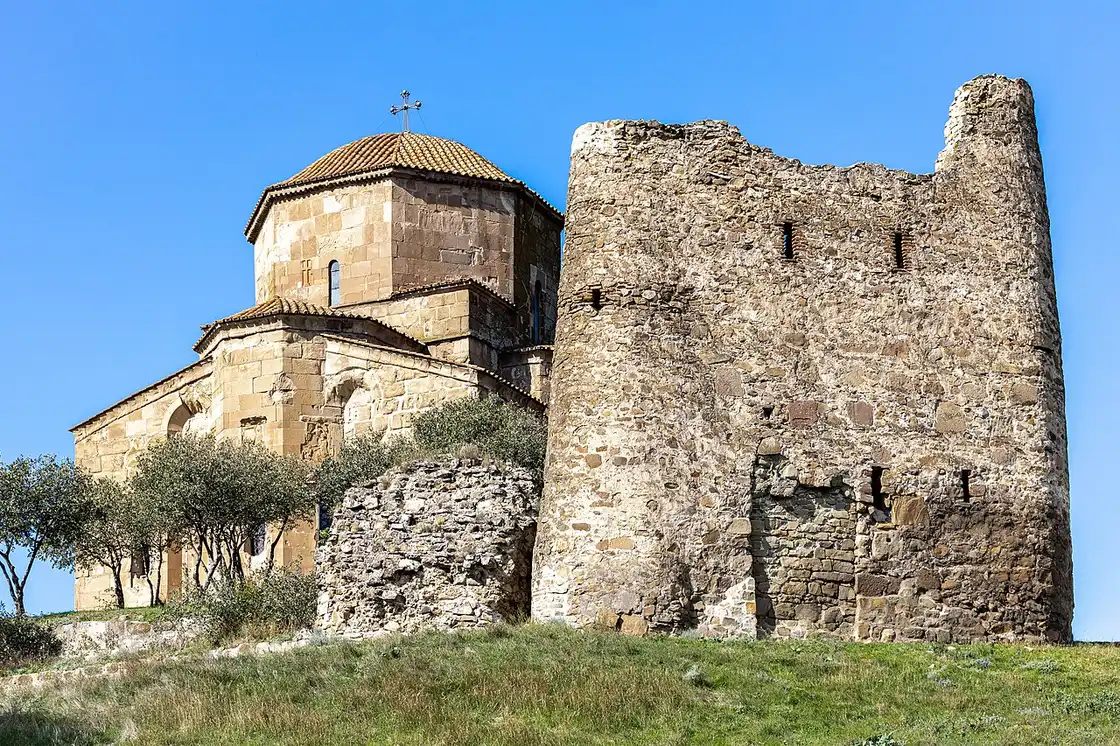
Look closely at the outer walls and Jvari keeps giving up detail long after the silhouette has stopped surprising you. On the east and south facades, beside the reliefs, run inscriptions in Asomtavruli script, one of the earliest forms of Georgian writing, and it isn’t decorative filler: the inscriptions record the construction work carried out under Stepanoz I, making the church one of the oldest pieces of Georgian epigraphy still in place. That’s a big part of why Jvari is generally held to have been built under Stepanoz I - a building this old rarely names its own builders on the wall, and Jvari does. On the south facade, above the entrance, a carved tympanum shows the Glorification of the Cross - a Bolnisi cross, the plain four-armed form typical of early Georgian churches and named after another ancient site further south, held aloft by two angels in a composition read as the Ascension of Christ. It’s a good reminder that Jvari wasn’t just an engineering milestone; the carving on it shaped how later Georgian churches told the same stories in stone.
How to get there
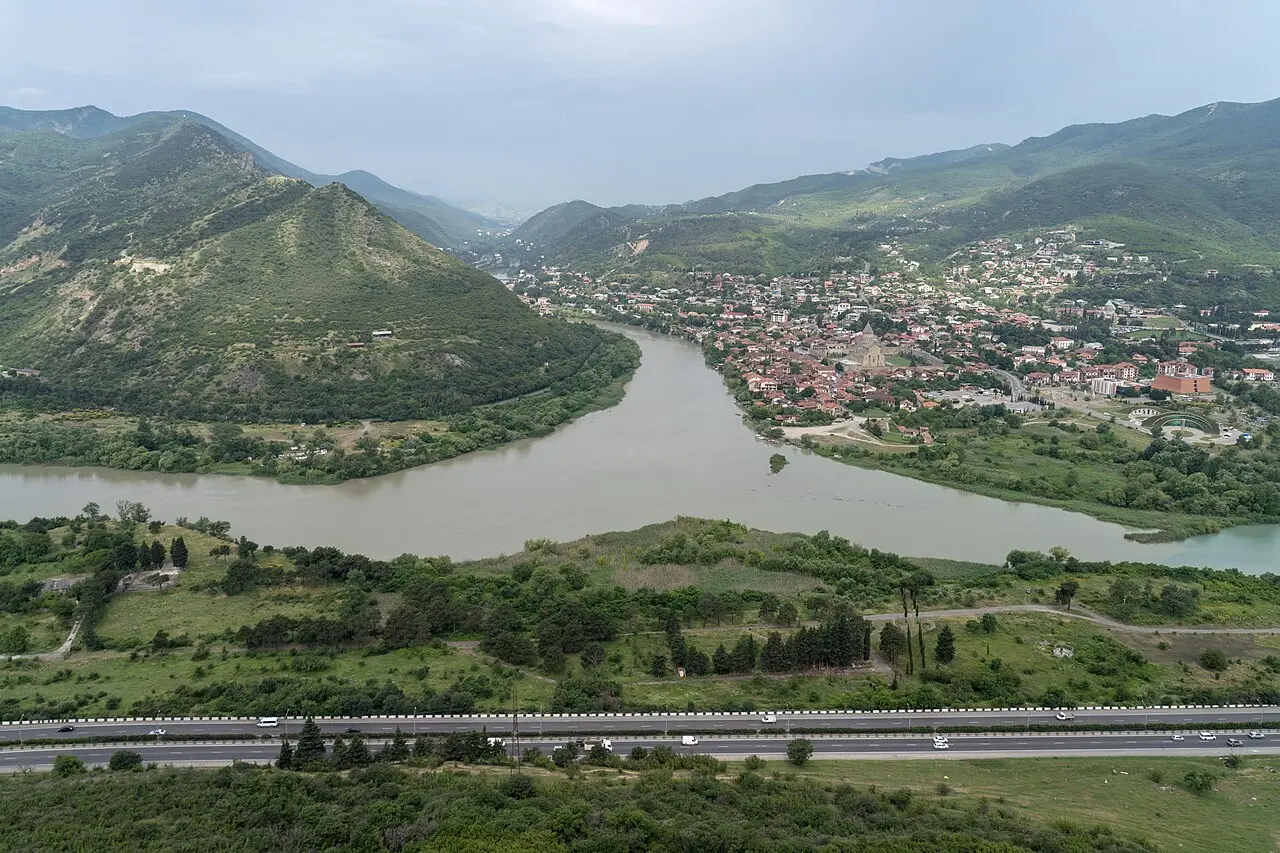
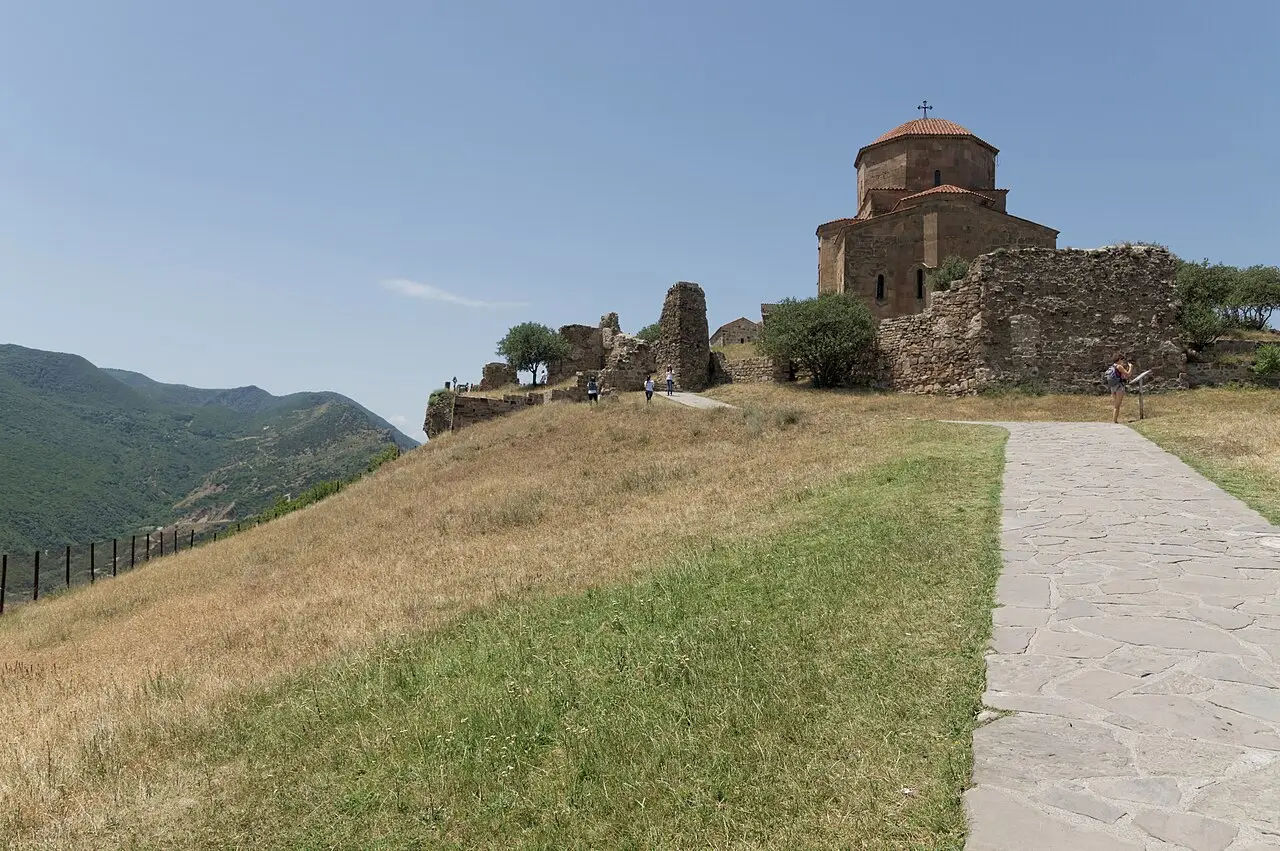
The monastery stands on a hill facing Mtskheta, about 25 km north-west of Tbilisi by road. From the capital the drive follows the S1 highway out past the airport and the Mtkvari’s floodplain before dropping into Mtskheta itself; a signed turn there climbs a narrow, switchbacking side road up to Jvari, quite separate from the road into town, so the easiest way to make the climb is by car or taxi rather than on foot from the centre of Mtskheta. From the top there’s a view over Georgia’s old capital and the meeting point of the two rivers: the whole layout of Mtskheta spreads out below, with the dome of Svetitskhoveli marking the town centre and the Mtkvari and Aragvi visibly merging into one wider river just beyond it. That view, more than the church itself for some visitors, is the reason most people put up with the short, winding drive in the first place. It’s also one of the most visited stops on the Tbilisi-Kazbegi highway, so expect tour buses and a busy car park around midday in season; if you’d rather have the view without the crowd, aim for early morning or the last couple of hours before sunset, when the light on the valley is better anyway.
There’s a rougher way in for anyone who’d rather walk than drive: an unmarked footpath climbs from Mtskheta itself, crossing the Aragvi on a pedestrian footbridge before switchbacking up the hillside. It isn’t signposted or maintained, so treat it as a fair-weather option for people who don’t mind route-finding, not a dependable shortcut, and budget a good hour of uphill walking rather than trying to time it precisely.
The tower and the low rampart wall you’ll see around the churchyard aren’t part of the original 6th-century build - they were added later, once Jvari had already stood on the hill for centuries, so don’t mistake them for the oldest part of the site.
Jvari isn’t a museum piece dressed up as a church, either. Monks have lived here again since 1996, after decades when Georgia’s Soviet period had emptied the monastery out, and it functions as a working religious community alongside being one of the country’s most photographed viewpoints. That mix is exactly why the dress code matters more here than it might elsewhere: a coach party in shorts and a service in progress can genuinely be happening in the same small room at the same time.
Nearby
Jvari makes sense to see together with Svetitskhoveli - both monuments are in Mtskheta and belong to the same UNESCO site, and the town itself is worth an hour beyond the cathedral, covered in our Mtskheta guide. Most people visit the cathedral first, down in the town, then drive up to Jvari afterwards - finishing on the panorama rather than in a car park makes for a better last stop, and it saves doubling back down into Mtskheta once you’ve already made the climb. Both are easy to fit into the Tbilisi → Kazbegi 2-day route, which continues up the same highway to Ananuri fortress if you have more than a morning to spend. For more places across the country, see the things to see section.
Photos
On the map
The map loads on click - to keep the page lightweight.
The map didn’t load. Check your connection and refresh the page.
Admission and opening hours
- Admission price
- Free entry
A working church, so there's no fixed visiting timetable - it's generally open from early morning to evening, but services take priority over sightseeing. Follow the dress code: covered shoulders and knees, a headscarf for women. Donations are welcome but optional.
Details checked: September 11, 2026
Distance
- Tbilisi ≈25 km · ~30-35 min the S1 highway to Mtskheta, then a mountain road
- Kutaisi ≈230 km · ~3 h approximate
- Batumi ≈370 km · ~5 h via Kutaisi, approximate
Read also

What to see · 10 min read
Skiing in Georgia: Gudauri vs Bakuriani
Updated · September 5, 2026Gudauri or Bakuriani: 2025/26 day passes 70 vs 55 GEL, elevations, last season dates, who each resort suits and how to get there.

What to see · 7 min read
Svaneti travel guide: Mestia, Ushguli and towers
Verified · August 25, 2026Svaneti mapped: Mestia vs Ushguli, tower villages, season, and how to link town guides, the trek, and the road from Tbilisi.

What to see · 9 min read
Resorts near Batumi: Gonio, Kvariati & Tsikhisdziri
Updated · September 2, 2026Where to stay near Batumi for cleaner, quieter beaches: Gonio and its Roman fort, Kvariati for diving, and secluded clifftop Tsikhisdziri - how to choose.

What to see · 10 min read
Georgia with kids 2026: family beaches & resorts
Updated · July 18, 2026Georgia with kids: sandy, shallow beaches up north (Ureki, Shekvetili, Kobuleti), amusement parks, when to go and how to plan a family trip.