
Mtskheta from Tbilisi: getting there, old town and food
Mtskheta without a car: marshrutka from Tbilisi, a half-day walking order, what else is in town, where to eat, and whether to stay the night.
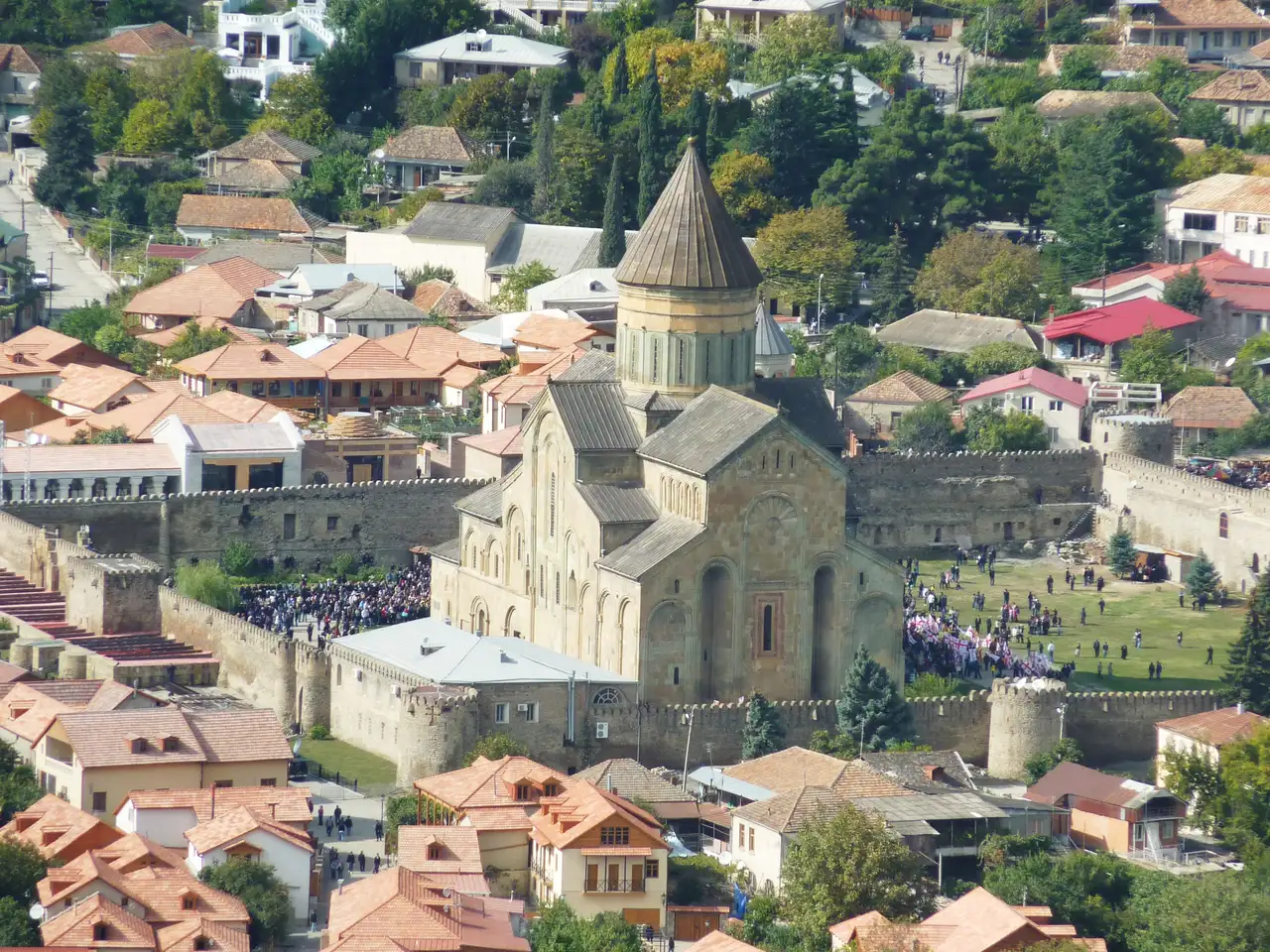
Metro to Didube, then a marshrutka marked მცხეთა: half an hour later you’re at Svetitskhoveli, in the middle of Georgia’s ancient capital, 20 km north of Tbilisi and no rental car required. Half a day covers the cathedral, Samtavro and the view from Jvari - all three on the UNESCO list under one entry. Stay longer and there’s the old town, the market by the cathedral gate and Bebristsikhe, a medieval fortress on the northern edge of town.
Getting there from Tbilisi and back without a car
Take the metro to Didube (red line) and walk into the bus terminal on the far side; minibuses marked მცხეთა (Mtskheta in Georgian script) go from the main part of the station, and the ticket for them is bought at the desk, not handed to the driver. Departures run every 20-30 minutes from about 08:00, the fare was 2 GEL when we checked in September 2026, and the ride takes 25-35 minutes. Nobody publishes an official timetable for the route, and fares on several intercity services went up in May 2026, so treat that price as a guide and confirm it at the desk. Ask to get off near Svetitskhoveli; most drivers already know that’s where every foreign passenger is headed.
A passenger train does technically stop in Mtskheta too, but services are sparse and the station sits about 2 km from the centre, so unless the timing happens to line up, the marshrutka is the more practical choice both ways. No one publishes the last departure back either, so ask your driver on the way in when the last marshrutka to Didube leaves. Driving is easy as well: the car hire section has the pick-up details if you’re continuing north afterwards.
Mtskheta in half a day: the walking order

Start at Svetitskhoveli, in the dead centre of town, since it’s where the marshrutka drops you anyway and every other stop is a short walk from it. From the cathedral gate it’s a ten-minute walk to Samtavro monastery, then back through the old town lanes to the market stalls by the main gate for a coffee or a snack. Jvari sits on the hill across the Aragvi, and the usual way up is a taxi there and back: the road loops round to the highway, so it’s about 13 km and 15-20 minutes each way. There is a footpath from the town over a pedestrian bridge, but it’s unmarked and takes a good hour uphill, and it’s described properly on the Jvari page. Leave the hill for last, when the view over the town and the confluence is the thing you finish on. Budget three to four hours for all of it without rushing, and another hour if you add Bebristsikhe below.
What else is in town, besides Svetitskhoveli and Jvari

Tour groups rarely get past the two big churches, which is exactly why everything else here stays quiet even on a busy day. Samtavro monastery, right in the centre, is the third monument in the same UNESCO listing as Svetitskhoveli and Jvari, and it holds the tombs of King Mirian and Queen Nana, the royal couple credited with bringing Christianity to Georgia in the 4th century; its own necropolis and bell tower earn the ten-minute walk on their own merits. Fewer people walk out to Bebristsikhe, an early medieval fortress on the northern edge of town. It stands on the same bank of the Aragvi as the old town, so there’s no river to cross: 1.8 km from Svetitskhoveli, about 25 minutes on foot along Erekle II and Agmashenebeli streets. The citadel is triangular with a tower at each corner - the eastern one was rebuilt in the 18th century - and what you get at the top is a view back over the cathedral, the meeting of the rivers and Jvari on its ridge. The town centre itself has narrow lanes of low houses with carved wooden balconies, worth ten minutes of aimless walking between the main sights.
Where to eat and what to buy
Cafes and market stalls cluster right by the Svetitskhoveli gate, selling homemade wine, churchkhela (walnuts dipped in grape-juice paste) and the local chacha - a grape spirit often infused with herbs and fruit. It’s touristy by Georgian standards, so prices near the cathedral run a little higher than a village stall would charge, but quality is generally solid and it’s a fair place to try churchkhela before committing to a bigger bag elsewhere. For a proper sit-down meal, the streets just off the main square hold a handful of unpretentious khinkali and khachapuri places that see more locals at lunch than the stalls right at the gate do.

Staying the night: why and where
Mtskheta works perfectly well as a half-day trip, and it doesn’t need an overnight stay to feel complete. The reason to stay is the quiet: once the day-trip buses clear out in the late afternoon, the old town empties, and an early walk to Svetitskhoveli before the next wave of groups arrives is a different experience from the midday crowd. That also settles the “where”: stay within walking distance of the cathedral, because the early hour is the whole point of the night, and a room on the edge of town hands it straight back to a taxi. Guesthouses here tend to be small and fill up around 14 October in particular (see below), so book ahead instead of turning up and hoping.
When to go: season, the festival, services and crowds
In spring and autumn the walk between the churches is comfortable and the midsummer crowds that build up by late morning haven’t arrived; in July and August an early start is what spares you both the heat and the tour buses. Svetitskhoveli is a working cathedral, so expect services on Sundays and feast days, when parts of the interior are off-limits to sightseeing. A respectful dress code - covered shoulders and knees - applies at all times, not only during services, and the fuller detail is in our Jvari guide, since the same rule holds at both churches. Every year on 14 October the town hosts Mtskhetoba-Svetitskhovloba, a public holiday centred on Mtskheta, so expect it busier than usual; the details are in our Georgia events calendar.
On the day: cash, water and the last marshrutka back
Marshrutkas back to Didube pick up on the main road below the cathedral, roughly where you were dropped off, and they run through the evening without a published last departure - which is why the driver on the way in is the person to ask. Small shops and cafes near the cathedral cover water and snacks, and the touristy stalls mostly take cards, while the smaller market vendors prefer cash. Inside town you won’t need a taxi at all except for the hop up to Jvari, and at 20 km from the capital a forgotten charger or a change of plan is never more than one short ride from a fix.
Nearby and beyond

For the full story of the two main churches, see Svetitskhoveli Cathedral and Jvari Monastery in depth. Many visitors combine Mtskheta with a longer day out to Uplistsikhe and Gori, and the road north continues to Ananuri fortress and on along the Georgian Military Road towards Kazbegi. Back in the capital, Tbilisi is just half an hour south, and the country’s other cities are gathered in the cities section.
Photos
On the map
The map loads on click - to keep the page lightweight.
The map didn’t load. Check your connection and refresh the page.
Distance ≈20 km · ~30 min
- Tbilisi ≈20 km · ~30 min marshrutka, train or car - a popular day trip
Read also

Cities · 10 min read
Ureki: black magnetic sand and a shallow sea
Updated · July 20, 2026Ureki, Guria's sandy resort: black magnetic sand, a shallow warm sea and easy family beaches. Where to stay, when to go and how to get there.

Cities · 10 min read
Borjomi town: the spa resort and a mountain base
Updated · June 16, 2026Borjomi spa town in its wooded gorge: the mineral-water park, the Likani palace, the old railway and a base for Bakuriani and Borjomi-Kharagauli.

Cities · 12 min read
Batumi: beaches, boulevard, what to see and where to stay
 Verified · June 15, 2026
Batumi, Georgia's Black Sea resort: beaches, the palm boulevard, Alphabet Tower, Piazza and skyscrapers. What to see, where to stay and how long.

Cities · 4 min read
Gori: Stalin Museum and the Uplistsikhe cave city
Updated · June 14, 2026Gori in Shida Kartli, where the Kura meets the Liakhvi: a hilltop fortress, the Stalin museum and the Uplistsikhe cave city nearby.