
Katskhi Pillar: a church on a rock and how to get there
The Katskhi Pillar near Chiatura: a ~40 m limestone monolith with a church on top nobody is allowed to climb. Why it's famous and how to get there.
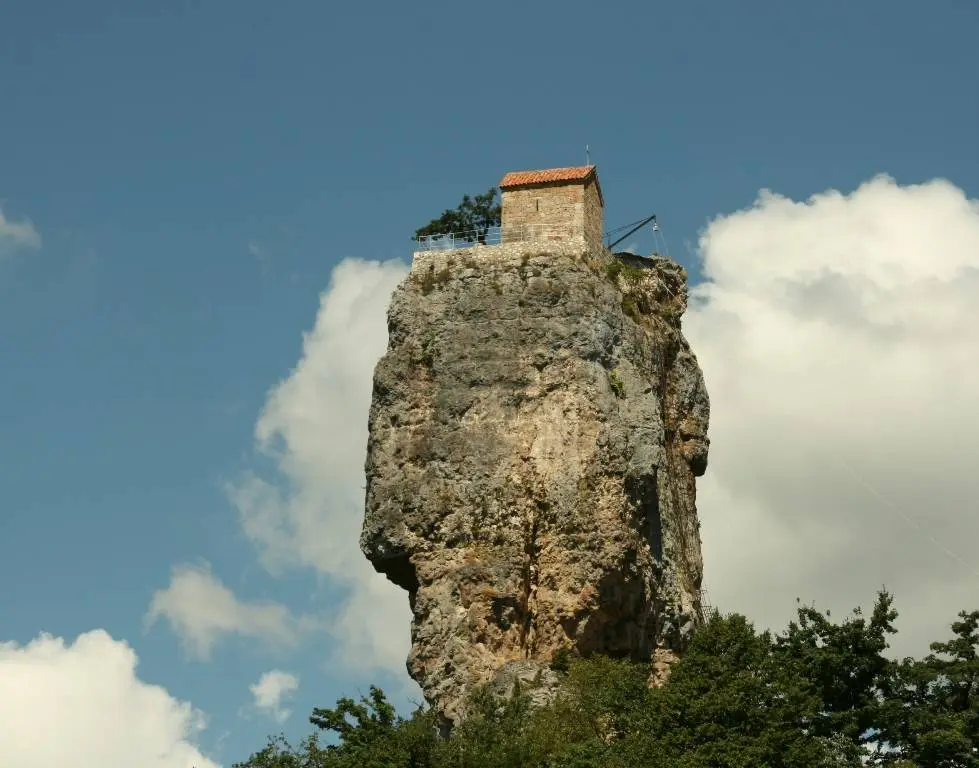
The Katskhi Pillar is one of the most unusual places in Georgia: a sheer limestone monolith about 40 metres high, with a tiny church and monastic buildings on its flat top, and a rule that surprises most first-time visitors
- nobody but the monks who live up there is allowed to climb it. From below it looks as though the church is literally floating above the green hills of Imereti.
Why the pillar is famous
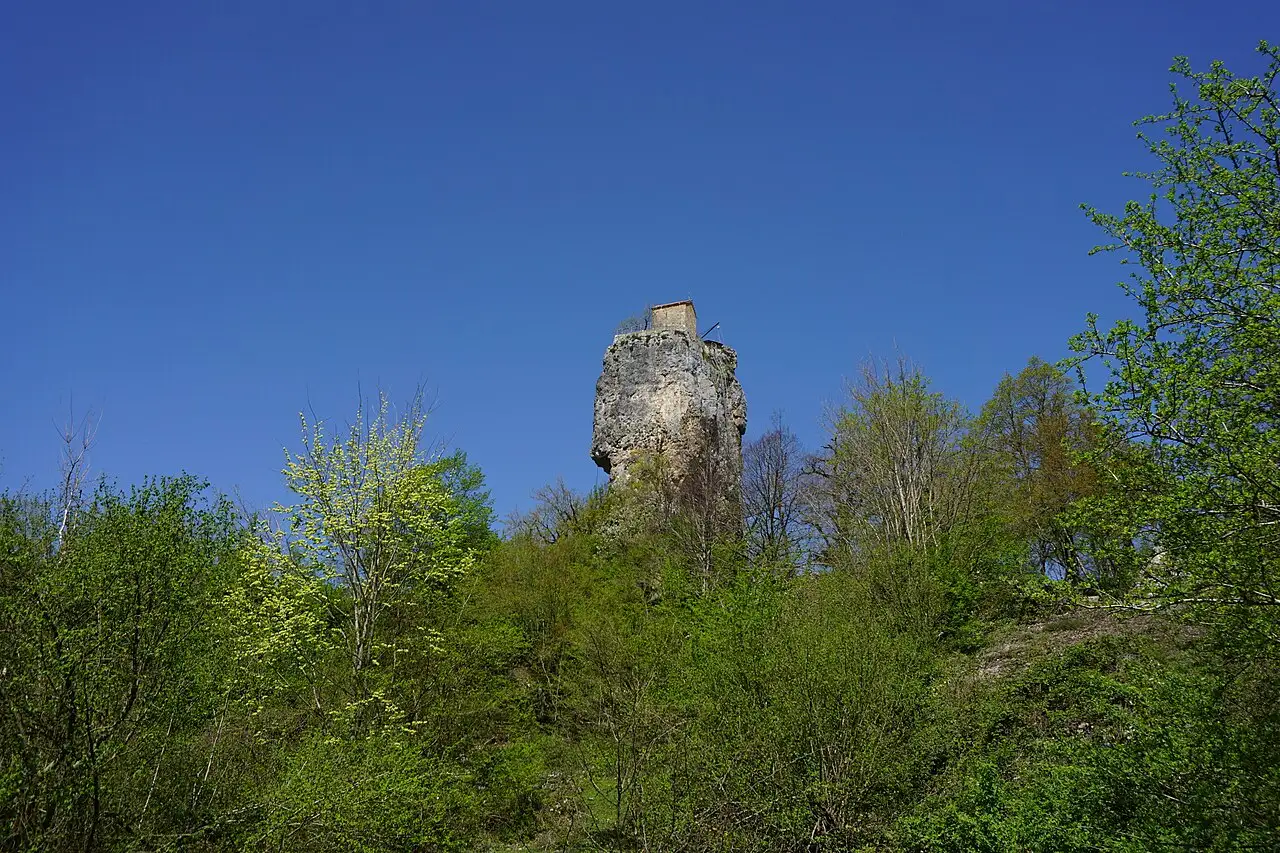
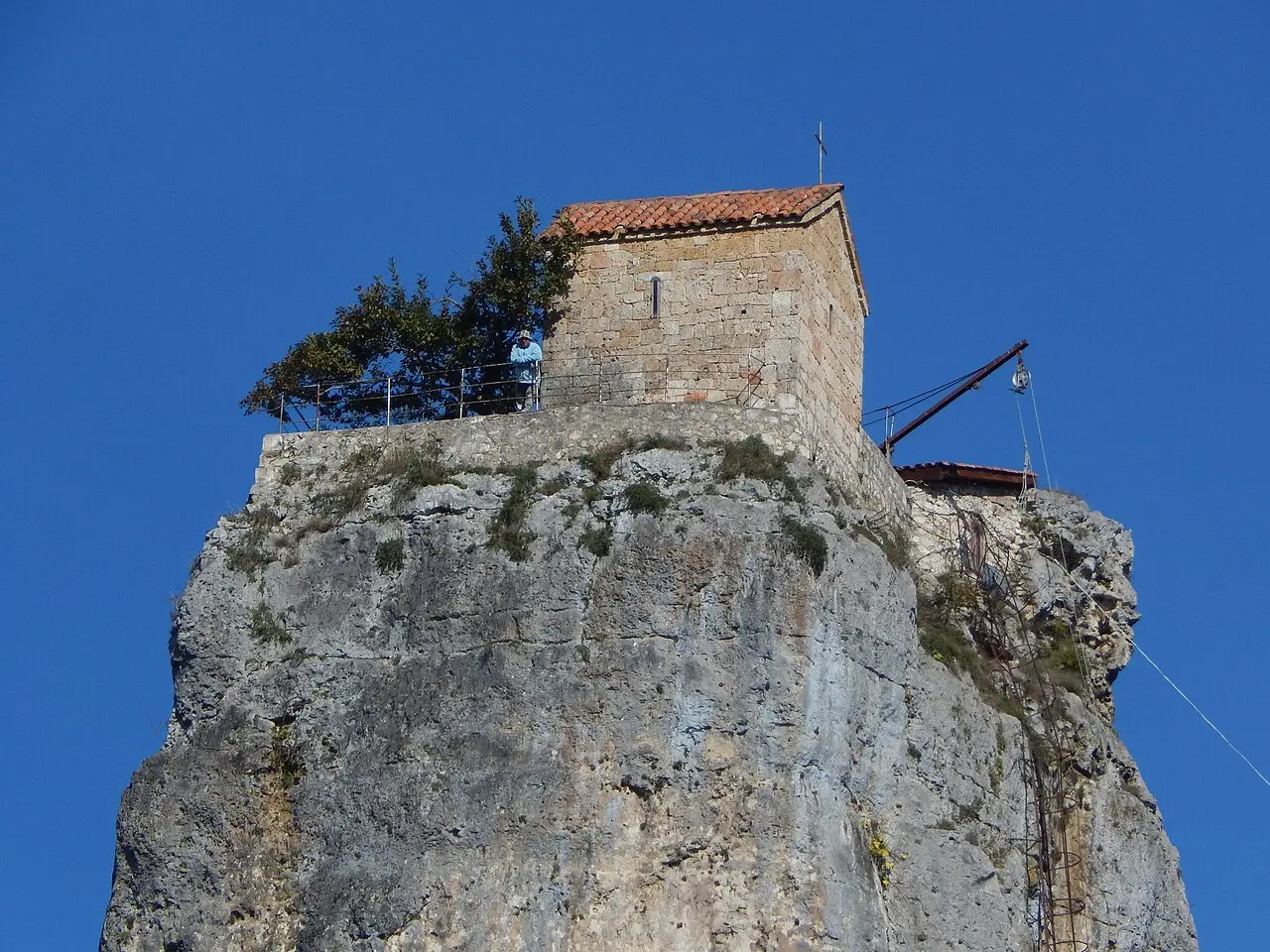
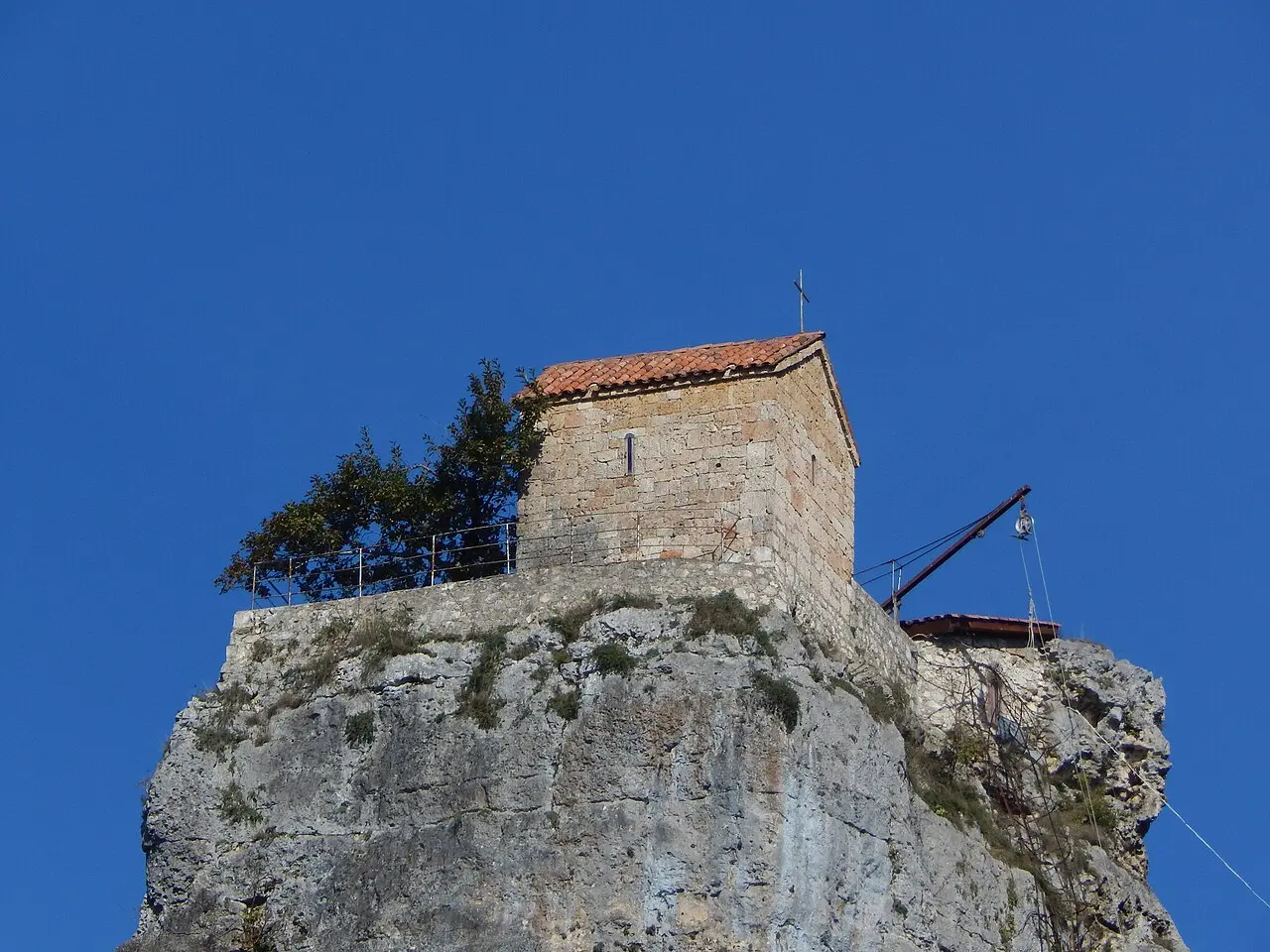
The Katskhi Pillar is a natural rock outcrop near Chiatura in Imereti. Its summit is a platform of about 150 square metres; on it stand the Church of Maximus the Confessor, several cells, a wine cellar and an enclosing wall. The dedication is a pointed one: Maximus was a 7th-century theologian tortured for his views - his tongue cut out, his right hand cut off - and exiled to Lazica, the old name for this same corner of western Georgia, where he died near present-day Tsageri in 662. A church for an exiled confessor, built partway up an inaccessible rock, is not an accident of naming. This is an ancient stylite hermitage: stylite monks, seeking solitude at an inaccessible height, lived here as early as the 9th and 10th centuries, and traces of their presence can be followed right up to the 13th century. Stylitism itself - living out one’s life on a pillar or platform, away from the ground - was never common even at its peak, and a working example of it in the 21st century is what makes Katskhi more than just an odd-looking rock.
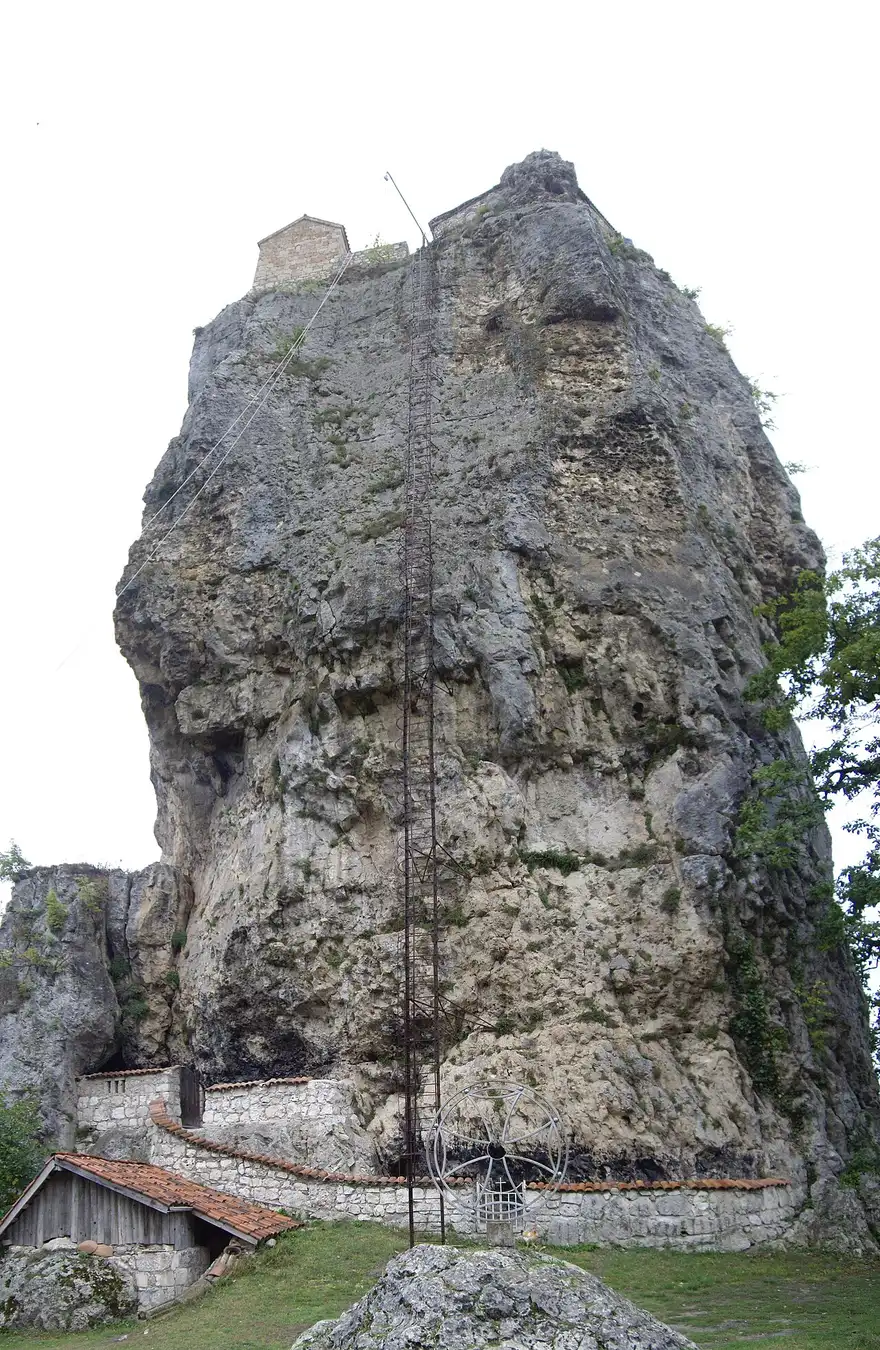
Over time the way up to the summit was lost, and the pillar stayed inaccessible for centuries. The first documented ascent only came in July 1944, when a team led by the mountaineer Alexander Japaridze and the writer Levan Gotua reached the top and found the remains of a chapel and a stylite’s skeleton; they first dated the ruins to the 5th or 6th century, and a fuller archaeological study between 1999 and 2009 revised that to the 9th and 10th centuries now generally accepted. In modern times the rock became inhabited again: in 1995 the monk Maxime Qavtaradze climbed to the top and spent about twenty years there, coming down to ground level only twice a week. Between 2005 and 2009 the monastery on the pillar was restored, and the Church of Simeon the Stylite was built at its foot - named for the 5th-century Syrian hermit who spent 37 years living on a pillar of his own and gave the whole practice of stylitism its name, which makes Katskhi’s place in that older tradition explicit rather than incidental.
Who is allowed to climb, and who never was
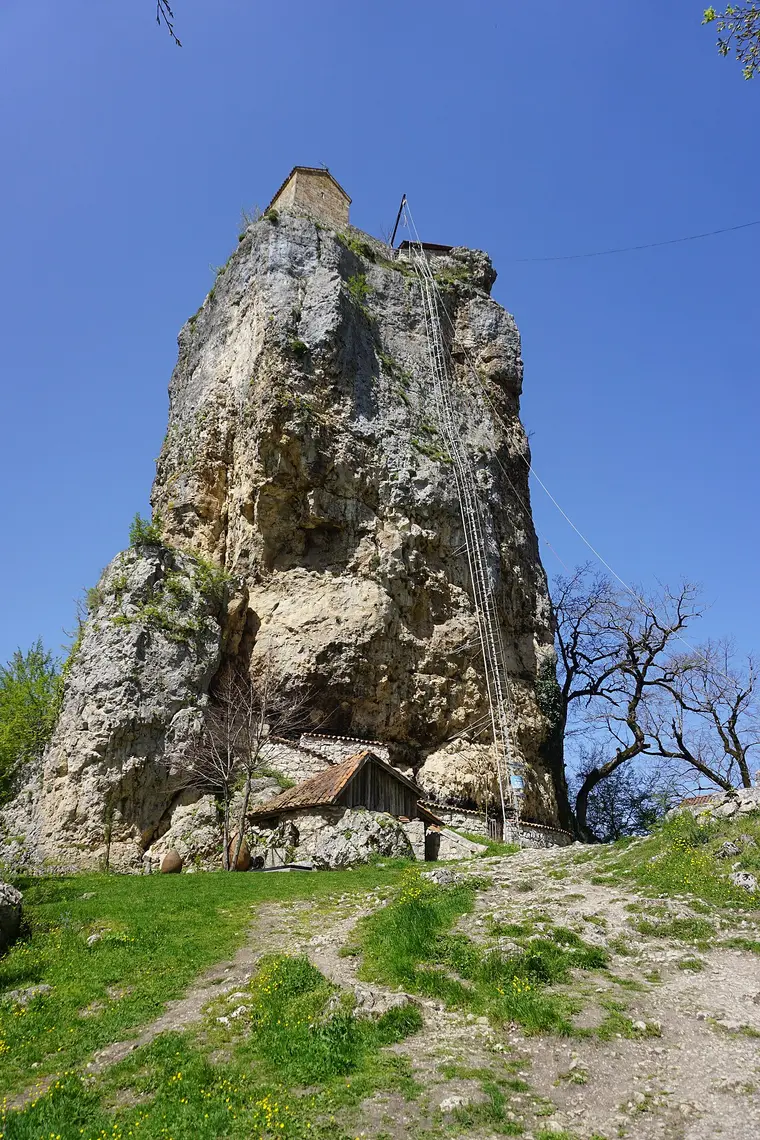
Today the answer is simple: nobody who isn’t a monk living there. The metal ladder bolted to the rock is for the handful of resident brothers, and even for them the climb is closer to a chore than a thrill - the descent alone reportedly takes about twenty minutes down the rungs, which is one reason the monks who keep the place go down only a few times a week instead of daily.
It wasn’t always closed to everyone. For much of the 20th century, male visitors could climb with the resident monk’s permission; women could not, at any point in the pillar’s history - that restriction was never about modern safety rules, it came from the stylite tradition itself, which kept the summit a male religious space from the start. Accounts differ on exactly when public climbing stopped for good: some sources point to 2012 and a safety decision, others to 2018 and a ruling from the Georgian Orthodox Church. Either way, the rule that survived is the same one - no visitor goes up now, regardless of gender - and asking the monks for an exception, however politely, isn’t going to change that. Photos online that show the ladder or the summit up close were mostly taken by the monks themselves or by press visits granted rare permission over the years; none of that access has ever extended to ordinary travellers.
What to see
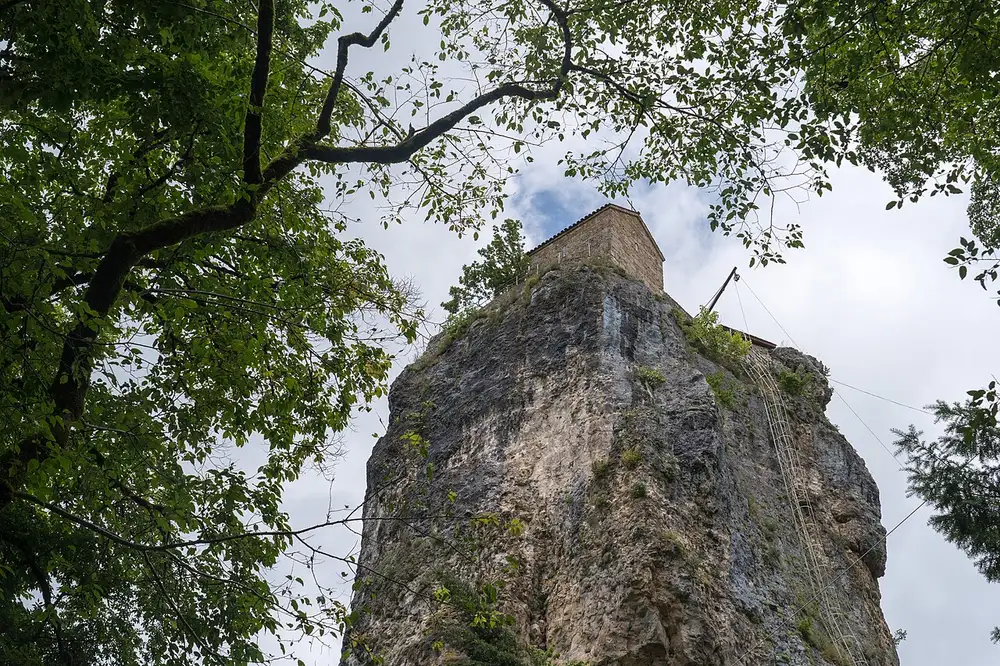
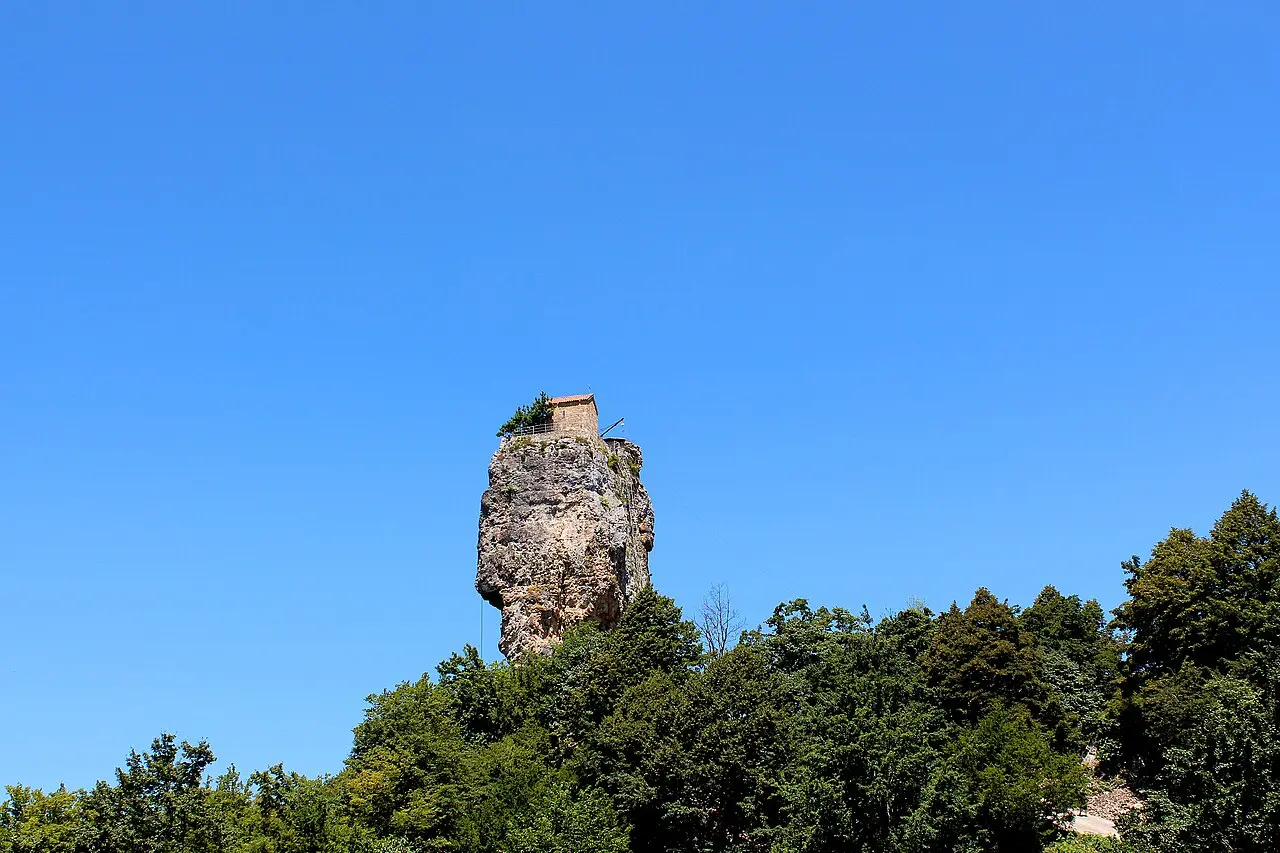
Since climbing is out of the question, people view the pillar from below - and that’s usually enough to leave an impression: a sheer rock with a church on top looks almost unreal in person, more than in photos. At the foot there is a monastery courtyard and a church, while the best views of the pillar itself open up from the surrounding slopes and the road rather than from directly beneath it. Bring a longer lens to make out the buildings on top; from ground level they read mostly as a silhouette against the sky, not as separate structures.
There’s no ticket booth here to begin with. After reading about the paid natural monuments nearby, that’s worth registering: Katskhi is active church property, not a state-run site, and Georgian Orthodox places of worship generally don’t charge for entry.
Visiting: getting there and how long to allow
Most people reach Katskhi from Kutaisi: about 55 km and an hour and a half by road through Chiatura. From Tbilisi it’s closer to 200 km and three and a half hours, so it usually works better as a stop on a longer trip through western Georgia than a dedicated day out from the capital. From Batumi, plan on roughly three hours. The last stretch of road is partly unpaved, so an ordinary car manages it fine in dry weather and more slowly after rain.
This is a working monastery, so dress modestly and keep your voice down in the courtyard. There’s little in the way of facilities at the base, so bring water in hot weather. Half an hour is enough to look around, photograph the pillar from a few angles and read the noticeboard; allow more time if you’d rather walk up the opposite slope for a higher viewpoint instead of staying at the base.
Day tours from Kutaisi often bundle Katskhi with Chiatura, and sometimes with both Prometheus Cave and the Sataplia reserve, into one long day - it’s a lot to fit in, but doable if you start early. Kutaisi remains the easiest base for the wider area either way, and having your own car makes all of it easier to string together at your own pace; see our car hire section if you need one.
Chiatura and its cable cars
Katskhi sits right on the road into Chiatura - fifteen to twenty minutes further on by most accounts - and the old mining town is worth the extra half hour even if cable cars aren’t normally your thing. Chiatura was one of the world’s biggest manganese mining centres through most of the 20th century, and in the 1950s Soviet planners strung dozens of cable cars across the valley to move miners between the valley floor and the mines and housing cut into the cliffs above - not for sightseeing, which is part of why riding one still feels a little like trespassing on someone else’s infrastructure.
Several of the old lines have been rebuilt in recent years with new cabins and cables on their original Soviet-era stations, and four of them - to Sanatorium, Mukhadze, Lezhubani and Naguti - now run daily for a token fare, around 50 tetri a ride; one or two of the restored heritage lines currently run for free instead, which is either a nice surprise or the first thing that changes next season. Ride one up, and Katskhi’s pillar is often visible in the distance across the valley - small and pale against the hills you were standing under not long before. Not every line runs on any given day, since the network has been under staged renovation for several years, so it’s worth asking locally which stations are open rather than planning around a specific one. The valley itself is dramatic even before you buy a ticket for anything - narrow, cut by a river, with old mine workings and apartment blocks stacked up the cliffs on both sides - which is reason enough to slow down on the drive in. Between the pillar and the cable cars, this corner of Imereti is worth a full afternoon, not just a quick stop on the way to Kutaisi.
Photos
On the map
The map loads on click - to keep the page lightweight.
The map didn’t load. Check your connection and refresh the page.
Admission and opening hours
- Admission price
- Free entry
Active church property, not a state-run site - no ticket booth. Climbing is closed to all visitors (only the resident monks go up); accounts differ on whether that ban dates to 2012 (safety) or 2018 (a Georgian Orthodox Church decision), but the current rule is not in doubt.
Details checked: August 30, 2026
Distance
- Tbilisi ≈200 km · ~3.5 h approximate, via Kutaisi
- Kutaisi ≈55 km · ~1.5 h via Chiatura
- Batumi ≈165 km · ~3 h approximate
Read also

What to see · 10 min read
Skiing in Georgia: Gudauri vs Bakuriani
Updated · September 5, 2026Gudauri or Bakuriani: 2025/26 day passes 70 vs 55 GEL, elevations, last season dates, who each resort suits and how to get there.

What to see · 7 min read
Svaneti travel guide: Mestia, Ushguli and towers
Verified · August 25, 2026Svaneti mapped: Mestia vs Ushguli, tower villages, season, and how to link town guides, the trek, and the road from Tbilisi.

What to see · 9 min read
Resorts near Batumi: Gonio, Kvariati & Tsikhisdziri
Updated · September 2, 2026Where to stay near Batumi for cleaner, quieter beaches: Gonio and its Roman fort, Kvariati for diving, and secluded clifftop Tsikhisdziri - how to choose.

What to see · 10 min read
Georgia with kids 2026: family beaches & resorts
Updated · July 18, 2026Georgia with kids: sandy, shallow beaches up north (Ureki, Shekvetili, Kobuleti), amusement parks, when to go and how to plan a family trip.