
Tbilisi markets: the Dry Bridge & Dezerter Bazaar
Markets in Tbilisi: the flea market at the Dry Bridge (antiques, Soviet items, cameras) and the Dezerter Bazaar for food. What to look for and where.
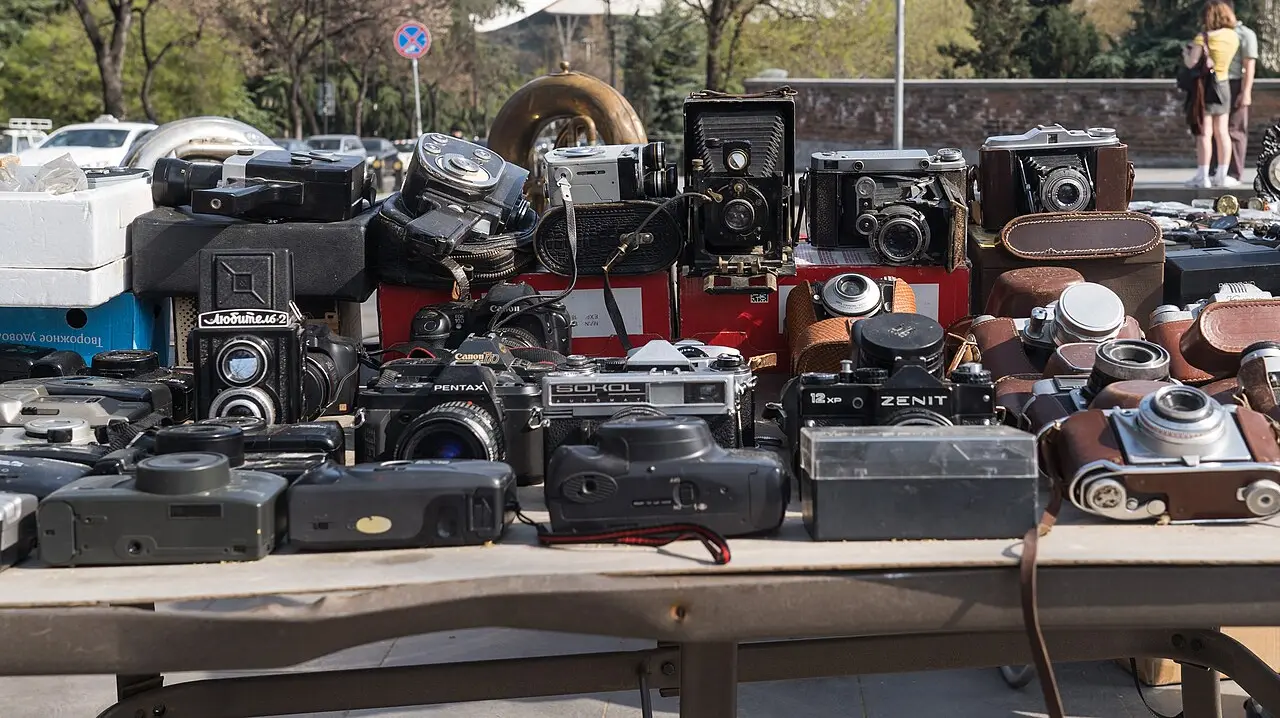
Markets are one of the best ways to feel the everyday rhythm of Tbilisi, and the city runs two that could hardly be more different: an open-air flea market by the Dry Bridge, piled with Soviet-era relics and local art, and the sprawling Dezerter Bazaar, where the city actually does its grocery shopping. Between the two you get a slice of Tbilisi that a museum visit alone won’t show you, and neither one charges an entry fee, so there’s no wrong time to wander in for twenty minutes and see what’s there.
The Dry Bridge flea market
Beside the Dry Bridge (Mshrali Khidi), a short walk from the Presidential Palace, an open-air flea market spreads along the riverbank most days of the week. The bridge itself dates to 1851-1857, and the “dry” in its name came later: once the city embanked the Kura in the 1940s to control flooding, the side channel that used to flow beneath the bridge was redirected, and the crossing found itself spanning a street instead of water. The market followed a similar arc. It grew out of the 1950s, when residents began laying out their own belongings for sale here, and it has kept that character since: more than a hundred vendors trade from blankets and folding tables rather than shopfronts.
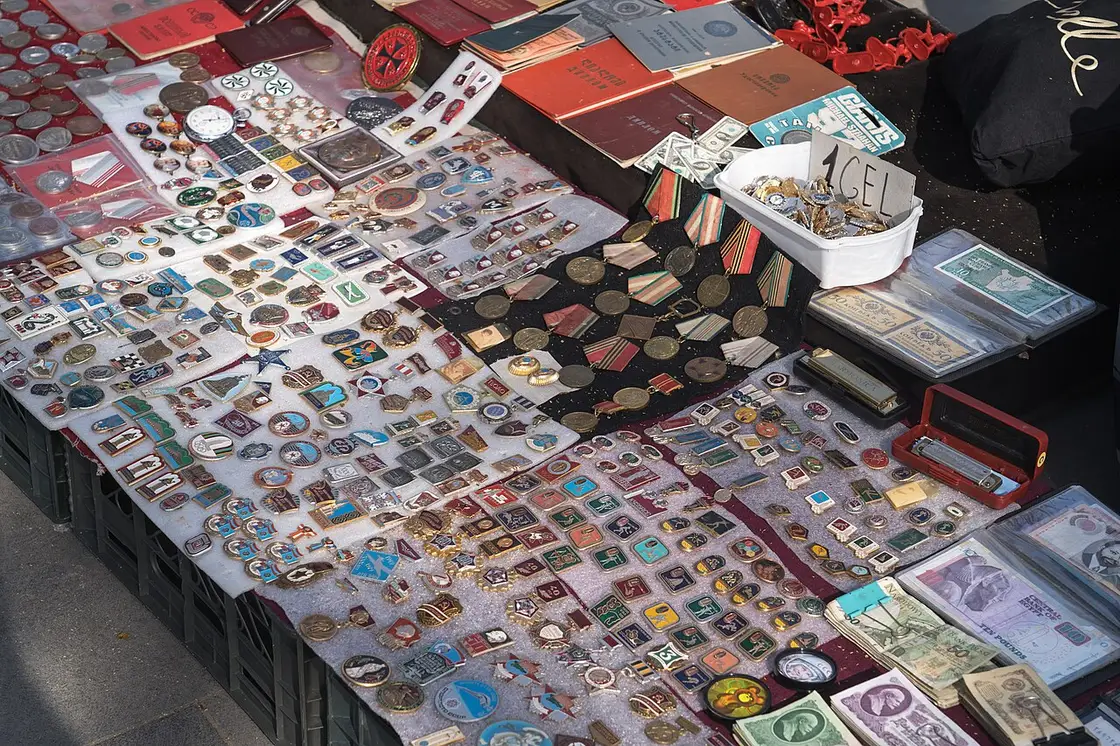
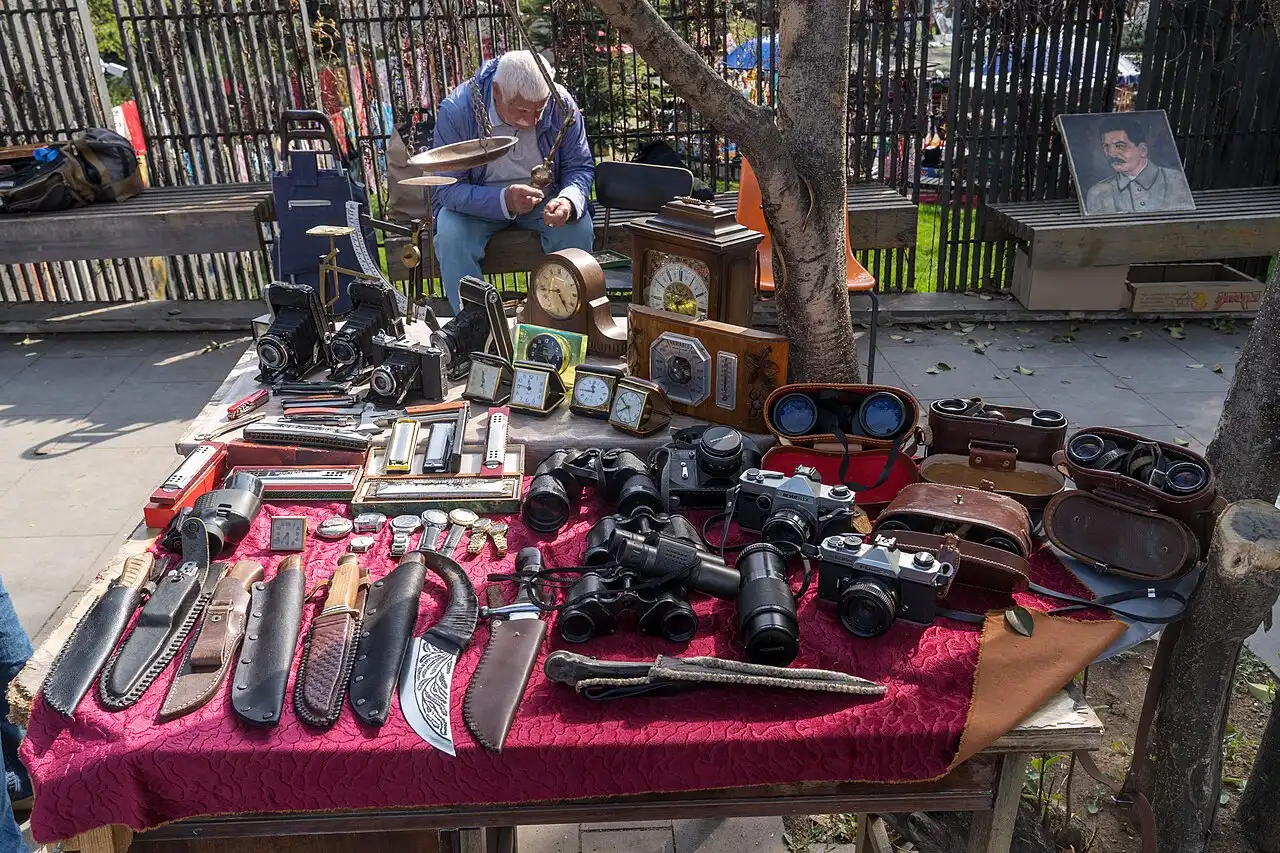
What’s on the stalls hasn’t changed all that much either. Second World War medals and Soviet-era pins sit next to cloisonné enamel pieces, silver jewellery, antique dishware, old radio sets and the odd ornate sword, plus coins, banknotes, cameras, watches, vinyl records and crockery. It’s as much an open-air museum of Georgia’s twentieth century as a shop, and treating it that way is half the fun - ask a vendor about a medal or a set of nesting dolls and you’ll usually get a story along with the price. Haggling isn’t just tolerated here, it’s expected, and cash is the only currency that works. The market is at its busiest and most photogenic at the weekend; heavy rain clears it out fast, since almost everything is outdoors with no cover to duck under.
One thing worth knowing before you fall for a tempting old icon or a bundle of pre-Soviet documents: Georgia’s law on cultural property has no single age cutoff, but for some categories it does: writings, coins and seals more than 100 years old, furniture 100 years or older, and postage stamps withdrawn from circulation - alongside fine art, objects tied to historical events and rare manuscripts whatever their age - and taking a genuine piece like that out of the country can require an export permit from the Ministry of Culture. Modern souvenirs and mass-produced items are explicitly exempt, so a fridge magnet or a printed scarf is never an issue. It’s not something that comes up with most purchases here, but if a seller is offering what looks like a real museum-grade object and not ordinary tourist Soviet-kitsch, ask about paperwork before you buy - not at the airport, once it’s already too late to fix.
The Painters’ Market next door
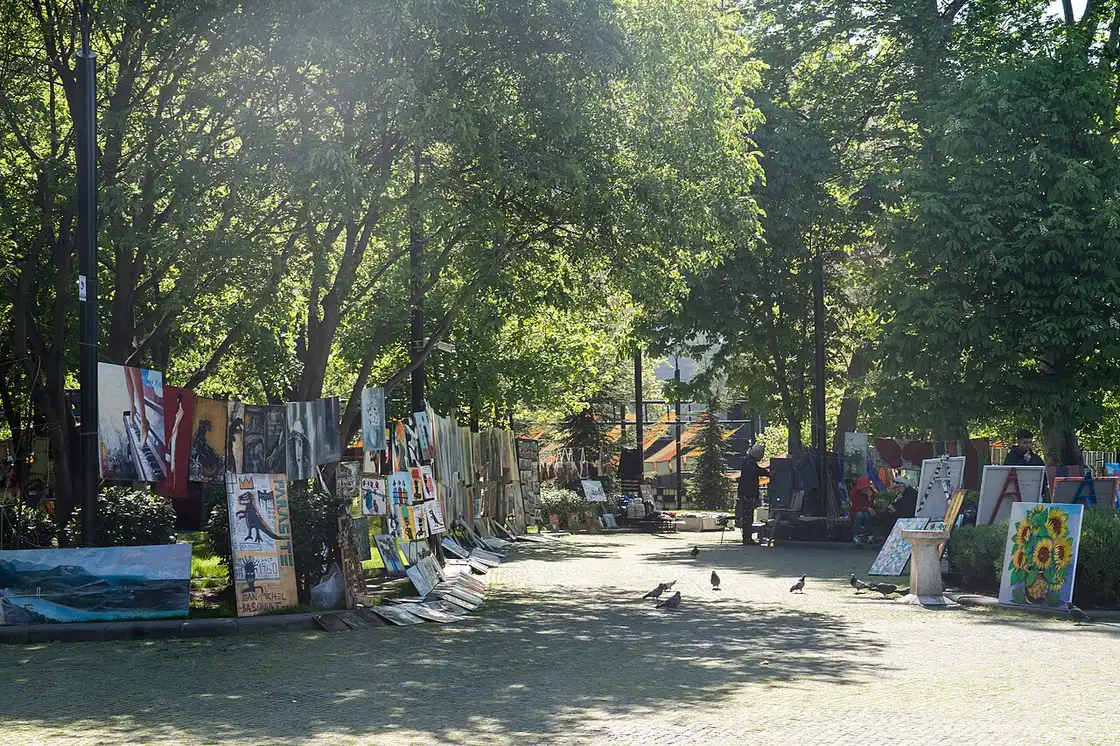
Officially this stretch of the bridge is a separate market from the flea market, even though the two blend into one at a glance: the Painters’ Market, sometimes called the Garden of Artists, runs along the railings where local painters hang their canvases in the open air. The mix is landscapes, Tbilisi cityscapes, abstract work and folk-style pieces, along with graphics, pottery, embroidery and felt work. A simple painting starts at around 20-30 GEL; a larger piece from an established artist runs into the hundreds, and some works reach thousands of lari. The art market usually keeps shorter hours than the flea market beside it, roughly 10:00 to 17:00, so if buying a painting straight from the artist is the plan, come earlier in the day rather than at dusk.
It’s worth asking before you photograph a particular stall closely, especially if a vendor is in the shot along with their goods - most are relaxed about it, some aren’t, and a quick nod or a few friendly words goes a long way. Buying something, even something small, tends to open the conversation more than a camera does; artists here are generally happy to talk about a piece once they see you’re actually interested rather than just passing through with a phone out.
The Dezerter Bazaar: Tbilisi’s food market
If the Dry Bridge is about the past, Dezerter Bazaar is about what Tbilisi eats. It covers roughly 2,000 square metres next to the Central Railway Station, and it’s the city’s largest working produce market, not a tourist reconstruction of one. The name itself, as local history has it, goes back to 1921: when the Red Army took Georgia that year, soldiers deserting the fighting are said to have sold their kit and weapons on this same ground to raise cash before slipping away, and “Dezerter” stuck as a nickname long after the deserters themselves were gone.
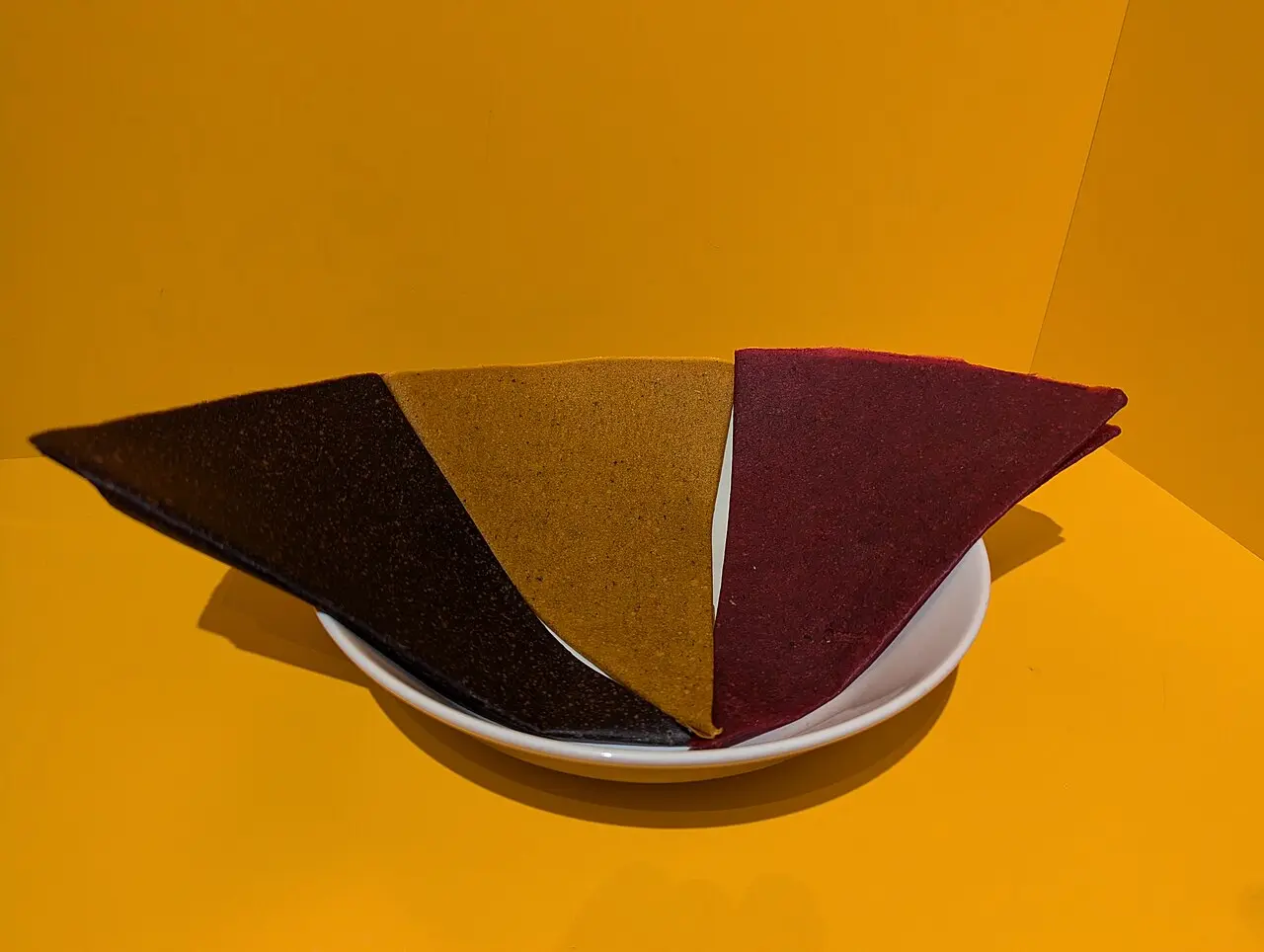
A typical day starts around 07:00, and the market is at its liveliest in the first few hours before thinning out by early afternoon. Late summer and autumn bring it fully to life, when villagers arrive with truckloads of their own harvest. Expect stalls of fruit and vegetables, sour cream, sulguni and other farm cheeses, cottage cheese, walnuts and hazelnuts, dried fruit, churchkhela and tklapi, and the full run of Georgian spices, right down to bay leaf sold loose by the handful.
The market itself is ringed by shops, stalls and small arcades selling everything from gold to carpets, so it’s easy to lose an hour just wandering the perimeter once the food stalls are done. Vendors expect cash, and prices are rarely marked, so it helps to have a rough sense of what things should cost before you start bargaining, especially for nuts and dried fruit sold by weight. Morning really is better here: by early afternoon the best produce is already gone and stallholders are packing up their tables. The streets around the market are dotted with plain, no-frills khinkali and khachapuri spots built for porters and shoppers rather than tourists - worth ducking into if hunger hits before you’ve finished browsing, since they’re usually cheaper than anywhere closer to the Old Town. If the market makes you want to make khinkali yourself, there are cooking classes in Tbilisi to compare.
Wine deserves a mention too: informal stalls selling homemade wine turn up around the edges of the market, sold straight from plastic containers, not bottled with a proper label. Ask which village it comes from and which grape - not idle curiosity, since homemade wine almost never carries a label and the seller’s story is the only way to know what you’re tasting. It can be excellent or rough depending entirely on who made it, so treat it as a curiosity to try rather than something to stock up on unless you already trust the seller.
Which one to visit first
Both are easy to reach on foot from the centre rather than needing a taxi: the Dry Bridge is a short walk from Liberty Square, and Dezerter Bazaar sits right by Station Square and the central railway station, so either metro stop drops you close. The two markets sit on opposite sides of the centre, though, so pairing them into one outing takes a bit of planning - it’s not the kind of thing you stroll between casually. If souvenirs and history are the goal, start at the Dry Bridge and the Painters’ Market in the morning, while the light and the vendors are both at their best; if you’d rather see how Tbilisi actually shops, get to Dezerter Bazaar early instead, since its best hours end well before the Dry Bridge even gets going. For a third option in the Old Town, Meidan Bazaar - an underground arcade beneath Meidan Square - sells Georgian wine, clay wine vessels, honey and antiques in a more compact, covered format, a useful fallback on a rainy day when the open-air markets are a washout.
Both markets fold easily into a longer walk through the city. The Bridge of Peace and Rike Park are a short stroll from the Dry Bridge along the river, and for the Georgian dishes worth hunting down among the food stalls, our guide to what to eat is a useful companion. For more on the city, see our guide to Tbilisi; for more ideas, the things to do section.
Photos
Admission and opening hours
- Admission price
- Free to enter both markets; haggling is normal at the Dry Bridge and expected on anything without a marked price
The Dry Bridge gets going around 10:00 and thins out through the late afternoon; it is busiest at the weekend, and the Painters' Market beside it keeps shorter hours, about 10:00-17:00. Dezerter Bazaar gets going around 07:00 and is past its best by early afternoon; rain thins out the Dry Bridge fast since it's entirely outdoors.
Details checked: September 11, 2026
Read also

Entertainment · 11 min read
Cooking Classes in Tbilisi: What to Pick and What It Costs
Verified · October 17, 2026Khinkali and khachapuri classes in Tbilisi from 110 GEL: family home or food walk, prices from operators' own sites, kids, vegetarians, how to book.

Entertainment · 9 min read
Georgian Folk Shows in Tbilisi: Where to Go and Prices
Verified · October 19, 2026Georgian dance and polyphony in Tbilisi: Erisioni at the Sports Palace on 30 October 2026, Ethno Tsiskvili nightly, lari prices and what the dances mean.

Entertainment · 9 min read
Paragliding in Gudauri: tandem flights, prices, season
Verified · October 10, 2026Tandem paragliding in Gudauri: the three launch sites, summer and winter prices in lari, weight limits, insurance and what happens if the weather turns.

Entertainment · 13 min read
Tbilisi Nightlife: Techno Clubs, Bars and Door Rules
Verified · October 6, 2026Tbilisi nightlife in 2026: Bassiani, KHIDI and Left Bank, entry prices in lari, how registration and the door work, where to drink first and getting home.