
Samegrelo in Two Days: Zugdidi, Anaklia, Lake Paliastomi
A two-day Samegrelo route: Dadiani Palace, the Anaklia footbridge, a boat on Lake Paliastomi. 114 km, real distances, costs and why you book ahead.
Two days in Samegrelo cover roughly 114 km and three things that have nothing in common: a princely palace in Zugdidi, the half-empty seaside resort of Anaklia with its wooden bridge over the mouth of the Enguri, and a boat trip on Lake Paliastomi inside Kolkheti National Park. With a car it’s an easy weekend, sleeping in Anaklia or Poti. Without one it still works, it’s just slower.
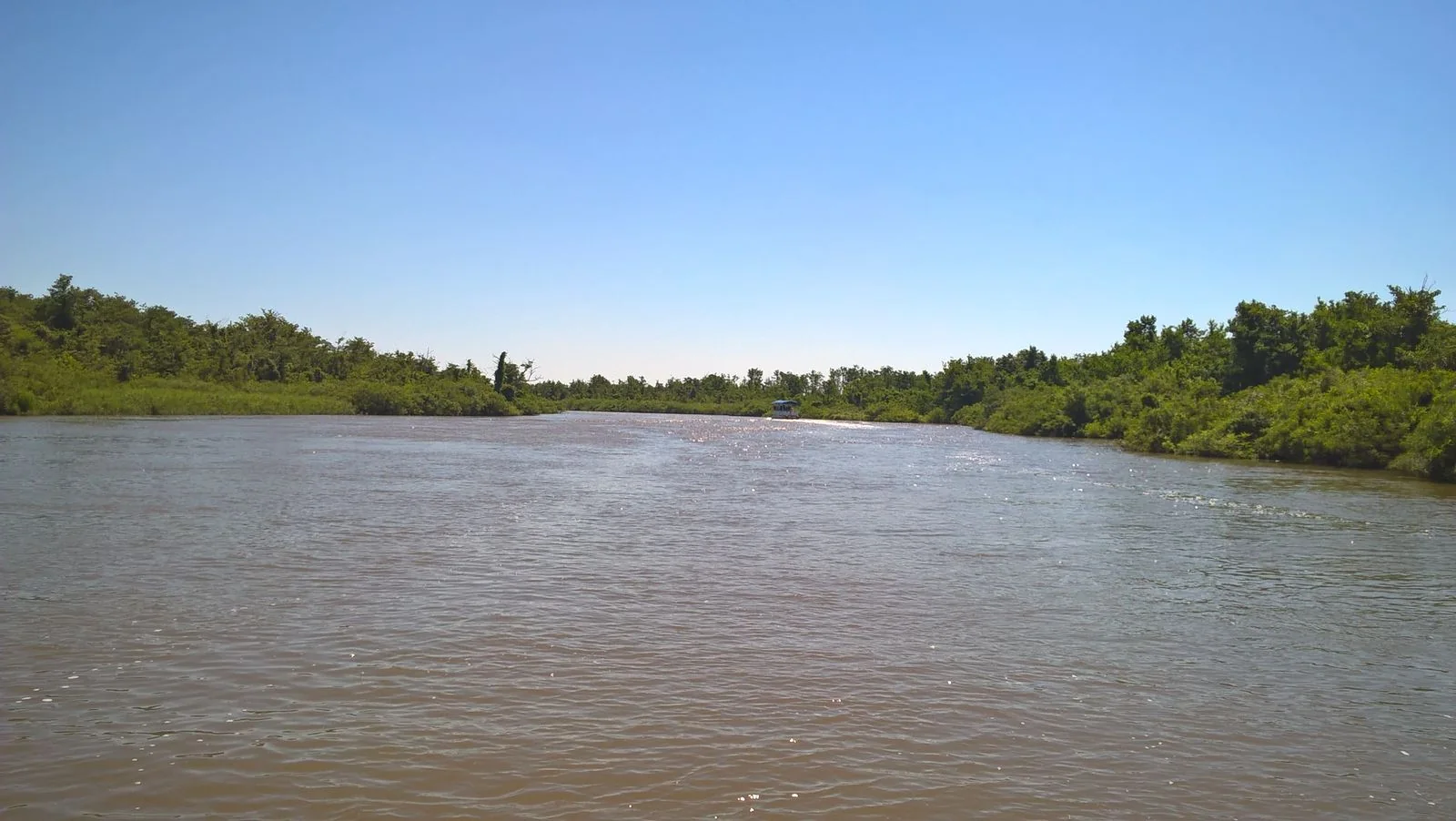
There’s one thing to sort out before you set off rather than on the road. The Paliastomi boat runs by advance booking only, it doesn’t go out in wind or rain, and you pay for the whole boat rather than per person. Three conclusions follow: phone a day or two ahead, put the lake on day two with some slack, and if you can, travel as a group of four or five instead of two, because the price is split.
What it costs and how to travel
Here’s the lower bound, per person. Admission to the Dadiani museum is a few lari: sources quote anywhere from 2 to 12 GEL depending on whether you want all the rooms or one, and the museum publishes no price list of its own. A motorboat on the lake for two costs 150 GEL, so 75 GEL each. Add the marshrutkas between stops: local operators don’t post their fares anywhere, but it’s the smallest line in the budget. That’s where the “from 100 GEL” figure comes from: a minimum per person for a pair, before beds and food.
The boat is the big line item, and it decides who you should travel with. A five-seat motorboat is 250 GEL, or 50 GEL a head; a pontoon for eight is 300 GEL, under forty each. The kayak trip is priciest at 350 GEL, but it includes the transfer and a two-seat kayak, and it’s the only way into the overgrown channels rather than past them. Those prices come from a wander-lush field report, not from the park: the official page lists only gear hire (binoculars 10 GEL a day, marsh boots 20 GEL).
A car roughly halves the time and removes the main headache, the Anaklia to Poti leg described below. If you drive, pick the car up in Tbilisi or Kutaisi in advance, because Zugdidi has few rental desks. The general rules and the traps are covered in our guide to car hire in Georgia.
How the two days split depends on where you sleep. Stay in Poti (better for food and beds) and day one holds everything: the palace, Anaklia and the monastery - a long but manageable day of around nine hours with stops, leaving just the boat for the second morning. Sleep in Anaklia instead and the days come out more even: palace and beach on day one, monastery, Poti and the boat on day two. The first option is more compact, the second is easier on the pace.
Zugdidi: a palace, Napoleon’s death mask and a relic
For most travellers Zugdidi is a change of transport on the way to Svaneti, and that’s largely how the town lives. Still, it holds half a day, on the strength of one site.
The Dadiani palace complex was the residence of the princes who ruled Mingrelia, and is now a museum with a collection of more than forty thousand objects. Two exhibits make it unusual. The first is a death mask of Napoleon, one of only three in the world, which arrived here through the marriage of Salome Dadiani and Achille Murat. The second is the Robe of the Virgin, and the story attached to it ties the whole route together. The museum opens Tuesday to Sunday from 10:00, with closing time given as anywhere between 17:30 and 18:00 depending on the source - confirm locally. Closed Mondays.
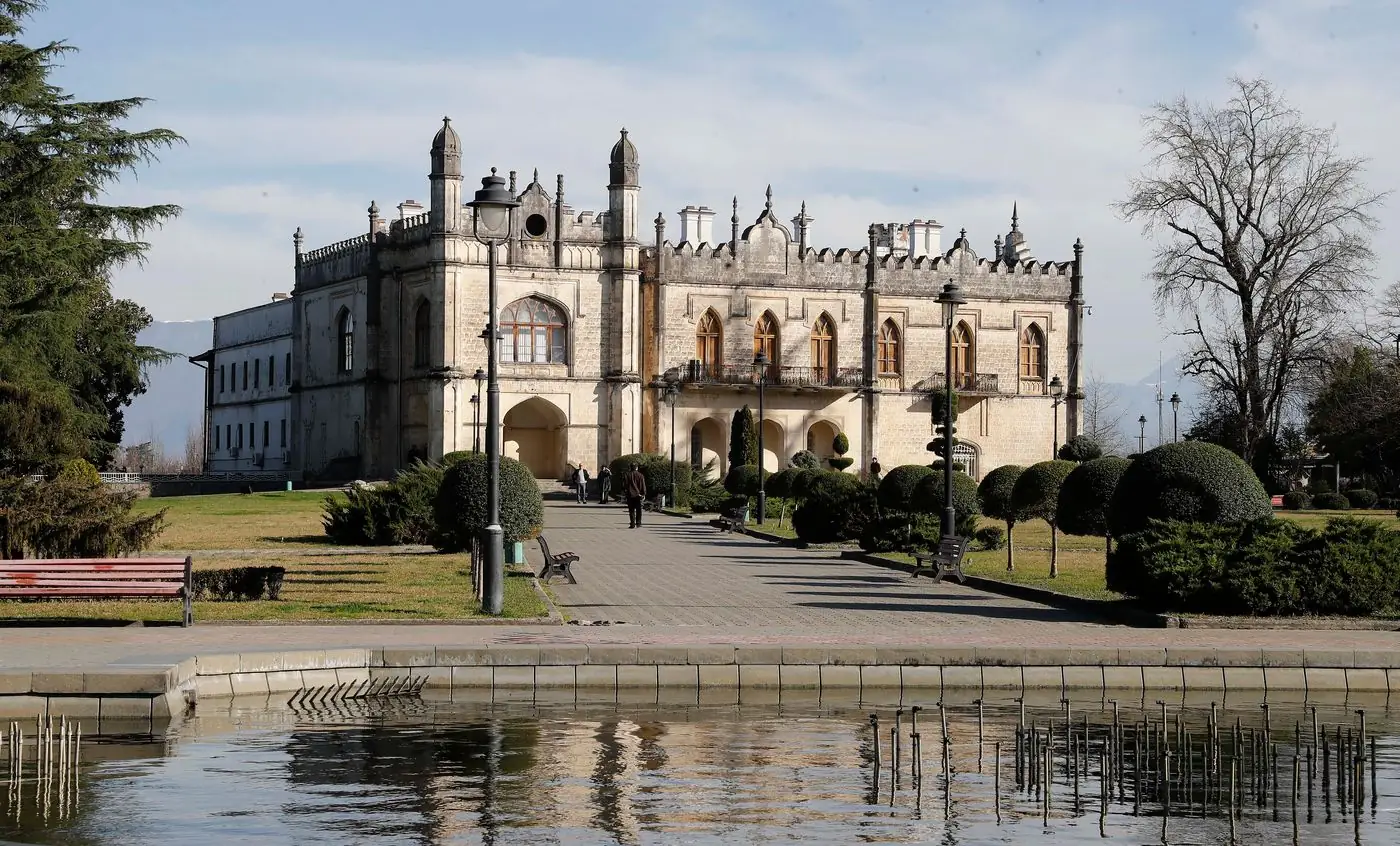
Once a year, on 15 July, for the feast of Vlakernoba, the robe is carried in procession from the museum into the palace church and pilgrims fill the town. Land on that date and Zugdidi looks nothing like it does on an ordinary weekday.
A fuller account of the town, the park and the mountain connection is in our guide to Zugdidi. This is also where the vans to Mestia leave from, so Samegrelo slots neatly onto a three-day Svaneti trip.
Anaklia: a bridge to nowhere, on a clock
Zugdidi to Anaklia is 32 km and about forty minutes. Marshrutka 24 leaves from the bazaar roughly between 7am and 6pm, with an extra run at 7pm in summer; the last one back goes at around 7pm, or 8pm in summer.
Anaklia is the strangest stop on this route. A wide beach of dark pebbles that turn to fine dark magnetic sand at the waterline, lifeguard towers along the shore, a smooth palm-lined promenade, and almost nobody. The resort was built on a grand scale and never filled up.
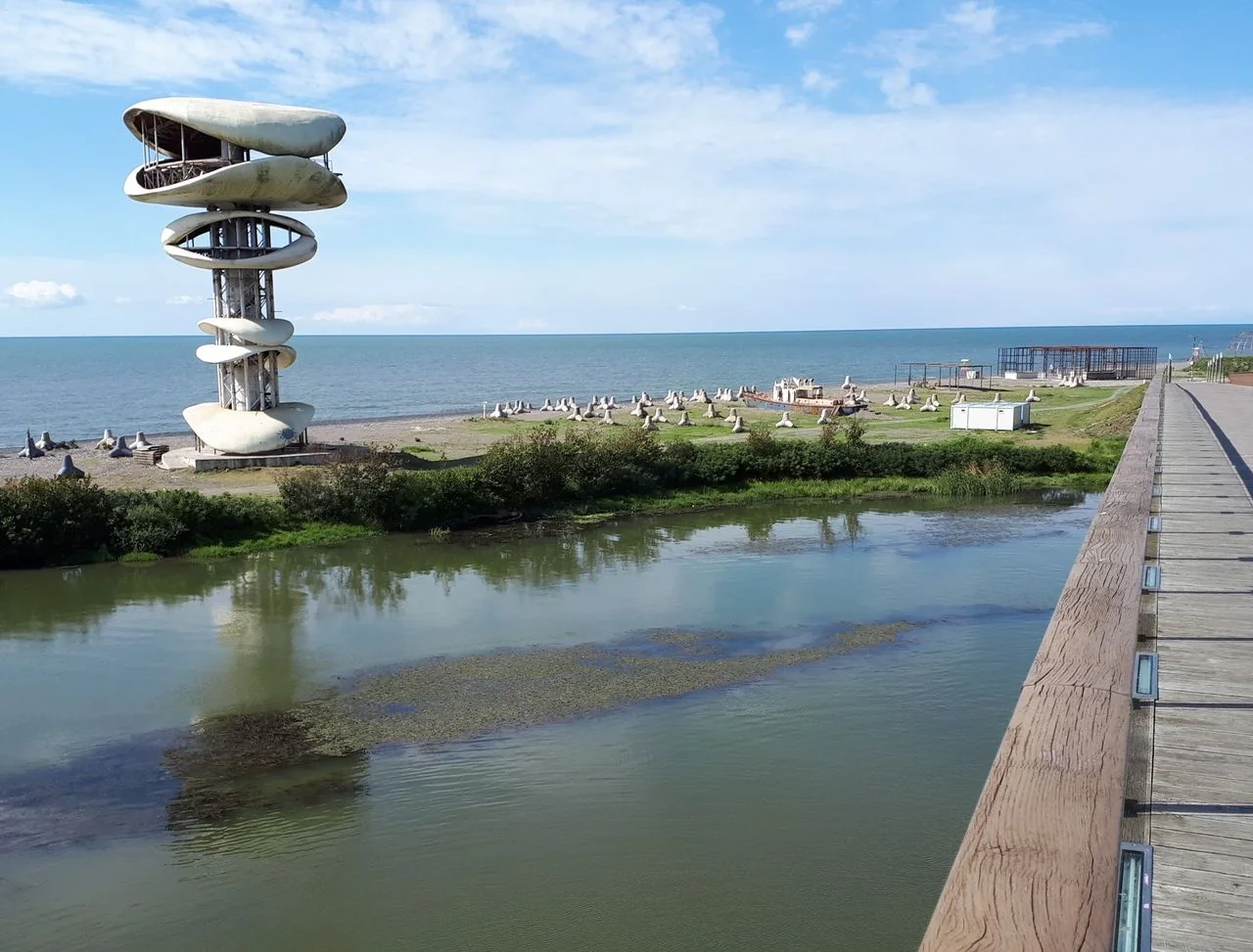
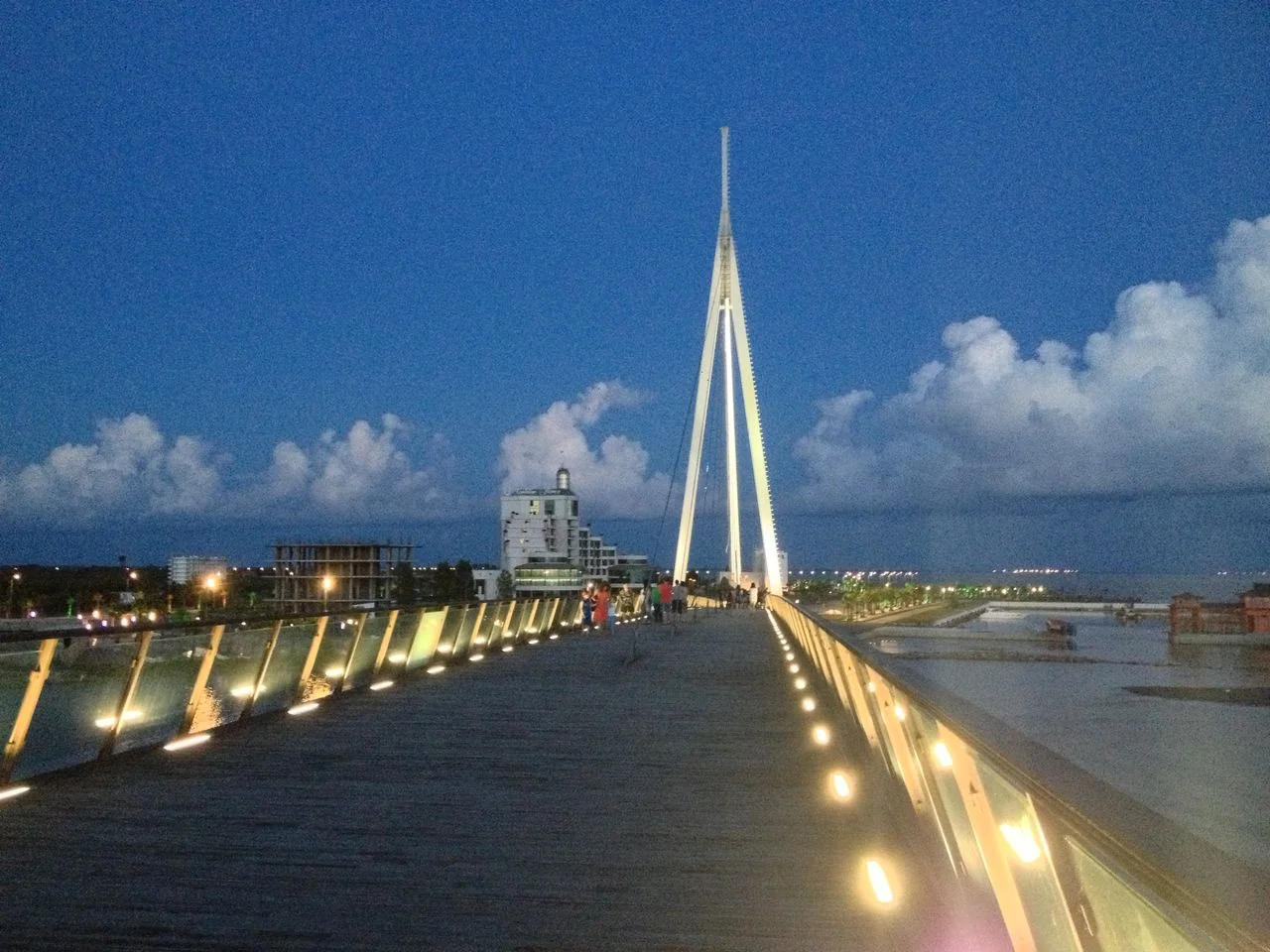
The main draw is the cable-stayed wooden bridge of 2012 across the Enguri mouth to Ganmukhuri. Sources put its length anywhere from 504 to 552 metres; either way that’s more than half a kilometre of decking over water, about ten minutes to walk one way. The boards have split and weathered in places, so watch your feet and don’t push a pram across. And Ganmukhuri sits roughly three hundred metres from the administrative boundary line with Abkhazia, so don’t carry on up the beach to the north.
Now about that clock. The Anaklia deep-sea port has been talked about since 2016: work began in 2017, the state cancelled the first consortium’s contract in 2020, and in 2024 China’s CCCC came in as private partner with Belgium’s Jan De Nul on the marine works. In May 2026 the active construction phase was announced: surveys finished, blocks being cast for a 1,380 m breakwater, dredging planned to 17.5 m. The 2026 budget line was cut by 100 million GEL to 50 million, so treat the timeline with caution. For a traveller the point is simple: quiet, empty Anaklia is a phase, not a feature. In a few years there’ll be a cargo port next door.
An honest note on food: the choice in the village is thin and a good lunch isn’t something to count on. Stock up in Zugdidi, or plan a proper dinner in Poti. If the sea is what brought you, compare the options in our roundup of Georgia’s beaches: people come to Anaklia for space, not for facilities.
Why the road south goes through Khobi
On the map it looks as though Poti is forty-odd kilometres down the coast from Anaklia. There’s no coastal road. The real route swings inland through Khobi: 41 km to the monastery, then another 38 to the park visitor centre, close to two hours of driving. People who plan by straight lines lose half a day and their good mood with it.
Since the detour is unavoidable, build the Khobi monastery into it. It stands in the village of Nojikhevi, three kilometres from the town of Khobi, barely off the road.
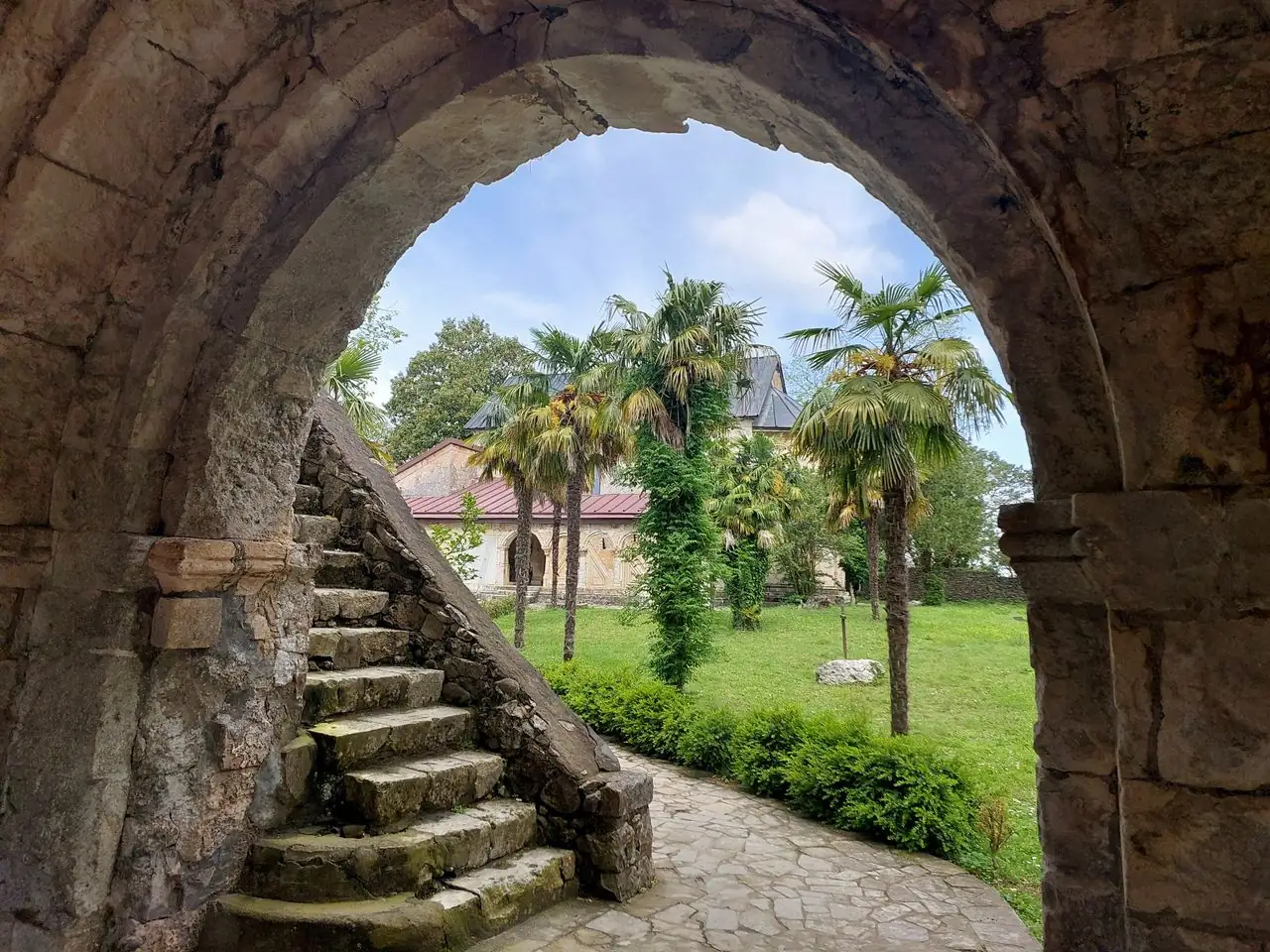
The Dormition church is dated to the second half of the 13th century: a domeless hall church with an open gallery along the west and south facades. Inside are frescoes of the 13th and 14th centuries in the late Byzantine Palaiologan manner and others from the 17th, some showing members of the Dadiani family. A bell tower of the 14th to 17th centuries and the ruins of a bishop’s palace stand alongside. It’s a working nunnery, so dress accordingly and don’t photograph the sisters without asking.
And here’s the link. The Robe of the Virgin that you saw in the Zugdidi museum that morning was kept here for centuries, in a silver casket on the altar, sealed by both the Catholicos and the local prince. In the Soviet years the relic was moved to Dadiani Palace, and there it stayed. The palace and the monastery are two halves of one story, and they read better on the same day than apart.
Poti and Lake Paliastomi
Poti is a working port city in the Rioni delta: 41,000 residents, a port rated at 7.7 million tonnes a year. No resort, but it’s the practical place to sleep before the boat and it has decent cafes. Worth knowing where you’re standing, though: the Greek colony of Phasis, founded by Milesians around the turn of the 7th and 6th centuries BC, lay nearby, and in the myth the Argonauts entered Colchis through this river mouth.
One thing in town deserves half an hour. The cathedral on the square, built in 1906-1907, is a scaled-down copy of Hagia Sophia, and it went up entirely in reinforced concrete on the Hennebique system, close to an experiment for a church of that date. The Soviets turned it into a theatre and took the bells down; it went back to the Church only in 2005.
The Kolkheti National Park visitor centre is in Maltakva, a settlement about five kilometres south of the centre, at 222 Guria Street. The jetty is another kilometre and a half beyond it. You’re asked to arrive half an hour before the boat leaves and to bring a passport or driving licence, because your details go into the register.
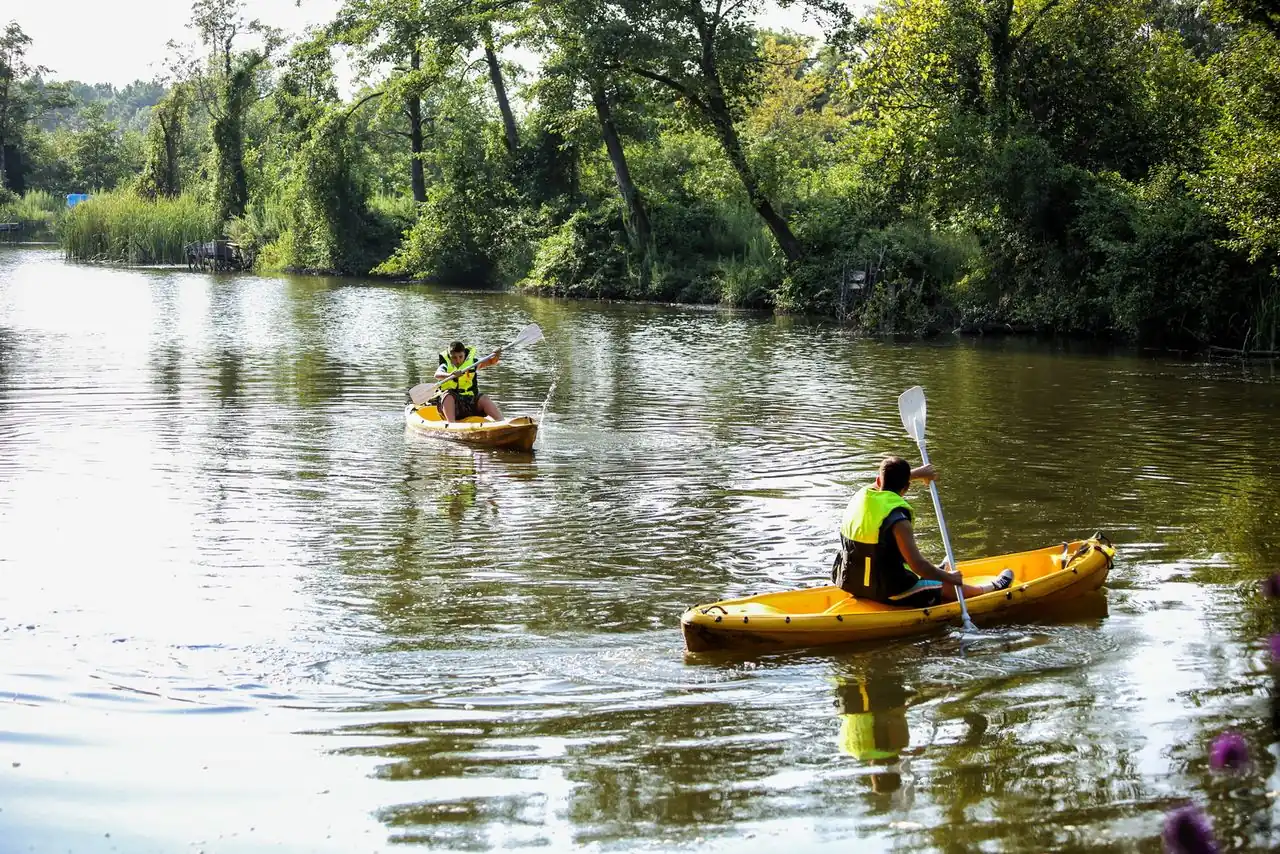
The trip lasts about an hour and a half: an hour afloat, half an hour ashore with two stops. Three routes run from the Poti side - short on the lake, standard turning into the Pichori river, and a full one adding Little Paliastomi. The park has a second base in the Churia valley some fifty kilometres from Zugdidi, but Maltakva is far easier to reach.
What you’re here for is the shoreline and the birds rather than the water: more than 190 species have been recorded in the park. Since 2021 the wetlands around it have been on the UNESCO World Heritage list as the Colchic Rainforests and Wetlands, a property of seven component parts, Kolkheti among them. The lake is shallow, averaging 2.6 m and reaching about six.
An honest word on timing. Early spring and autumn are the best months for birds, and they’re the best months for people too. July and August in the delta mean humid heat and mosquitoes. Tours technically run all year, but they get cancelled on the spot in bad weather, so if the boat is the reason you came, keep a spare day.
Things to keep in mind
- Book the boat ahead. The park’s booking number is +995 552 223 222, visitor services +995 591 96 87 85. Turn up without calling and you’ll most likely find an empty jetty.
- Price the boat by the group, not the head. Two people pay 75 GEL each, five pay 50, eight on the pontoon pay under forty.
- The Anaklia to Poti leg runs inland. There’s no coastal road, the detour through Khobi takes about two hours, so treat the monastery as a stop rather than skipping it.
- Distances and times are rounded guides. Train and marshrutka timetables in Samegrelo change, so check before you set off.
- Poti is the easier place to sleep, with better food and beds. Anaklia’s compensation is an empty beach in the morning, and some people stay on the coast for exactly that.
- The route stitches well into western Georgia: Poti is about an hour and a half from Kutaisi, and if you head back north, Martvili Canyon is on the way. Other ideas are in the routes section.
Getting there without a car
There’s one daytime train from Tbilisi to Zugdidi: number 870 leaves at 8:15 and arrives at 14:25, and the return, 869, departs at 17:10 and gets in at 23:20, roughly six hours each way. Tickets cost 16 GEL in second class, 28 in first and 43 in business. The night train to Zugdidi no longer exists: it was withdrawn in early 2020 and never came back, so if you’ve read advice about taking the sleeper, it’s out of date. Timetables shift, so check with the railway before you travel.
After that, marshrutkas do the job: number 24 from Zugdidi to Anaklia, and regular services to Poti via Khobi. From central Poti to the Maltakva visitor centre take a taxi, it’s too far to walk. You can also arrive from the other direction: Batumi is a little over an hour and about 8 GEL, Kutaisi roughly 1 hour 45 minutes for 7 GEL, and there’s a train from Rioni station. So the route runs in reverse just as well, lake first, palace last.
Route day by day
- Days on the road
- 2
- Distance
- ≈114 km
- Budget from
- 100 GEL
- Best season
- April, May, September, October
The route at a glance
-
Zugdidi: Dadiani Palace
Route startstop ≈120 min
The start. A museum inside the princely palace: a death mask of Napoleon, the Robe of the Virgin, an old park around it. Tuesday to Sunday from 10:00, closing between 17:30 and 18:00 depending on the source - confirm locally. Closed Monday.
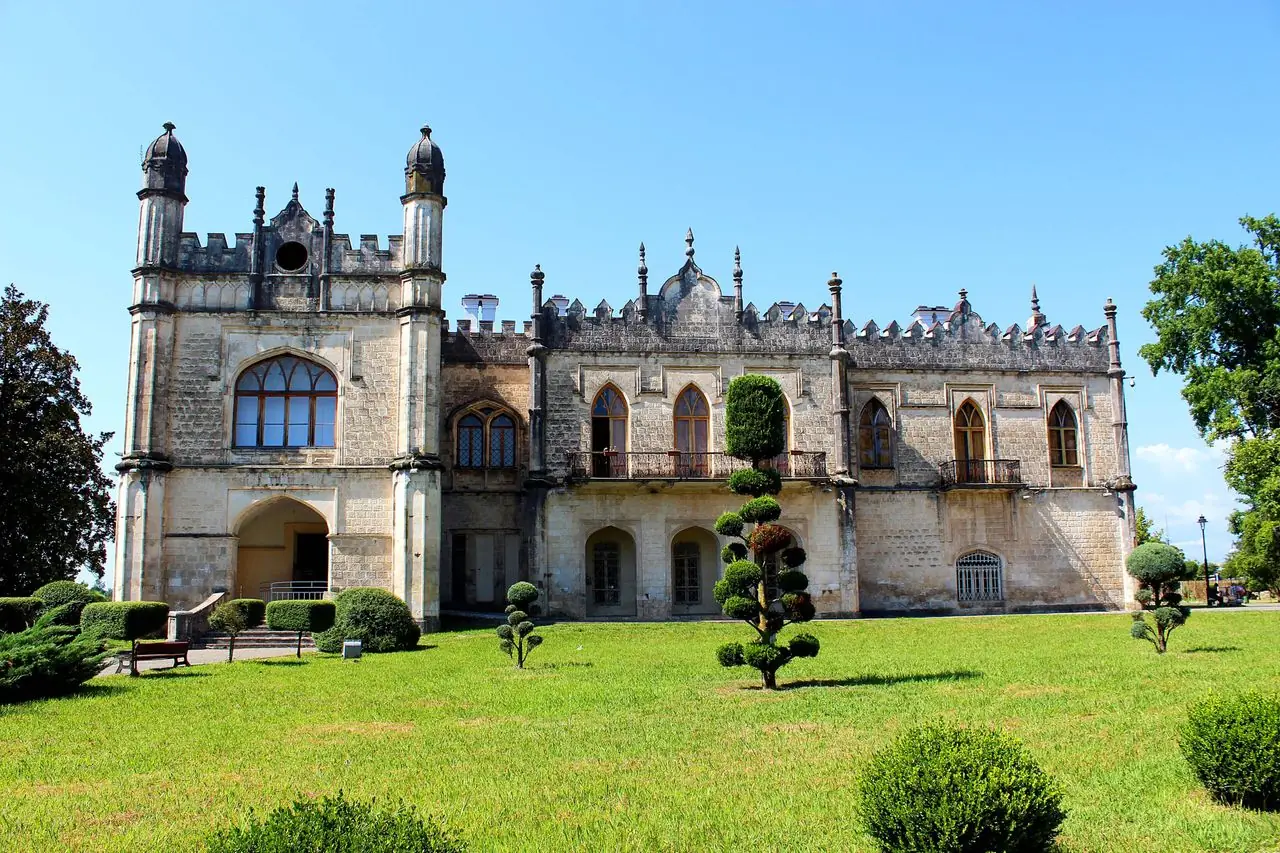
Photo: Kakhi Kuloshvili / Wikimedia Commons, CC BY-SA 4.0 ( source) -
Anaklia
32 km from the startstop ≈180 min
A dark pebble beach, an empty promenade and a wooden footbridge across the Enguri mouth to Ganmukhuri. The deep-sea port is being built next door.
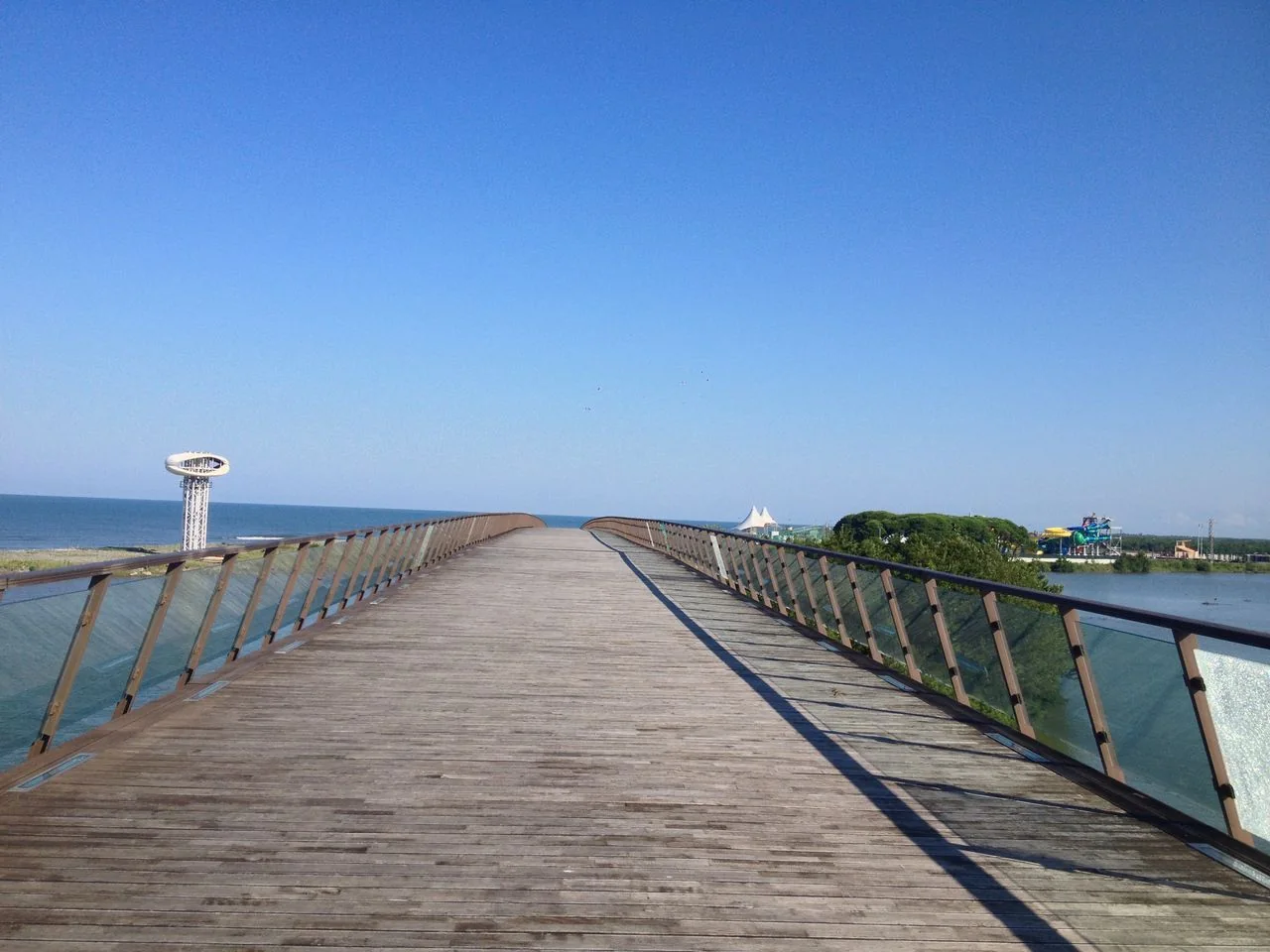
Photo: Dalibor Z. Chvatal / Wikimedia Commons, CC BY 3.0 ( source) -
Khobi Monastery
74 km from the startstop ≈45 min
Nojikhevi village, 3 km from Khobi town. A domeless hall church from the later 13th century with frescoes and a bell tower, now a working nunnery. It sits on the inland road south.
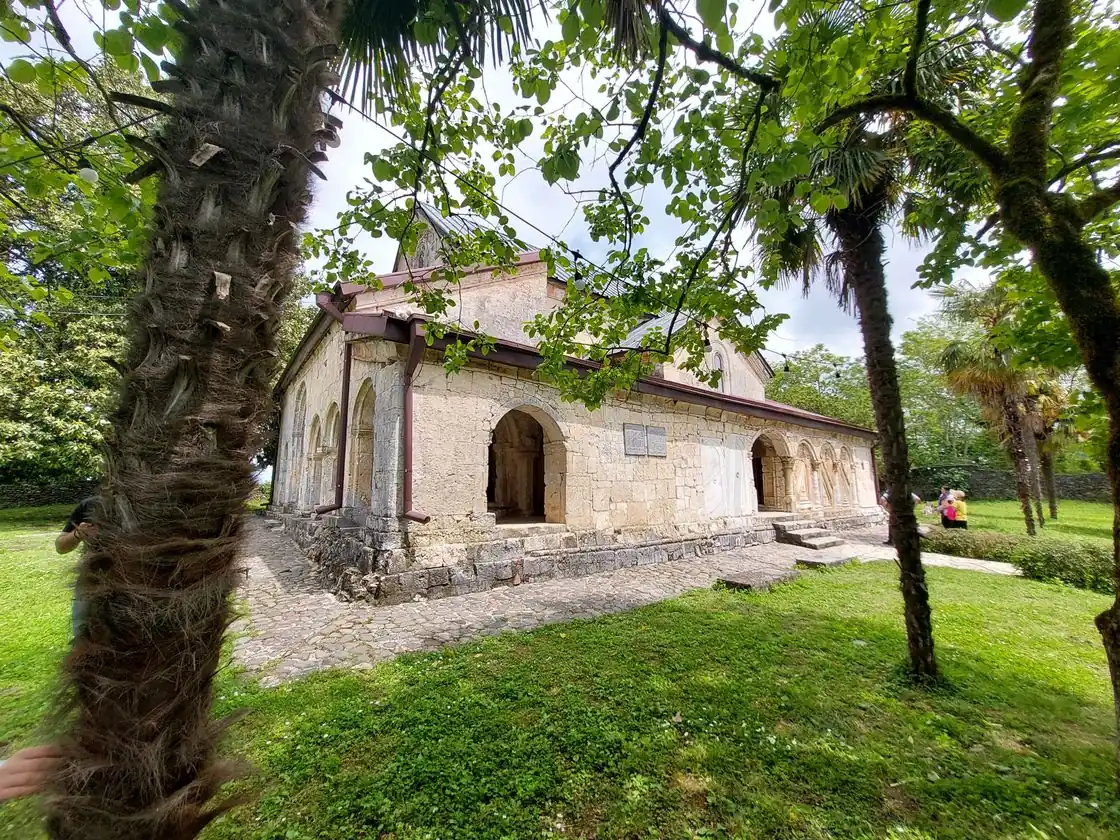
Photo: Jaba1977 / Wikimedia Commons, CC BY-SA 4.0 ( source) -
Poti
108 km from the startstop ≈60 min
A working port city in the Rioni delta, 41,000 people. A concrete copy of Hagia Sophia from 1906-1907, the port, and a handy overnight stop before the boat. Poti makes no claim to be a resort.
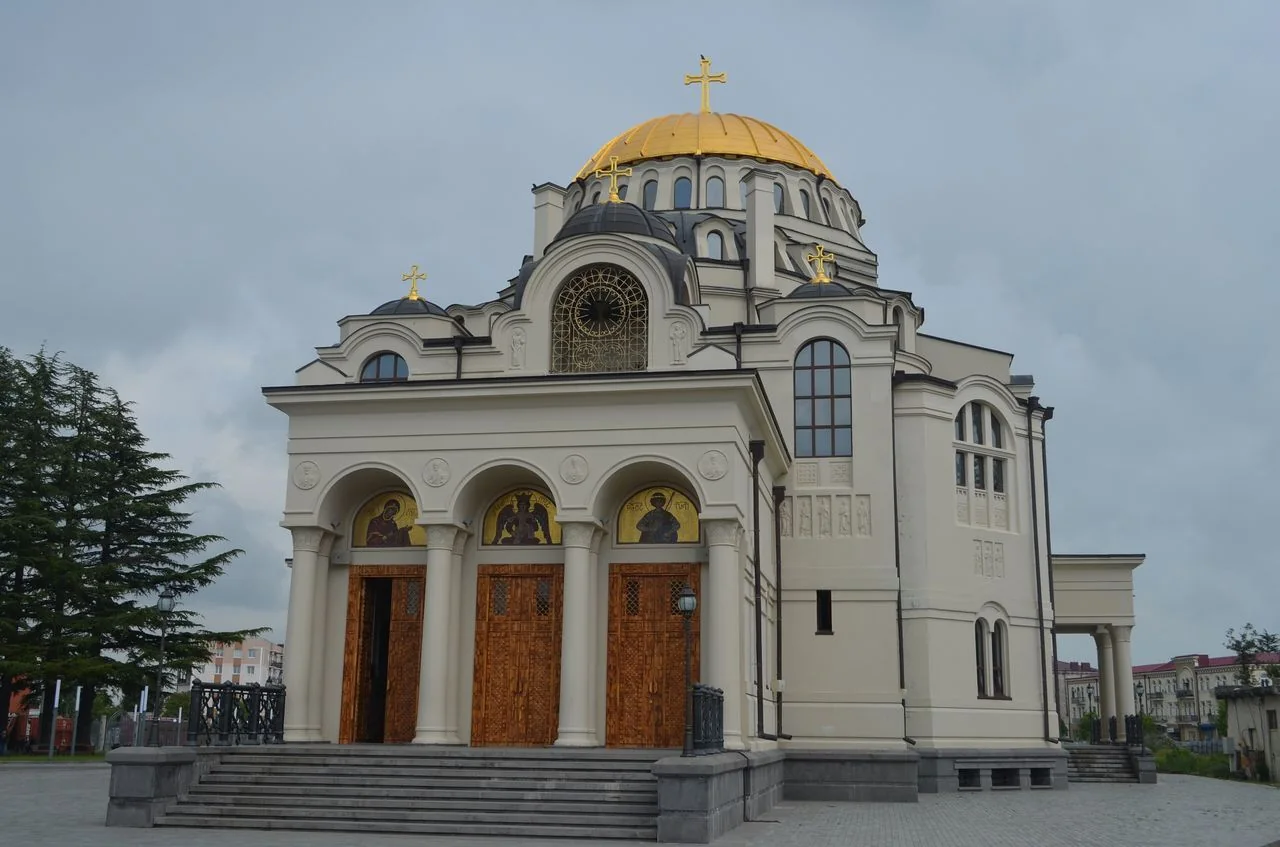
Photo: Автандил Цецхладзе / Wikimedia Commons, CC0 ( source) -
Lake Paliastomi (Maltakva visitor centre)
114 km from the startstop ≈150 min
Kolkheti National Park. A boat trip on the lake and the Pichori river, about an hour and a half, by advance booking only and only in decent weather.
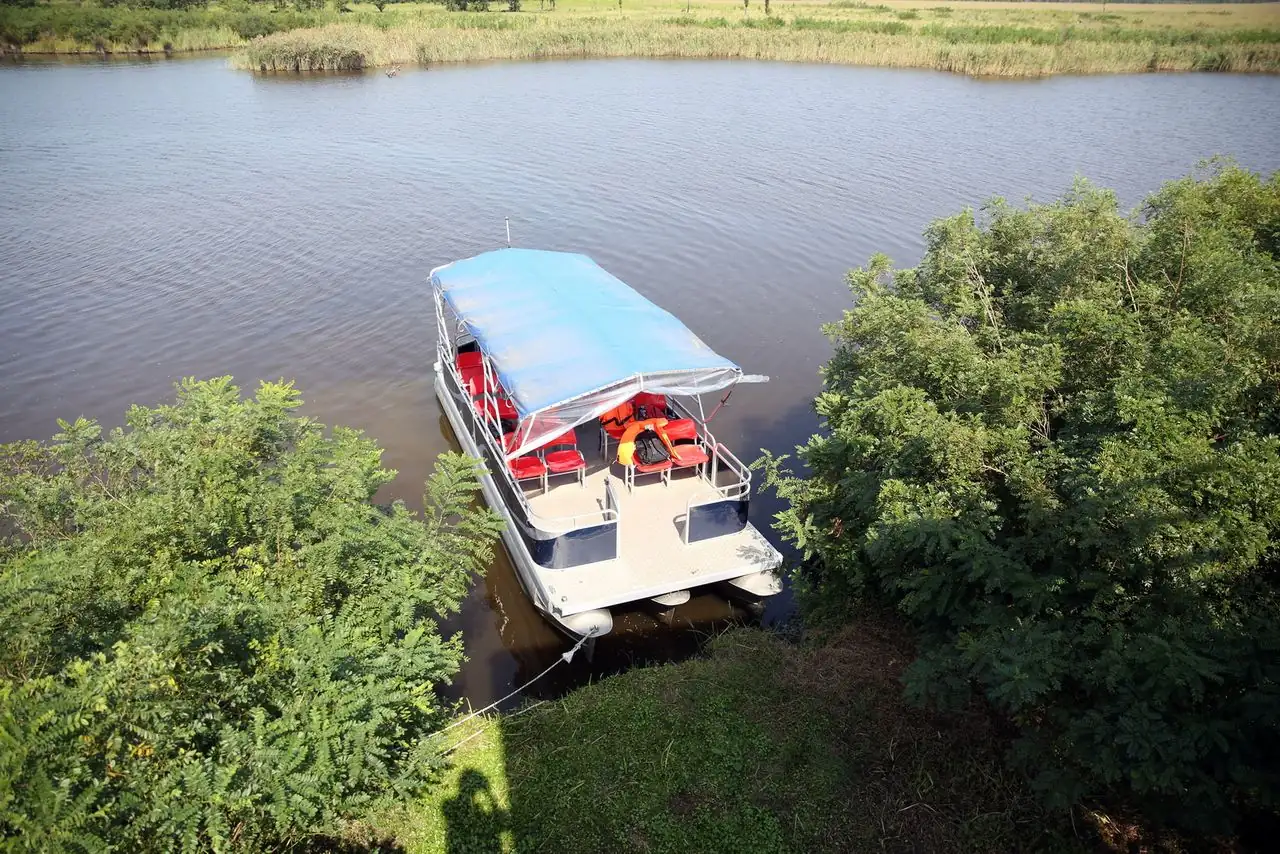
Photo: Paata vardanashvili / Wikimedia Commons, CC BY-SA 4.0 ( source)
Route map
The map with stops loads on click - to keep the page lightweight.
The map didn’t load. Check your connection and refresh the page.