
Kinchkha Waterfall from Kutaisi: views and pools
How to reach Kinchkha Waterfall from Kutaisi, the trail views over the 70 m cascade and turquoise pools, and combining it with Okatse Canyon.
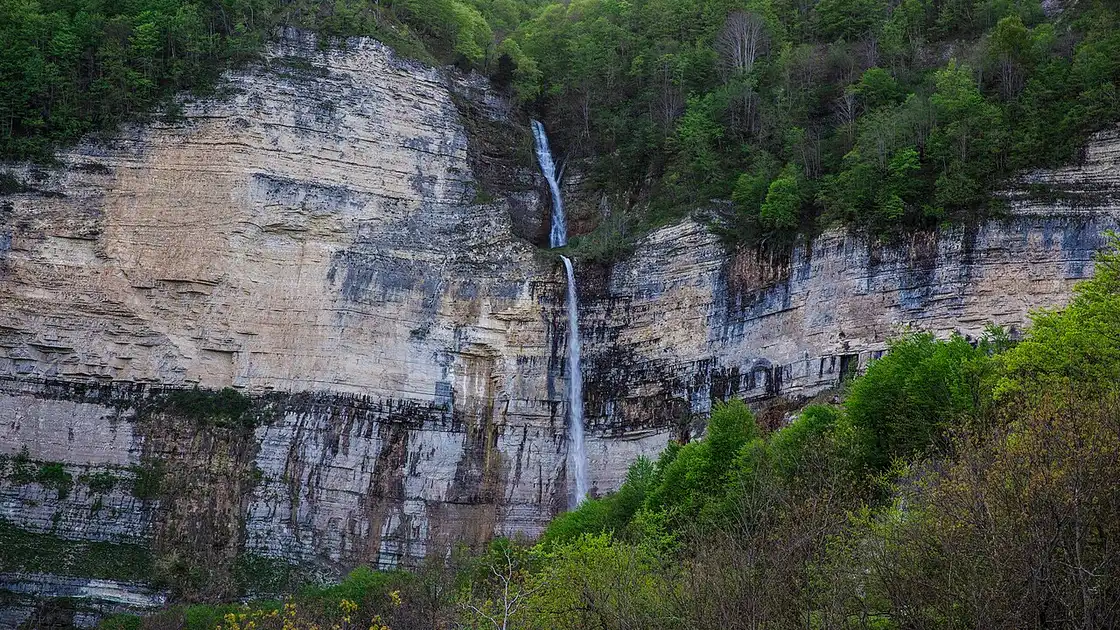
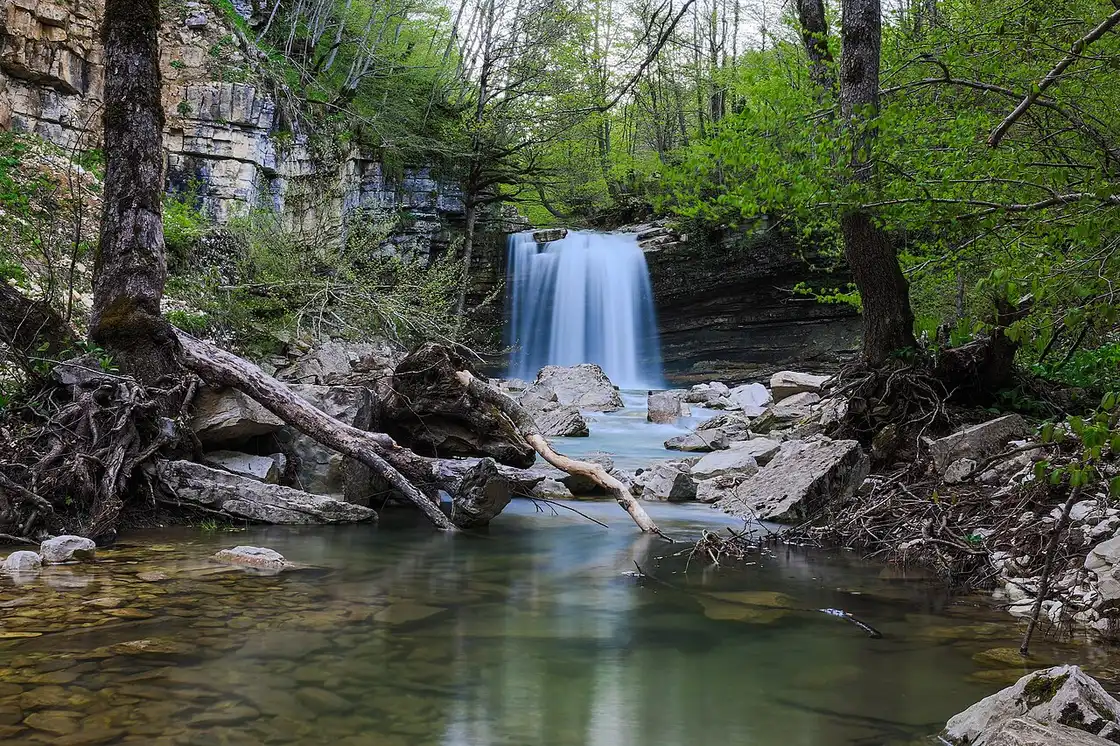
Kinchkha is one of the most spectacular waterfalls in western Georgia: the water drops in several tiers down a tall, layered limestone wall, and turquoise pools gather beneath the ledges. The waterfall hides in the gorge of the Okatse River, the same river that carved the canyon a short drive further along, and people usually see the two together on a single trip into the hills above Kutaisi.
Why the waterfall is famous
Kinchkha sits in the Khoni Municipality of Imereti, in the gorge of the Okatse River, at about 843 metres above sea level, named for the small village at its foot. It’s remote enough that you won’t stumble on it by accident - this is a deliberate detour into the hills, not a stop that happens to sit on a main road. On the country’s own protected-areas register it’s listed under its older name, Okatse Waterfall, sharing the Sataplia-Okatse managed area with the neighbouring canyon - so don’t be thrown if you see both names for the same place. It is a cascade of three steps down the limestone: the upper one around 25 metres, the main drop up to about 70, and the lower one about 35 metres, which begins some 20 metres below the point where the stream joins the Satsiskvilo river. If you have seen “20 m” quoted for the lower step, that is this distance read as a height. Because of its total height, Kinchkha is considered one of the largest waterfalls in western Georgia.
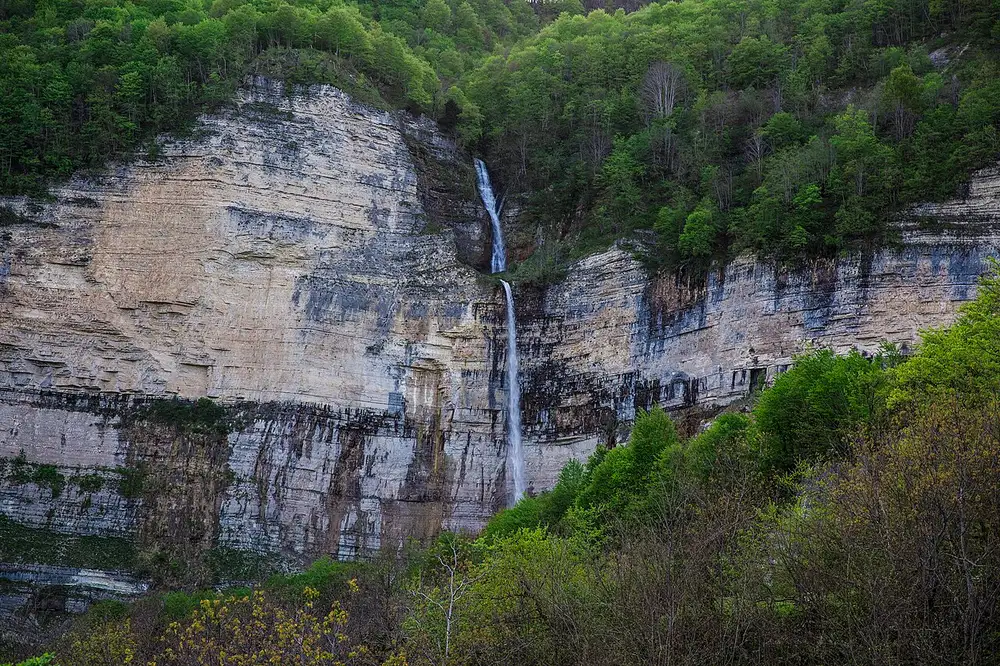
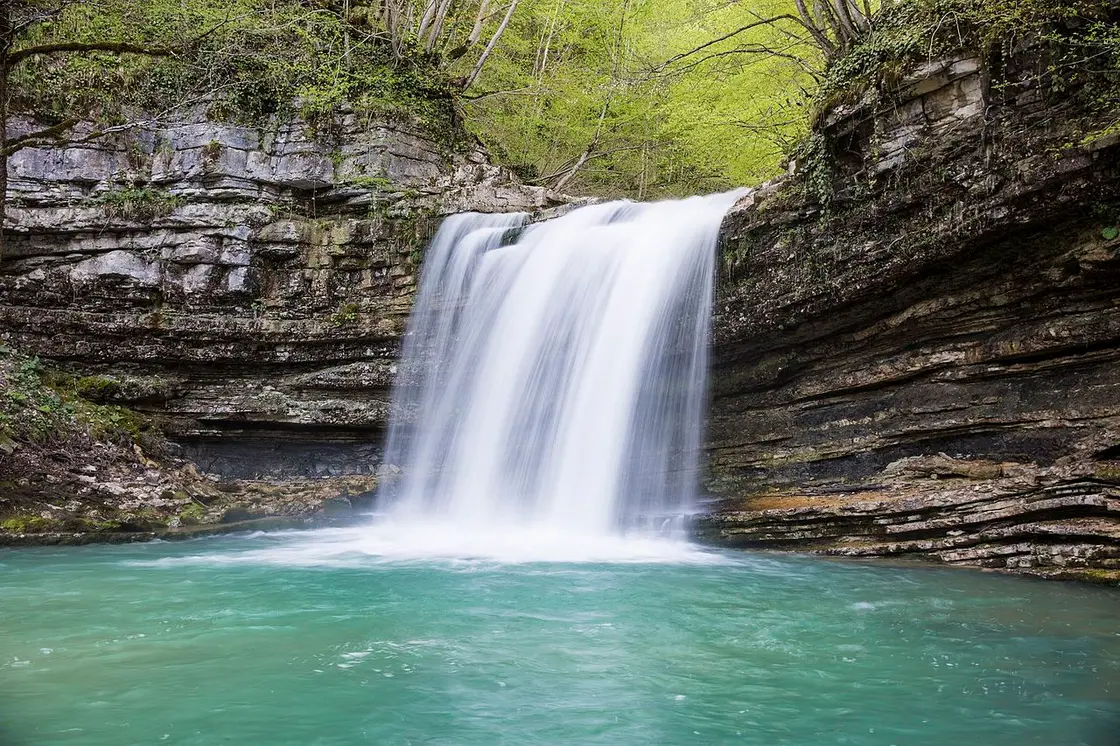
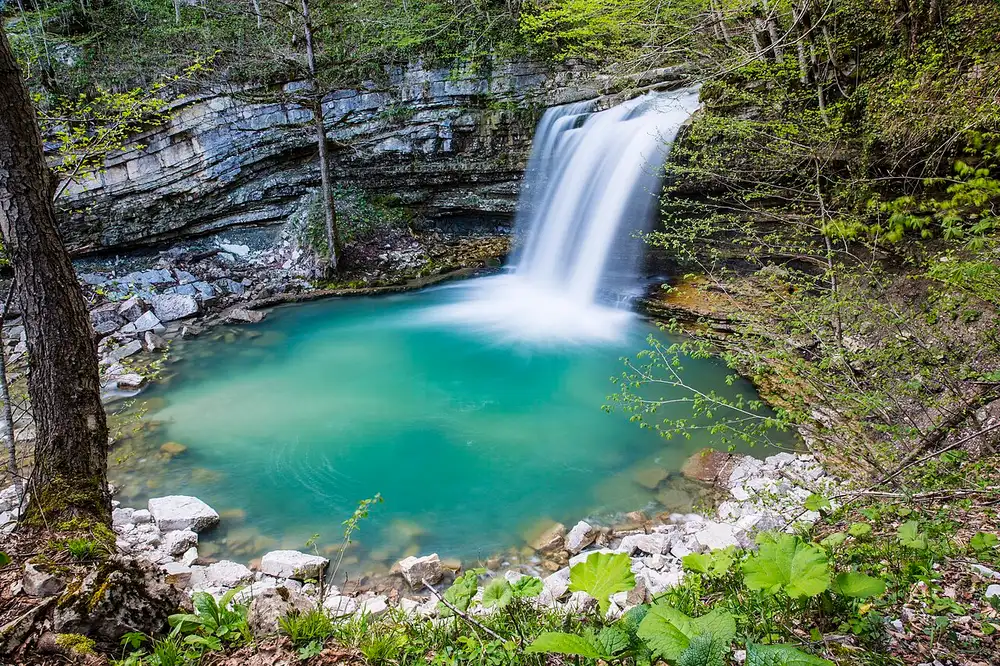
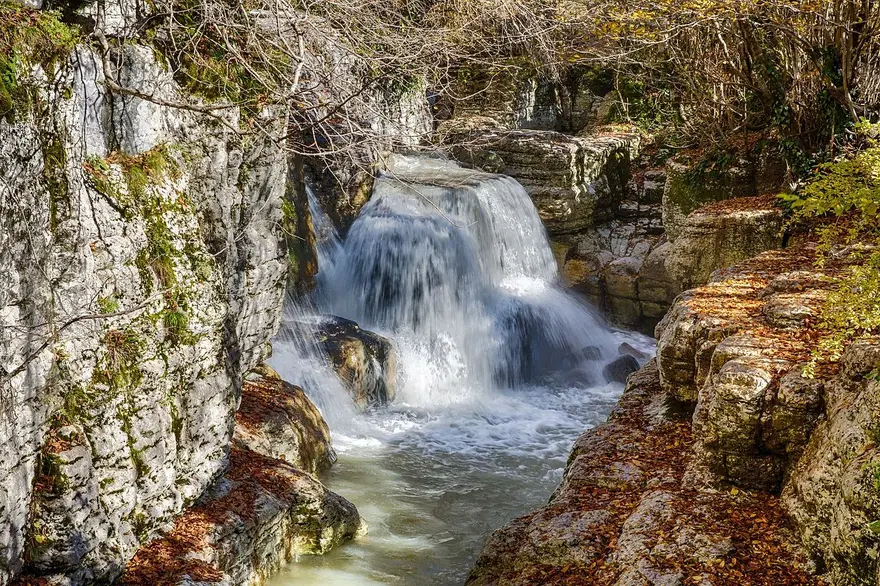
What gives the place its special beauty are the pools: beneath the ledges the water collects into round basins with a distinctive turquoise-green colour. It is the combination of white jets, dark layered rock and bright pools that makes Kinchkha so photogenic. Most people get a good look at the main drop from above, near the top of the trail, and a second, closer view lower down once the path reaches the pools themselves - two genuinely different photos from the same waterfall, not just the same shot from a slightly different angle.
Tickets and hours
Kinchkha is inside a managed protected area, so there’s an actual ticket booth at the entrance, not just an honesty box. The Agency of Protected Areas (APA) charges 20 GEL for foreign visitors aged 18 and over, 12 GEL for Georgian citizens and residents of the same age (bring ID to prove it), 5.50 GEL for anyone 6 to 18, and lets children under 6 in free; a teacher accompanying a school group also gets in free. Georgian citizens and residents who are war or armed-forces veterans pay 5 GEL - a tariff line that appears only on the Georgian-language version of the APA page. As of October 2026 the site is open 10:00 to 17:30, every day - the agency shifts the closing time with the season, and in early September it was still 18:00. None of that is negotiable at the gate - it’s the rate the APA publishes, not a starting price you can talk down. APA also runs a visitor-service contact for this site if you need to check anything before you drive out - worth using for a group booking or if you’re travelling with limited mobility.
Weather, seasons and crowds
The water is at its fullest in spring and early summer - that’s when the waterfall is most powerful. In summer the flow is weaker, but the descent is easier and the turquoise of the pools shows up better. Winter brings its own risk: the descent gets properly slippery, and heavy rain or snow can make the unpaved final stretch of road to the car park hard going even for a capable vehicle. Weekday mornings are quieter than weekend afternoons, when tour groups from Kutaisi tend to cluster around midday.
What to see and how a visit works
A trail leads from the car park down to the cascades: it descends into the gorge, and along the way the views open up onto the main drop, then onto the lower tiers with their pools. The APA marks the walking route from the village of Kinchkha down to the waterfall as a 2.1 km signposted trail, about 25 minutes one way, before you add time at the pools.
Self-drive or tour
On the approach, the APA’s own distance notes are the ones to trust: from Khoni to the village of Kinchkha it’s 26 km and about 40 minutes, and from Gordi, where the Okatse Canyon entrance is, only 5 km and about 15 minutes - which is why the two sites pair so naturally in one day.
A rental car gives you control over timing - arrive early, beat the tour buses, linger at the pools as long as you like - but that unpaved final stretch and the steep trail are real considerations if you’re not confident off tarmac or on uneven ground. A higher-clearance vehicle handles the last kilometre with less drama than a low sedan, especially if it’s rained recently, and it’s worth checking the forecast the night before either way. A day tour out of Kutaisi typically bundles Kinchkha with Okatse Canyon and sometimes Prometheus Cave or Tskaltubo, handles the ticket queue and the tricky road for you, and suits anyone travelling without their own vehicle. Neither option is clearly better - it comes down to how much you value flexibility against not having to think about the driving at all, and how much company you want on what’s otherwise a fairly quiet, remote spot.
Kinchkha or Martvili Canyon?
Western Georgia has more than one photogenic gorge, and it’s worth knowing the difference before you commit a day to one. Martvili Canyon, further west toward Samegrelo, is built around a short boat ride along a narrow emerald channel - calm, scenic and physically easy. Kinchkha is the opposite kind of experience: no boat, just a steep trail on foot and falling water dropping from real height, not a placid channel. Pick Martvili for an easy, photogenic outing that doesn’t ask much of your legs; pick Kinchkha if you’d rather earn the view with a proper walk and don’t mind getting your shoes wet near the pools.
What to keep in mind when visiting
The main thing is the descent and climb along the trail: in places it is steep and slippery, especially after rain, so you’ll want comfortable, non-slip shoes. The last stretch of the road to the car park is unpaved and can be tricky for an ordinary car in wet weather. Bring water, and if you plan to go down to the pools, bear in mind that the water is cold and the rocks are wet. It’s also worth carrying some cash for the ticket booth - the APA doesn’t publish payment methods for this specific gate, and a rural booth in the hills isn’t somewhere you want to find out the hard way.
Nearby
People usually see Kinchkha together with Okatse Canyon, a short drive away and run by the same protected-areas agency, so the ticket process and the general feel of the two sites - marked trails, a real gate, a fee - will already be familiar by the time you reach the second one. Its entry fee is higher than Kinchkha’s: 16 GEL for Georgian citizens and residents, 30 GEL for everyone else, and 5.50 GEL for ages 6-18, the same as at the waterfall. It keeps the same hours, 10:00 to 17:30 as of October 2026, its active season runs April to October, and the walkway closes in rain or snow for safety. Before you set off, note that the canyon trail is closed to children under 6 and to anyone under 1.20 m tall. If you’re doing both in one day, ask for the combined ticket: 22 GEL for residents and 40 GEL for foreign visitors covers the canyon and the waterfall together (a three-site version with Martvili Canyon is 38 GEL for residents; for foreign visitors the agency’s Martvili and Kinchkha pages say 90 GEL and its Okatse Canyon page 80 GEL, as read on 03.10.2026, so confirm at the desk). One warning: the English-language APA page for the canyon still shows 12 / 20 GEL, which is the waterfall’s tariff, not the canyon’s - the Georgian page is the one that gets updated. Prometheus Cave and Tskaltubo round out a full day in this part of Imereti - caves, a waterfall and Tskaltubo’s abandoned Soviet sanatoriums make for a genuinely varied itinerary if you have the time, and none of it is far from Kutaisi, the obvious base for the trip. It’s easier to get around the sights of Imereti by car - for how to rent one, see the car hire section; more places are in the things to see section.
Photos
On the map
The map loads on click - to keep the page lightweight.
The map didn’t load. Check your connection and refresh the page.
Admission and opening hours
- Admission price
- 20 GEL foreign visitors 18+ / 12 GEL Georgian citizens and residents 18+ / 5.50 GEL ages 6-18 / free under 6
- Opening hours
- 10:00-17:30 daily as of October 2026 (the agency changes the closing time with the season)
Agency of Protected Areas (APA) ticket booth at the entrance; bring ID for the resident rate
Details checked: October 2, 2026
Distance
- Tbilisi ≈270 km · ~4 h approximate, via Kutaisi
- Kutaisi ≈55 km · ~1.5 h via Khoni
- Batumi ≈155 km · ~2.5 h approximate
Read also

What to see · 10 min read
Skiing in Georgia: Gudauri vs Bakuriani
Updated · September 5, 2026Gudauri or Bakuriani: 2025/26 day passes 70 vs 55 GEL, elevations, last season dates, who each resort suits and how to get there.

What to see · 7 min read
Svaneti travel guide: Mestia, Ushguli and towers
Verified · August 25, 2026Svaneti mapped: Mestia vs Ushguli, tower villages, season, and how to link town guides, the trek, and the road from Tbilisi.

What to see · 9 min read
Resorts near Batumi: Gonio, Kvariati & Tsikhisdziri
Updated · September 2, 2026Where to stay near Batumi for cleaner, quieter beaches: Gonio and its Roman fort, Kvariati for diving, and secluded clifftop Tsikhisdziri - how to choose.

What to see · 10 min read
Georgia with kids 2026: family beaches & resorts
Updated · July 18, 2026Georgia with kids: sandy, shallow beaches up north (Ureki, Shekvetili, Kobuleti), amusement parks, when to go and how to plan a family trip.