
Ushguli in Svaneti: towers, Shkhara and how to get there
The high-mountain community of Ushguli in Svaneti at about 2,100 m below Shkhara: Svan towers of the 9th-12th c., a UNESCO site. How to get there.
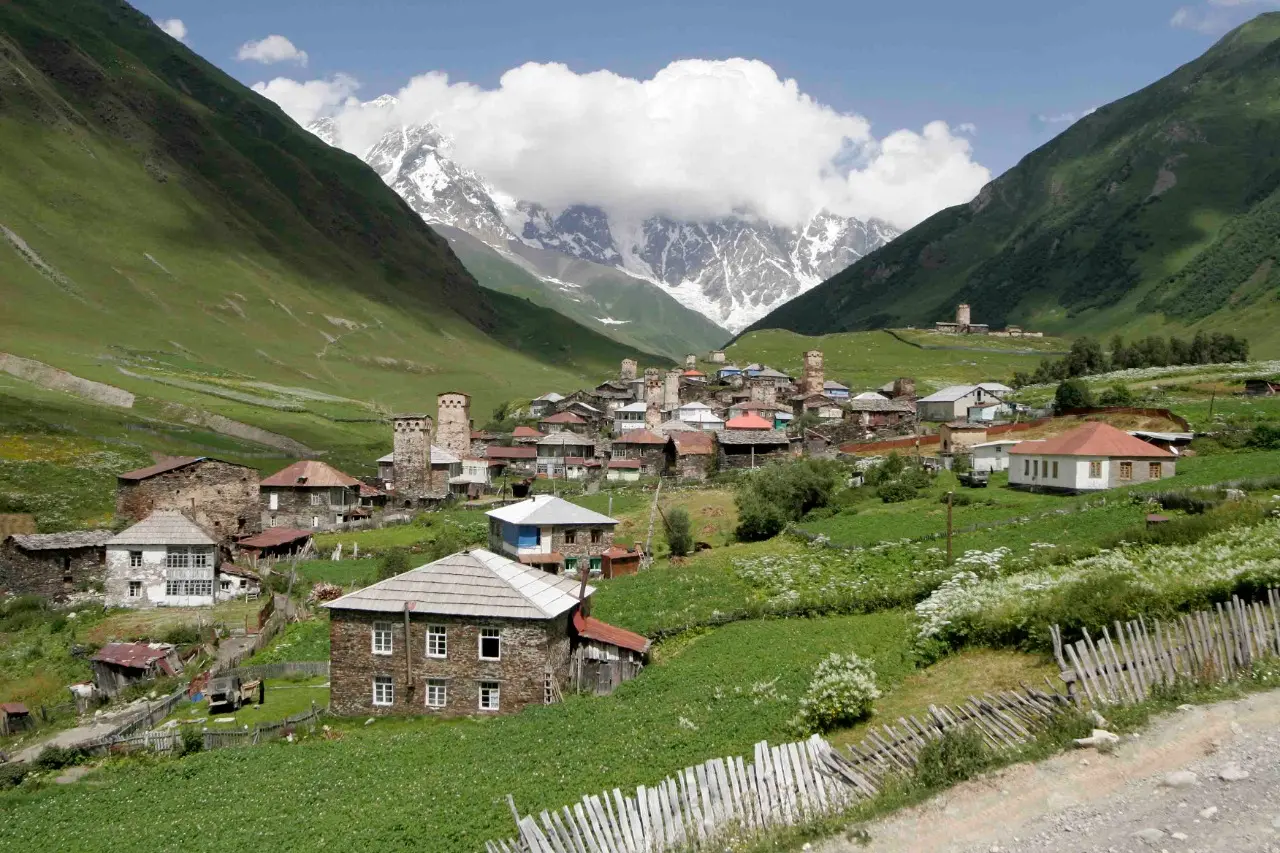
Ushguli is a community of medieval villages deep in the heart of Svaneti, at around 2,100 metres below Shkhara, the highest peak in Georgia. Dozens of Svan towers among stone houses, and behind them a snowy massif on the horizon: this is one of the highest continuously inhabited places in Europe and a fitting goal for the long road into the mountains.
Why Ushguli is famous
Ushguli is not a single village but a community of several settlements (Zhibiani, Chvibiani, Chazhashi, Murkmeli) in the upper reaches of the Enguri River. Its character is defined by the Svan towers, built mostly in the 9th-12th centuries: stone defensive towers attached to dwelling houses. A tapered koshki of three to five storeys stands right beside the family’s two-storey machubi home, the two built as one working compound and not as a freestanding monument. The village of Chazhashi has preserved more than 200 such towers and is protected as a museum-reserve. The name itself is usually traced to a Svan phrase meaning something like “fearless heart” - a fitting description for a place that spent centuries governing itself rather than answering to anyone else.
As part of Upper Svaneti, Ushguli has been on the UNESCO World Heritage list since 1996. It has its own shrine, too - the Lamaria church in Zhibiani, dated to the 12th century; inside, frescoes from the era of Georgia’s “golden age” have survived. Two towers with a different character stand out among the rest: the so-called summer and winter residences of Queen Tamar, built with distinct architecture from the standard defensive koshki, local tradition holding that the queen herself once stayed here. And rising above it all is Shkhara (over 5,000 metres) - one of the main reasons to come here. This is also where svanuri marili, Svan salt, comes from - the mix of salt, garlic and mountain herbs used across Georgian cooking traces back to villages exactly like this one, and it’s one of the few souvenirs from here that survives a long drive home undamaged.
A free community with its own rules
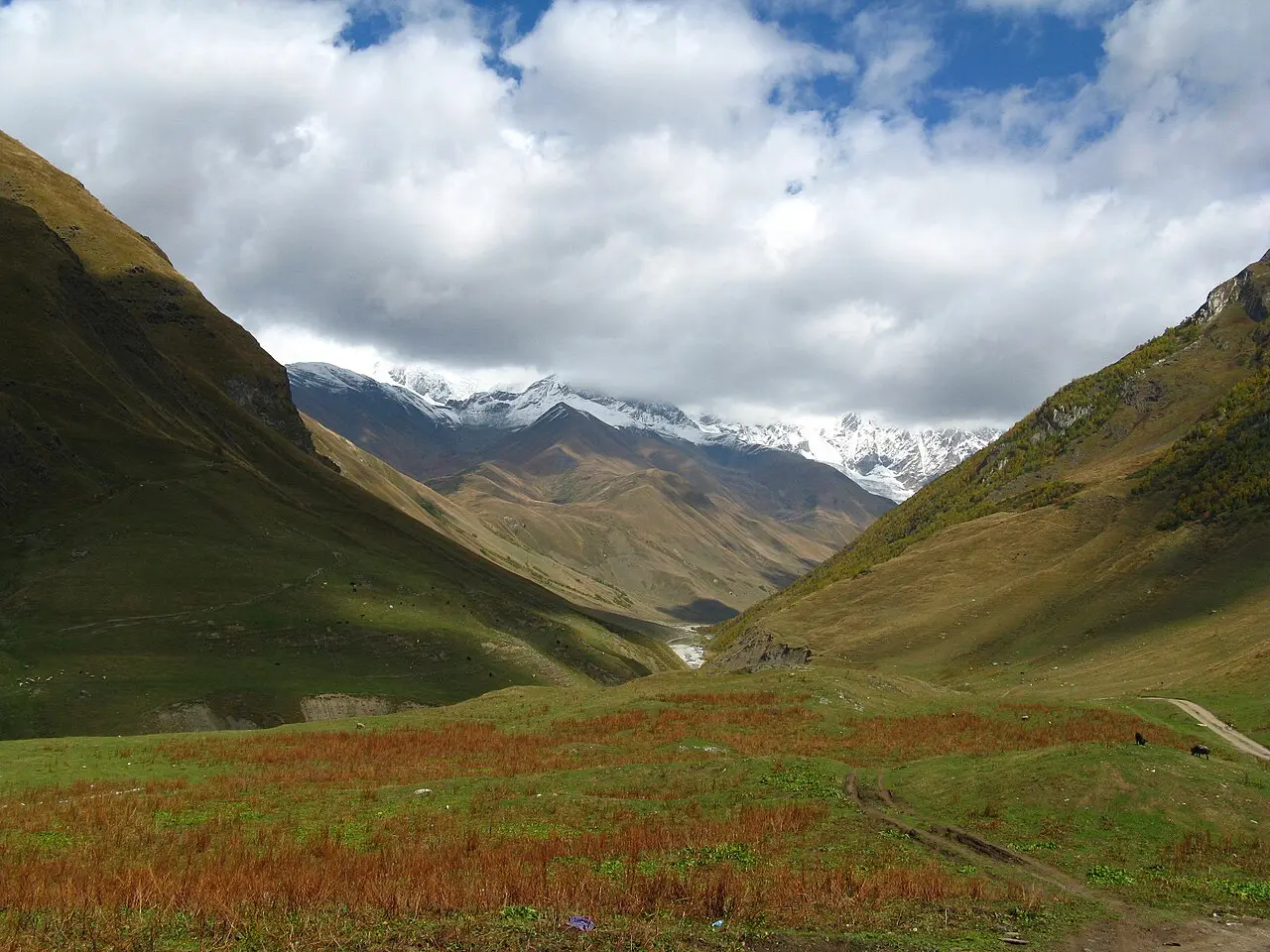
Long before UNESCO took an interest, Ushguli had a reputation for running its own affairs. Locally it’s remembered as part of “Free Svaneti”, a cluster of highland communities that governed themselves rather than bowing to a single noble house, though on paper it counted as part of the Kingdom of Imereti, together with the neighbouring Racha region, until 1810. Local tradition holds that seven Svan princes once tried to seize control of the village in turn, and each one was killed; the last, Puta Dadeshkeliani, was reportedly killed by the whole community together at Limrie, an old noble residence that still gives its name to a site in the village today. Whether every detail of that story is history or legend hardened into fact, the pattern it describes - a community that valued its independence above almost everything - matches what you see on the ground: a settlement that grew up as far from centralised control as Georgian geography allows. There’s an older story attached to the valley too, about a giant’s boulder (locally, Devi’s Rock) that once dammed the Enguri and flooded the land downstream, until two rams from Ushguli and the neighbouring village of Kala were sent to charge it from opposite directions and finally broke it apart. It’s the kind of tale told to explain a landscape, not a person, and Ushguli, wedged between mountains that make every route in and out genuinely hard-won, is exactly the kind of place that invites it.
The same isolation that let Ushguli govern itself for centuries is precisely what earned it UNESCO recognition later on: a settlement pattern this old rarely survives intact anywhere easier to reach.
What to see and do
The main experience is a walk among the towers and stone houses with the mountains in view. It’s worth heading up to the Lamaria church on the hill above the village and to the Chazhashi museum-village with its dense cluster of towers, where the Church of the Savior stands among the tower houses as the community’s other working place of worship. In Murkmeli, a short walk from the main cluster, the small St Barbare church is easy to miss but worth the detour if you have the time. The four component villages sit close enough together that walking between all of them in an afternoon is realistic, rather than something that needs a car - most of the actual sightseeing here happens on foot regardless of how you arrived.
Ushguli is also the final point of the popular trek from Mestia (usually done over four days) and the starting point of short routes towards the Shkhara glacier. You don’t need to be doing the full multi-day trek to walk some distance up the valley towards the ice itself; even an hour or two out and back, on a clear day, gets you a much closer view of the glacier than anything visible from the village, though the trail is unmarked and mountain weather can close in fast, so treat it as a fair-weather outing and turn back at the first sign of cloud building over the peak.
What to keep in mind when visiting
Ushguli is really only accessible in the warm season. Two roads connect it to the outside world: the main one runs to Mestia, roughly 45 km of rough track that needs a 4x4 or a local jeep transfer even in summer, while a second, quieter road heads south towards Lentekhi and is only passable in the warmer months - don’t count on it as a winter route under any circumstances. Even the Mestia road gets difficult once the snow sets in, and Ushguli can end up effectively cut off for a good part of the year. If you’re not driving yourself, a shared jeep or marshrutka back to Mestia typically runs somewhere around 40-50 GEL a person for the roughly two-hour journey, though it’s an informal market with no fixed timetable, so confirm the price and departure time locally rather than assuming it.
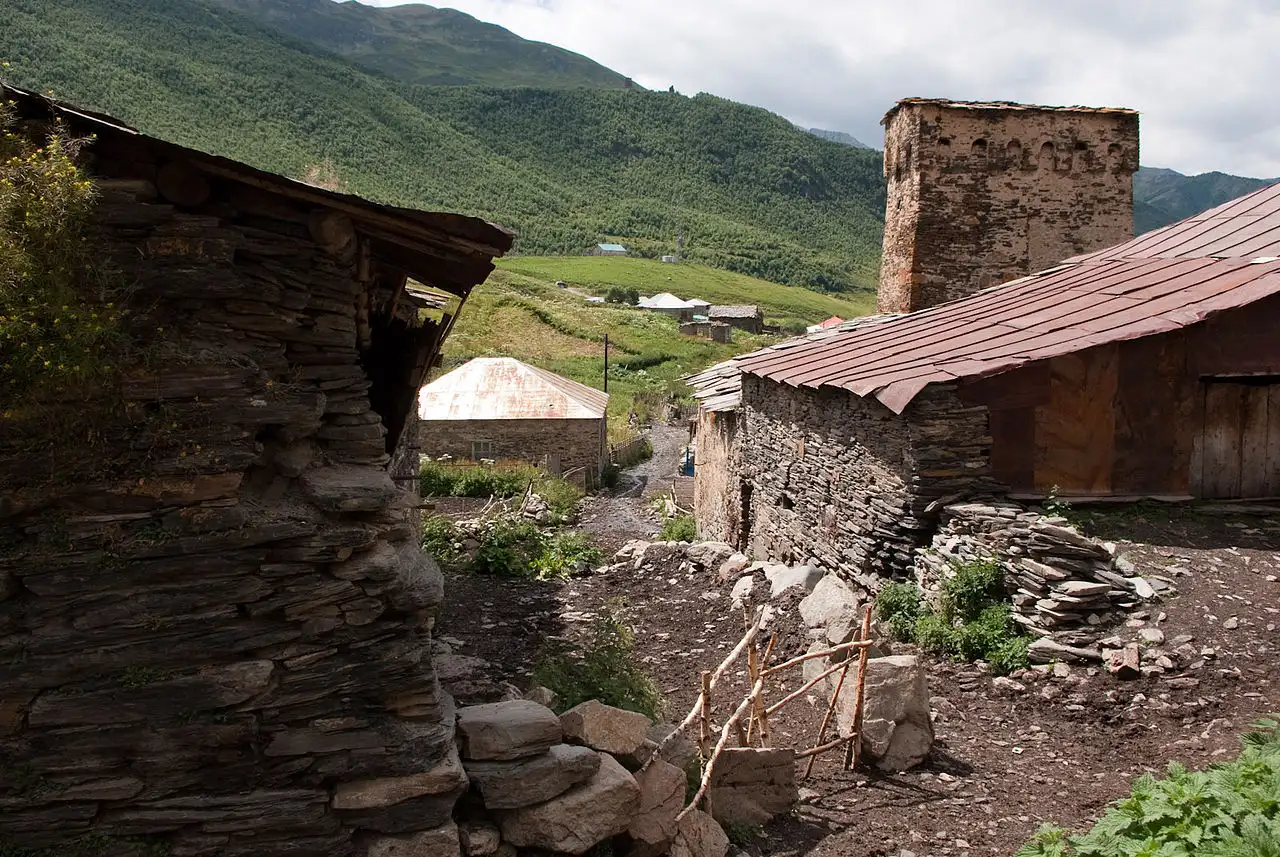
Ushguli is a working village, not a resort built for visitors: people farm here, keep livestock and live in the same stone houses their towers are attached to, and accommodation is almost entirely small family guesthouses rather than hotels. Book ahead in the busiest weeks of summer if you can, and don’t expect much beyond a bed, a hot meal and a genuinely warm welcome - the towers weren’t built with modern plumbing in mind, and neither were most of the houses beneath them. Mobile signal is patchy in places and drops out altogether in parts of the valley, so download any maps you need before you leave Mestia rather than relying on a live connection once you’re here.
Mountain weather changes fast, and it’s cool at the top even in summer - bring a warm layer and a raincoat, and allow plenty of spare time for the journey. If you’re arriving on foot rather than by road, you’re most likely finishing the Mestia-Ushguli trek, and Ushguli is exactly where that four-day walk is built to end - arriving on foot after climbing over a pass is a genuinely different experience from stepping out of a jeep, even though you end up looking at the same towers either way.
Nearby
The road to Ushguli runs through Mestia - the main centre of Svaneti, with its towers and museum - and the easiest way into the region is via Zugdidi. For how the whole region fits together, season by season, our Svaneti travel guide is the place to start, and the three-day Svaneti route lays out a full road-trip itinerary that ends here. Svaneti is easier to get around by 4x4 - for how to rent a car, see the car hire section; more places are in the things to see section.
Photos
On the map
The map loads on click - to keep the page lightweight.
The map didn’t load. Check your connection and refresh the page.
Admission and opening hours
- Admission price
- Free to walk through the village; the small museum-tower in Chazhashi charges a separate entry fee
There's no fixed opening timetable for the village or the museum-tower - hours depend on whoever's staffing it that day, so treat a visit there as a bonus rather than a plan.
Details checked: September 11, 2026
Distance
- Tbilisi ≈500 km · ~9 h via Zugdidi and Mestia
- Kutaisi ≈270 km · ~6 h approximate, via Mestia
- Batumi ≈320 km · ~6.5 h approximate, via Mestia
Read also

What to see · 10 min read
Skiing in Georgia: Gudauri vs Bakuriani
Updated · September 5, 2026Gudauri or Bakuriani: 2025/26 day passes 70 vs 55 GEL, elevations, last season dates, who each resort suits and how to get there.

What to see · 7 min read
Svaneti travel guide: Mestia, Ushguli and towers
Verified · August 25, 2026Svaneti mapped: Mestia vs Ushguli, tower villages, season, and how to link town guides, the trek, and the road from Tbilisi.

What to see · 9 min read
Resorts near Batumi: Gonio, Kvariati & Tsikhisdziri
Updated · September 2, 2026Where to stay near Batumi for cleaner, quieter beaches: Gonio and its Roman fort, Kvariati for diving, and secluded clifftop Tsikhisdziri - how to choose.

What to see · 10 min read
Georgia with kids 2026: family beaches & resorts
Updated · July 18, 2026Georgia with kids: sandy, shallow beaches up north (Ureki, Shekvetili, Kobuleti), amusement parks, when to go and how to plan a family trip.