
Day Hikes from Kazbegi: Juta, Truso, Gveleti & Sno
Day hikes from Kazbegi beyond Gergeti: Juta and the Chaukhi pass, the Truso valley travertines, Gveleti waterfalls and the Sno stone heads.
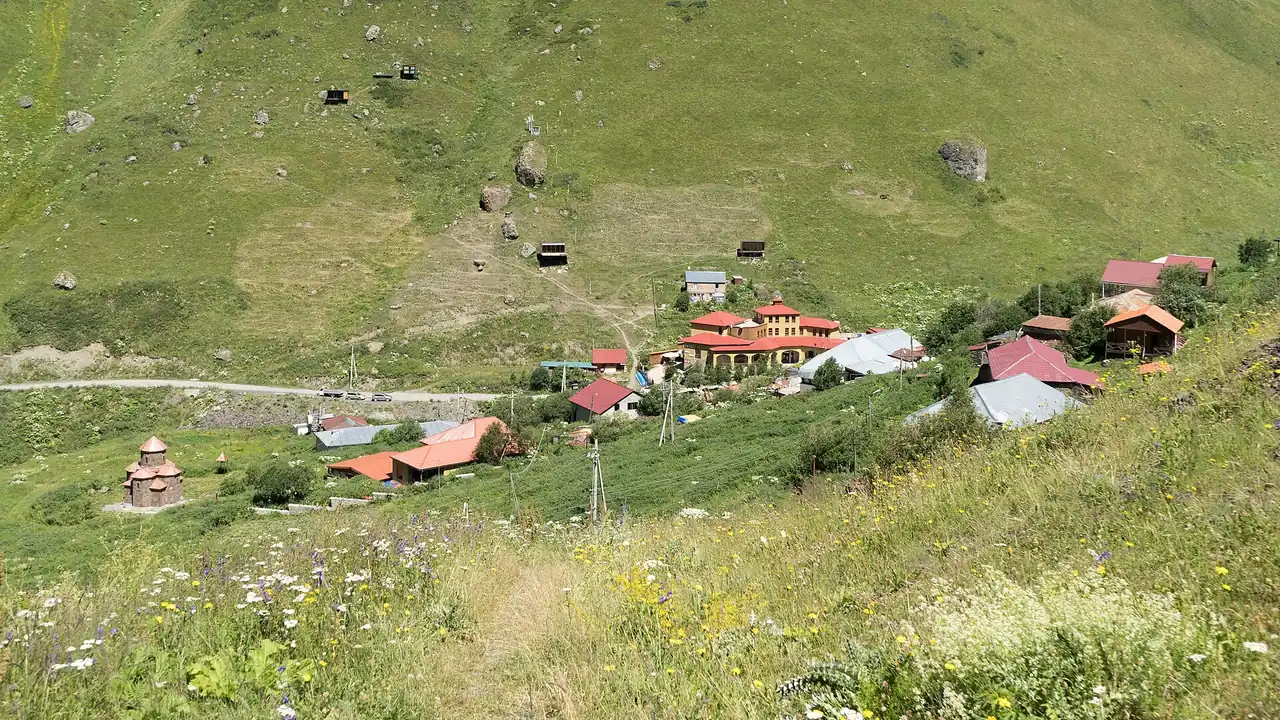
Most people come to Kazbegi for a single photo: Gergeti church with Mount Kazbek behind it. But Stepantsminda works better as a base for several very different day hikes, and if you stop at the church you miss half of what the region does well. The short version: the Gveleti waterfalls are an easy half-day walk; the Sno valley with its stone heads is a quick stop; the Truso valley is a long but flat day of travertines and mineral springs (with a border checkpoint at the far end); and Juta with the Chaukhi massif is the serious mountain outing with a steep climb.
Stepantsminda as a hiking base
Stepantsminda (its older name is Kazbegi) sits about 150 km north of Tbilisi at the end of the Georgian Military Road. How to get here’s covered in the guide on getting from Tbilisi to Kazbegi, and the drive itself, stop by stop, in the Georgian Military Road route. This page is about what to do once you have arrived.
There are three ways to reach the trailheads. The cheapest is the seasonal shared shuttles run by local agencies in the centre of the village: they usually leave around 9:30 in the morning, the Juta and Truso runs have a fixed return time, and a round trip costs roughly 45 GEL. The second option is a private taxi, usually a 4x4: budget 60-70 GEL, but you travel at your own pace. The third is your own or a rented car. One practical catch: a shuttle ties you to its timetable, and fitting two short walks into one day on the shuttle is close to impossible, so for that plan take a taxi. The shuttles only run in season, the return leg is in the afternoon (for Truso, around 17:00), and you have to be back at the drop-off by then; miss it and you get home on your own or for extra money.
Most trails are in season from roughly July to September; snow lingers longest on Chaukhi because of the height of the pass. Mountain weather turns in minutes, so a warm layer and water are worth carrying even on a sunny July day. For active outings a travel insurance policy makes sense - a helicopter out of a gorge is not cheap.
Gveleti: the easiest walk to a waterfall
If you want to stretch your legs on day one, or you are travelling with children, start with the Gveleti waterfalls. They lie to the north of Stepantsminda, in the Dariali gorge of the Terek river, about 6 km along the road towards the Verkhny Lars border. Worth correcting a common mistake: some guides send you “south” to Gveleti, when it’s actually north - the road and the Terek run down from the village towards the Verkhny Lars border.
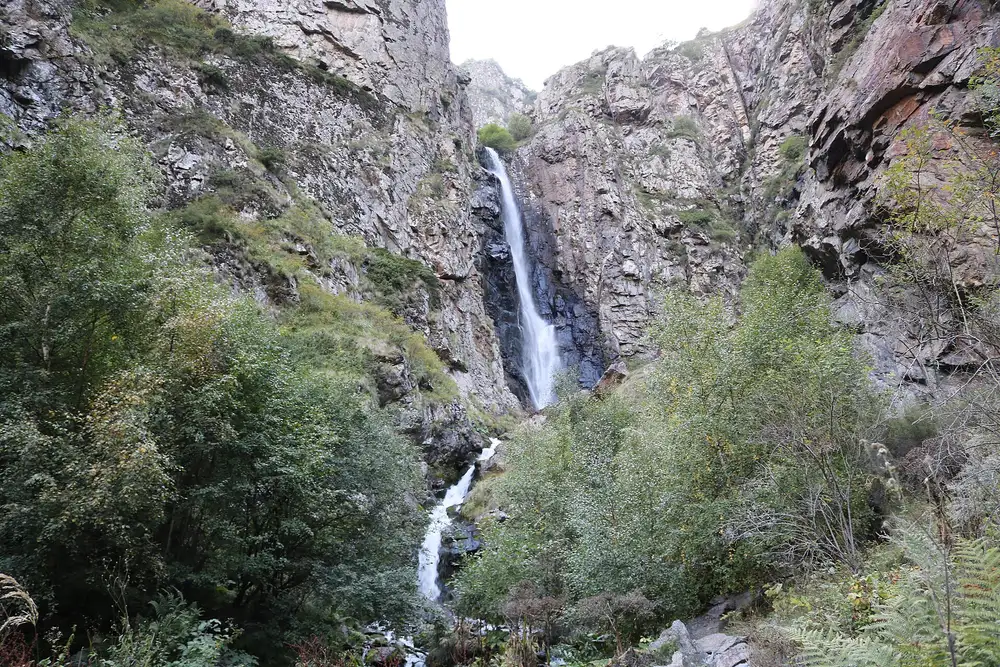
A taxi takes you to the drop-off near Gveleti village (around 50-60 GEL), and from there it’s about a 30-minute walk on a trail. There are two falls: the lower one (Small) is easier to reach, while the upper one (Big) is a steeper approach with some light scrambling over rocks. The upper fall drops from about 25 metres; after rain the path turns muddy and the rocks get slippery, so shoes with proper tread aren’t a luxury here. The whole thing takes half a day, which makes it a good “after the drive from Tbilisi” option, when you’ve neither the energy nor the daylight left for a serious hike.
The Sno valley and the stone heads
The Sno valley pairs nicely with a trip to Juta: it lies on the same road, about 10 minutes from Stepantsminda once you turn off the Georgian Military Road onto the Sno-Juta road. The reason to stop is an open-air field of giant stone heads.
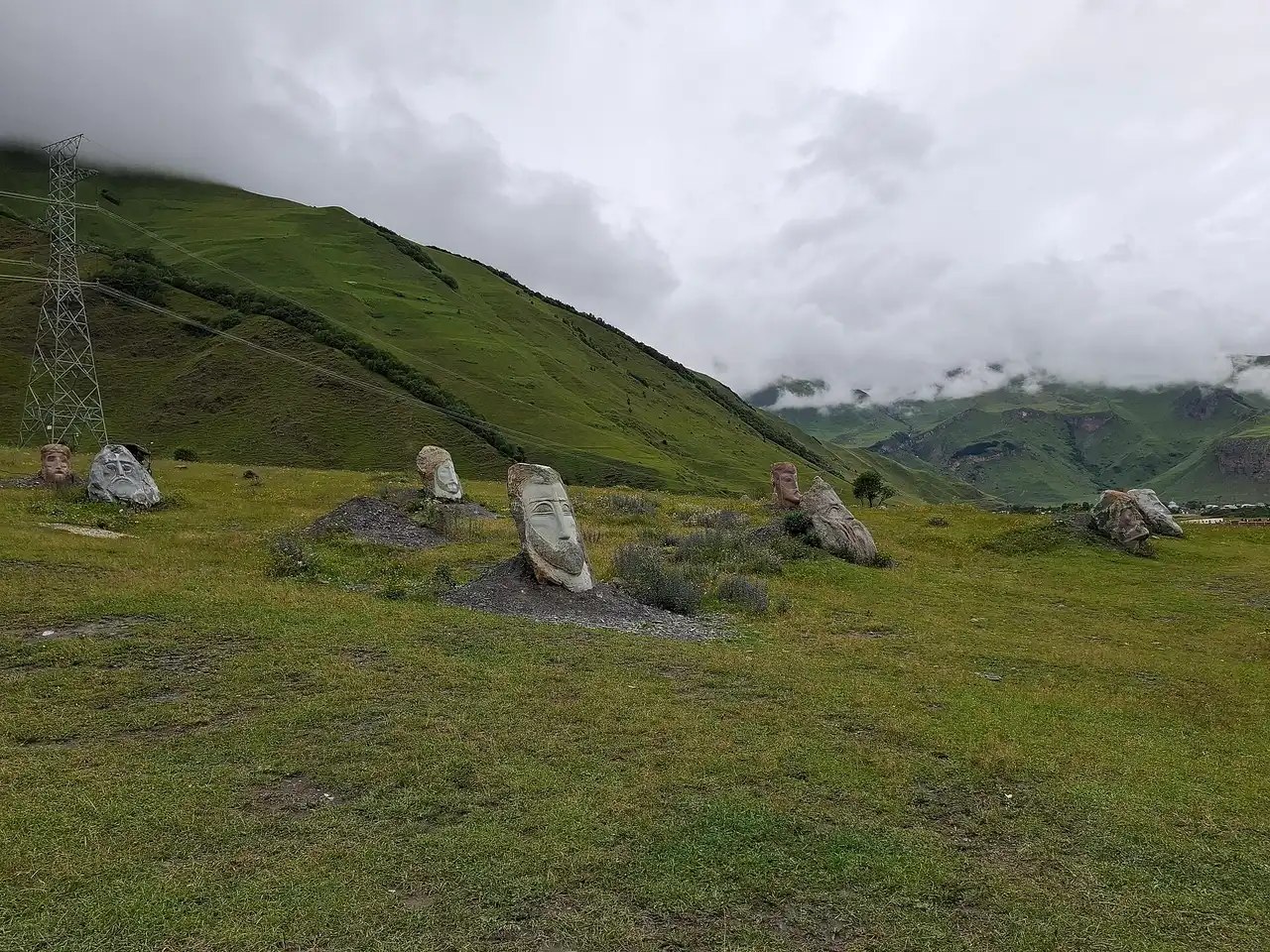
The heads were cut from local granite boulders by a self-taught sculptor, Merab Piranishvili, and portray Georgian cultural figures: Shota Rustaveli, Ilia Chavchavadze, Akaki Tsereteli, Vazha-Pshavela and others. Entry is a donation of about 5 GEL. In the village itself there are also the ruins of the small Sno fortress, worth the short climb if you have time. Sno doesn’t need a day of its own, but as a stop on the way to Juta it earns the pause.
Juta and the Chaukhi massif: the main mountain hike
Juta is where the real mountains start. The village is about 20 km from Stepantsminda, roughly 45 minutes by 4x4 along the road through Sno; the last stretch is rough, and an ordinary car doesn’t always manage it, so most people go by jeep or shuttle. From Juta the trail climbs towards the rocky Chaukhi massif: a day hike to the base and the lower lake is around 13 km and 4.5-5 hours there and back, moderate in terms of technique but with roughly 1100 metres of ascent. The village sits at about 2200 metres and the trail takes you above 3000, which is where that gain comes from; it’s the climb, not the distance, that wears you out here.
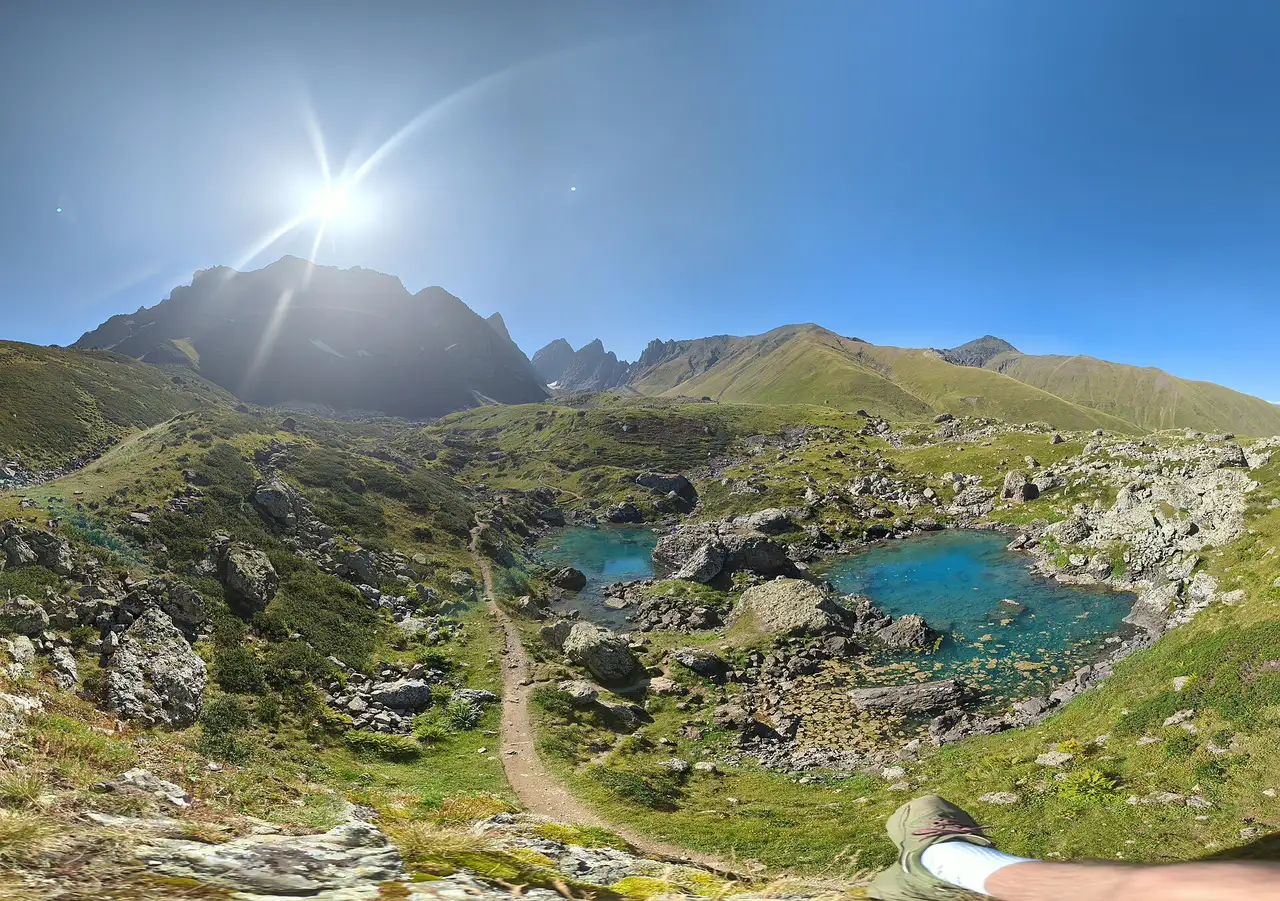
The Chaukhi pass (about 3341 m) is one of the highest “tourist” passes in Georgia, and it opens later than the others. Beyond it, on the Roshka side, lie the Abudelauri lakes - three alpine lakes in different colours: green, blue and white. A sober warning, though: the full loop from Juta to the lakes and back in one day is 12-14 hours, and plenty of people turn back exhausted. If the lakes are the goal, it’s smarter to plan two days with the Juta-Roshka crossing (about 19 km) and a night on the trail; Juta has guesthouses, so the two-day version is entirely realistic. One more thing: the road to Juta is sometimes closed by landslides, so it is worth checking the state of the drive in the village before you set off.
The Truso valley: travertines, mineral springs and a border zone
Truso is the opposite of Juta: an almost flat valley with no steep climb, but a long one. The trail starts at the near-abandoned village of Kvemo Okrokana near Kobi, about 23 km southwest of Stepantsminda. Walking from Kvemo Okrokana to Zakagori fortress and back takes around 6 hours - not hard physically, but on foot it adds up to roughly 20 km of gravel track along the Terek. A good choice if you want distance and unusual scenery without the vertical.
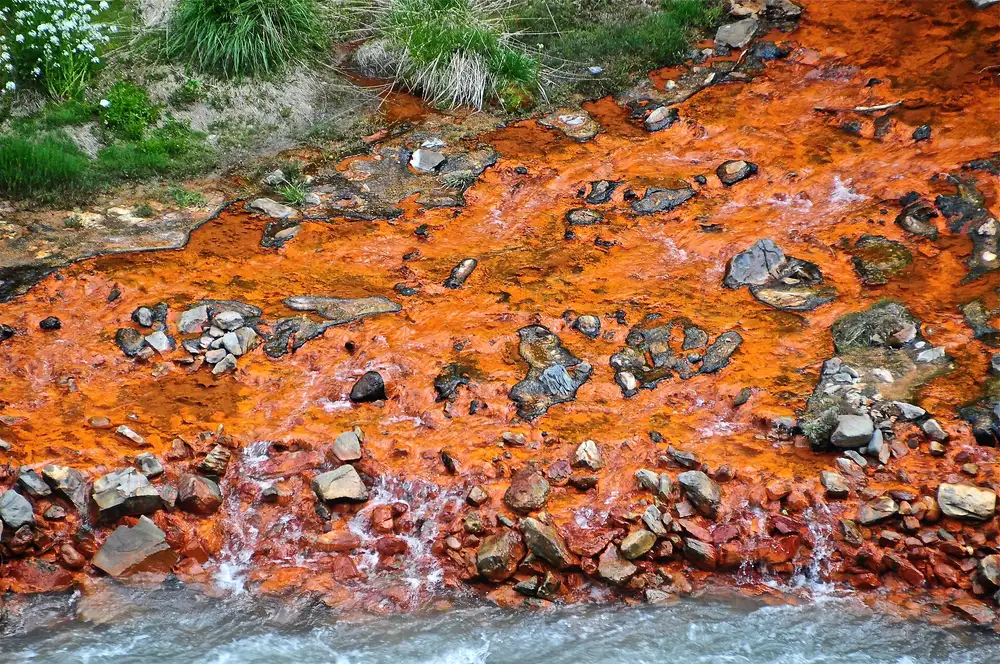
There is plenty to see in the valley: rust-and-white travertines, a red “geyser” where mineral water bursts out of a pipe, the turquoise Abano mineral lake, the abandoned villages of Abano and Ketrisi with their clan towers, and finally Zakagori fortress. The travertines themselves are a protected natural monument, and the same springs that run along the trail keep building them.
One point that changes your planning: the Truso valley runs along the administrative boundary with occupied South Ossetia. There is a Georgian border checkpoint at Zakagori fortress, and tourists aren’t allowed past it - this is your turnaround point. Carry your passport (a hard copy, not just a photo on your phone): documents are checked at the post. For an ordinary walk to the villages of Abano and Ketrisi and up to Zakagori you do not need a separate permit; it is only required for the more distant Kelitsadi lake - a free permit is issued by the border police (with your passport, at the post or in advance by application). Rules in the border zone can change, so it is worth confirming the current situation with the border guards or at the Stepantsminda tourist centre before you head out. What the US, UK, Canadian and Australian advisories say about this boundary, and why entering the occupied regions other than from the Zugdidi or Gori side is a crime, is laid out in our Georgia safety guide.
Which hike to choose
It comes down to how much time and energy you have. For half a day with no strain, do Gveleti plus a quick stop at the Sno stone heads; that pairing suits families and arrival day. For a full day, moderate and without a steep climb, take Truso: long but flat, and with the most unusual scenery in the region. For a proper mountain day, if your legs are ready for 1100 metres of ascent, go for Juta and Chaukhi; for the lakes, give it two days.
If you only have one day and still want the classic church, the plan is simple: climb to Gergeti Trinity Church in the morning for a clear Kazbek, then do Sno and Gveleti in the afternoon, since neither needs an early start. Everything to see in and around the village is gathered in the guide to Stepantsminda, and if you’re coming from Tbilisi with an overnight, the ready-made Tbilisi to Kazbegi in 2 days plan will help.
What to bring on any of these outings: water, a snack, a windbreaker and a warm layer, a sun hat, and footwear with real grip - smooth-soled trainers slide on scree and wet grass. Set off early: by midday Kazbek and the peaks often disappear into cloud, and rain is more likely in the mountains after lunch.
Photos
Read also

What to see · 10 min read
Skiing in Georgia: Gudauri vs Bakuriani
Updated · September 5, 2026Gudauri or Bakuriani: 2025/26 day passes 70 vs 55 GEL, elevations, last season dates, who each resort suits and how to get there.

What to see · 7 min read
Svaneti travel guide: Mestia, Ushguli and towers
Verified · August 25, 2026Svaneti mapped: Mestia vs Ushguli, tower villages, season, and how to link town guides, the trek, and the road from Tbilisi.

What to see · 9 min read
Resorts near Batumi: Gonio, Kvariati & Tsikhisdziri
Updated · September 2, 2026Where to stay near Batumi for cleaner, quieter beaches: Gonio and its Roman fort, Kvariati for diving, and secluded clifftop Tsikhisdziri - how to choose.

What to see · 10 min read
Georgia with kids 2026: family beaches & resorts
Updated · July 18, 2026Georgia with kids: sandy, shallow beaches up north (Ureki, Shekvetili, Kobuleti), amusement parks, when to go and how to plan a family trip.