
Tbilisi public transport: metro, buses and Bolt
Getting around Tbilisi: metro, buses, marshrutkas, cable cars and Bolt taxis. Real TTC fares from 1 GEL, the Metromoney card, and what covers what.

Tbilisi is compact, and public transport here is cheap and reliable enough that you often don’t need a car in the city at all. The metro, city buses, marshrutkas and most cable cars run on one card and one tariff system, and a single ride costs close to nothing by Western standards. The system is less simple than it looks, though: some cable cars sell their own tickets, and how you pay changes what a trip costs. Here’s how the fares actually work and which option makes sense for which trip.
The Metromoney card and how fares work
A single Metromoney card pays for the metro, buses, minibuses and two of the city’s cable cars. You buy one for 2 GEL at ticket windows inside metro stations, or at Bank of Georgia express branches, and top it up the same way; hold on to the purchase receipt, since it’s the only way to get the card replaced if you lose it. Most buses and the metro also accept a contactless bank card directly, no Metromoney needed.
The catch is in how you pay. Tap a Metromoney card or a bank card and a single ride costs 1 GEL, with unlimited transfers between metro, bus and marshrutka for 90 minutes. Pay by mobile app or in cash on the buses that still have a cash box, and you lose that 90-minute window - each ride is billed on its own. It’s a small detail that changes the maths on anything with more than one leg, like riding the metro to a transfer point and finishing by bus.
What a ride costs
The city transport company (Tbilisi Transport Company) publishes a flat set of passes on top of the 1 GEL / 90-minute fare, and they’re worth knowing if you’re staying more than two or three days: a day pass runs 3 GEL, a week 20 GEL, a month 40 GEL, three months 100 GEL, six months 150 GEL, and a full year 250 GEL. All of them load onto a Metromoney card, not a bank card, so if you know you’ll be riding daily, it’s worth buying the card on day one rather than tapping a bank card each time. For a short city break the difference is trivial, but for anyone based in Tbilisi for a month or more, the 40 GEL pass pays for itself in about three weeks of daily commuting (two rides a day at 1 GEL).
The metro
The metro is the fastest way to cross the city clear of traffic, and it’s also older than most first-time visitors expect: it opened on 11 January 1966, which makes it one of the older systems in the wider region. Two lines cross at Station Square, where a shared underground hall lets you change between them without going back through the turnstiles: the Akhmeteli-Varketili line and the Saburtalo line, 23 stations and about 28.6 km of track between them. Signs are in Georgian and English, trains run roughly from 06:00 to midnight, and there are no tokens - it’s Metromoney or a bank card at the gate, nothing else.


If you’re crossing the centre at rush hour, the metro almost always beats a car or even a taxi stuck behind it, since Tbilisi’s main avenues bottleneck badly between roughly 8:00-10:00 and 17:00-20:00. The stations themselves are worth a glance even if you’re not in a hurry - several of the older ones on the Saburtalo line keep the marble-and-chandelier look typical of Soviet-era metro design, a smaller and less famous cousin of what Moscow or Tashkent built on a grander scale.


Cable cars
Tbilisi runs more aerial cable cars than most visitors realise, and they’re not all the same system. Two are built for tourists and run on the standard Metromoney tariff: the ride from Rike Park up to Narikala fortress costs 2.5 GEL one way, and the smaller line out to Turtle Lake costs 1 GEL one way, with another 1 GEL if you’re bringing a bike. Less obviously, there’s a third ropeway that has nothing to do with sightseeing at all - the Bagebi-University line, which locals use as an ordinary commute and which is billed exactly like a bus or the metro under the same 1 GEL / 90-minute ticket.
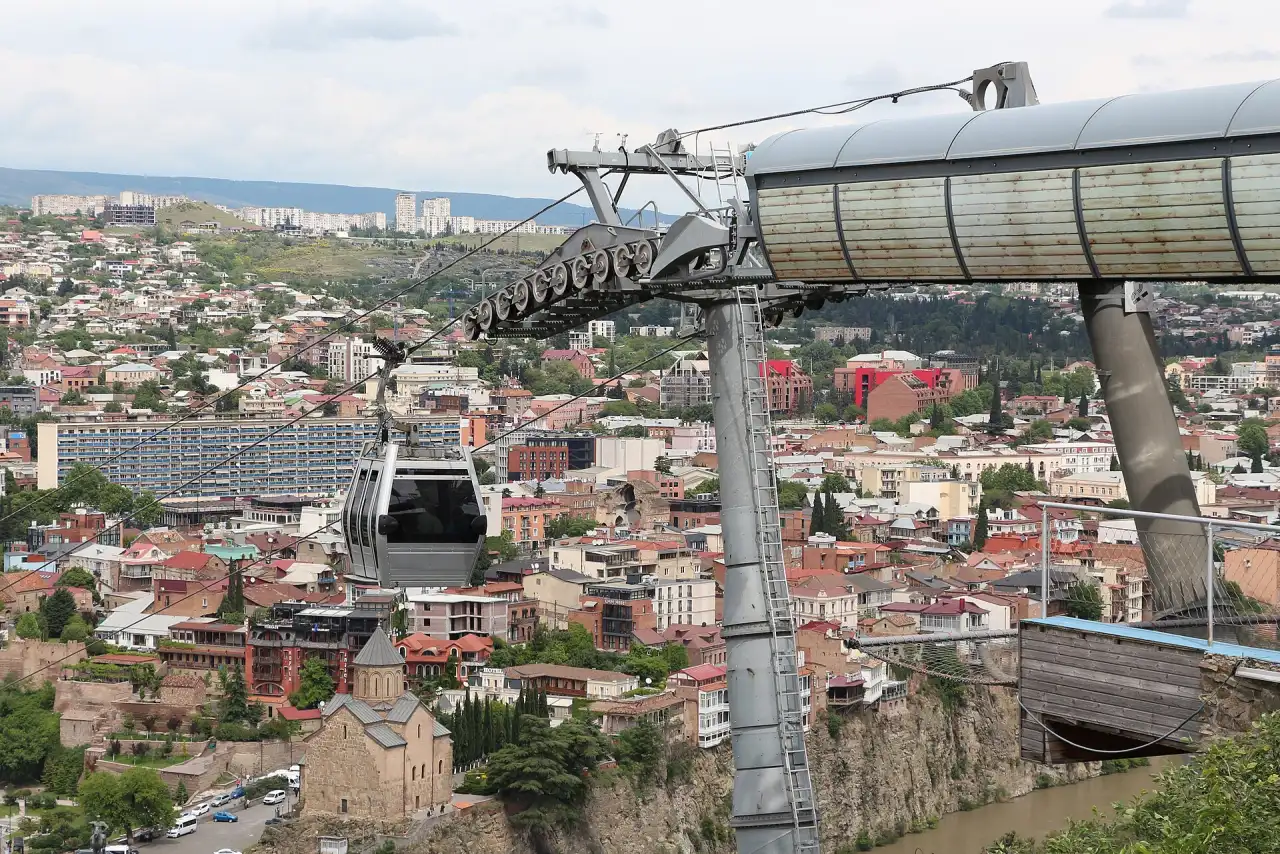
The newest line is the fourth: a gondola from Rustaveli Avenue 52 up to Mtatsminda Park, run by the park itself - 21 cabins for 8 people, about 5 minutes to the top, daily from 11:00 to 22:30. It isn’t part of the TTC tariff either: it runs on the park’s own card, like the funicular.
What often trips people up is the fifth one: the historic funicular railway up Mtatsminda, the mountain that overlooks the whole city. It looks like part of the same network, and it uses the same word “cable car” in casual conversation, but it runs on its own separate ticket, a Mtatsminda Park card, not Metromoney, sold at the lower station and topped up online through the park’s site. The fare is set by Mtatsminda Park, not by the city tariff, and you pay it on top of the card itself, so don’t expect your Metromoney balance to get you up the funicular - the park doesn’t publish the fare online (our Mtatsminda Park page keeps the latest visitor-reported price), so budget for it as a separate small excursion, not part of the daily transport tally.
Buses
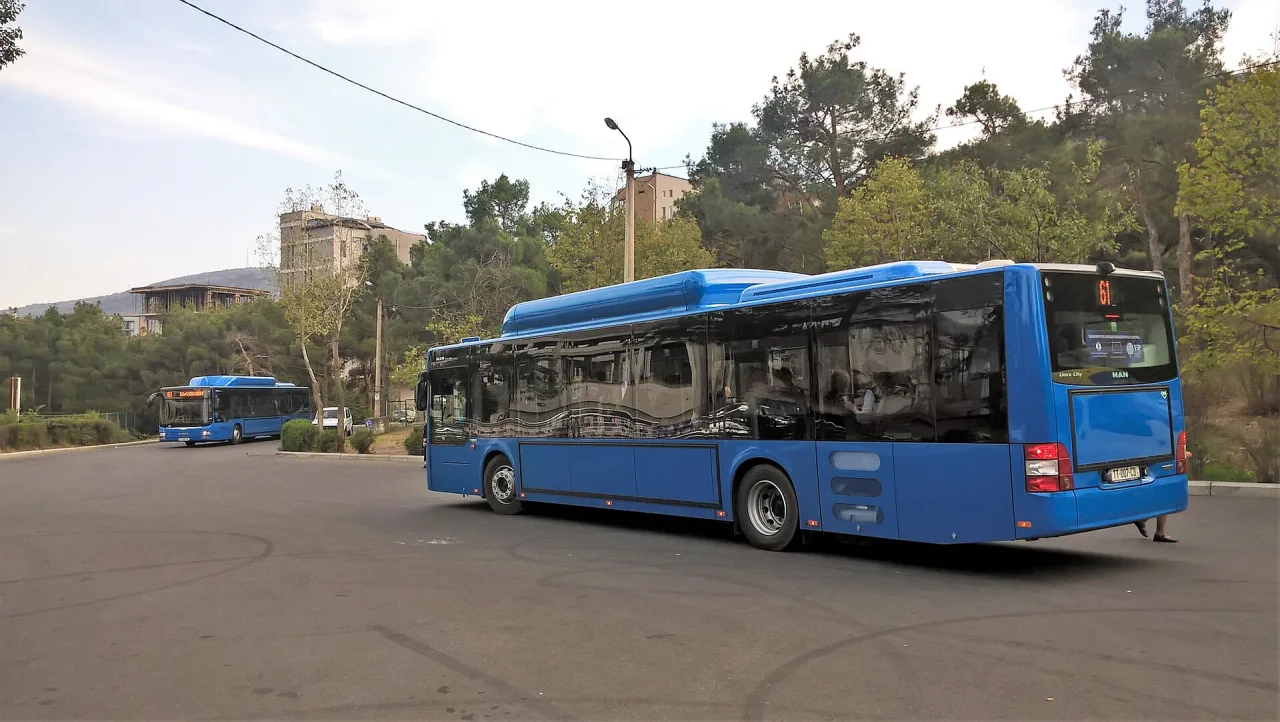
City buses, mostly blue, run frequently on numbered routes across the centre and out into the suburbs, and several main streets have dedicated bus lanes that help them skip at least part of the traffic. Payment works the same as the metro - tap a Metromoney or contactless bank card as you board - and the same 1 GEL / 90-minute transfer applies if you switch to the metro or another bus within the window. Digital screens above the doors show the route number, and stops are announced, so you don’t need much Georgian to follow along.
A navigation app such as Google Maps or Moovit will show you the nearest stop and a reasonably accurate arrival estimate, which matters more here than it would in a smaller town - Tbilisi’s bus network is large enough that guessing a route number from a map alone isn’t practical. TTC, the company behind all of this, also runs its own journey planner and a real-time bus tracker on its website, which is worth bookmarking if you end up relying on buses for more than a day or two - it’s more reliable than trying to read a paper timetable at the stop, and neither requires an account.
Marshrutkas
Marshrutkas (minibuses) cover routes a full-size bus doesn’t reach, and on some roads they’re genuinely faster, since a smaller vehicle can weave through traffic that a bus just sits in. The trade-off is predictability: departures are looser and seating is tighter. City marshrutkas take the same Metromoney or bank card as the metro and count towards the same 90-minute window; on some routes you can still hand the driver cash, but that forfeits the transfer window, so keep the card handy. They’re most useful for reaching outlying neighbourhoods or connecting to intercity routes at the bus stations, less so for a first-time visitor sticking to the centre.

Bolt (taxi)
The easiest way to order a taxi in Tbilisi is through the Bolt app: the fare is quoted before you accept the ride, there’s no haggling, and cars usually show up within a few minutes even outside the centre. It’s the option that actually matters late in the evening, in bad weather, or when you’re hauling luggage to or from a train station - situations where waiting for a bus stops being worth the saved money. Street taxis still exist and some drivers won’t have a meter running, so agree the fare out loud before you get in if you flag one down rather than booking through an app. It’s a habit worth keeping even for a short hop, since a driver who quotes a number in the car has no reason to lower it once you’re already moving.
Trips out of town
For day trips beyond the city (Mtskheta, Kazbegi, Kakheti) marshrutkas and trains leave from the city’s main stations, and if you’d rather set your own schedule, car hire is the more flexible option once you’re outside the metro’s reach. Longer western hauls - including the run west to mountain Mestia - leave from the same rail and bus hubs. National rail routes, tickets and classes sit in trains in Georgia. For ready-made plans, see the routes section.
Next up - our guide to Tbilisi and how to get in from the airport.
Read also

Transport · 13 min read
Kutaisi Airport to Gudauri 2026: 4 h, Shuttle, Transfer, Car
Verified · October 24, 2026Kutaisi airport to Gudauri: 309-310 km, about 4 h by road. A 30 GEL coach to Tbilisi and a marshrutka, a transfer timed to your flight, the winter bus.

Transport · 12 min read
Trains in Georgia: routes, tickets, express
Updated · October 17, 2026Georgian Railway in 2026: the Tbilisi-Batumi Stadler in about 4 hours from 35 GEL, how to buy on gr.com.ge, and which other routes still run.

Transport · 12 min read
Tbilisi to Gudauri 2026: Marshrutka, Taxi, Transfer
Updated · August 29, 2026Tbilisi to Gudauri for ski season: marshrutka 15 GEL, transfer 190-320 GEL per car, 120 km in 2-2.5h. Winter tyre law, closures, what to pick.

Transport · 10 min read
Tbilisi to Kutaisi 2026: train, bus, transfer
Updated · August 24, 2026Getting from Tbilisi to Kutaisi: train to Rioni station, marshrutkas from Didube, driving and transfers - times, prices and what to pick in 2026.