
Borjomi: mineral waters, the park and how to get there
The spa resort of Borjomi in its gorge: mineral waters in the central park, a cable car, the Romanov palace in Likani. Why it matters and how to get there.
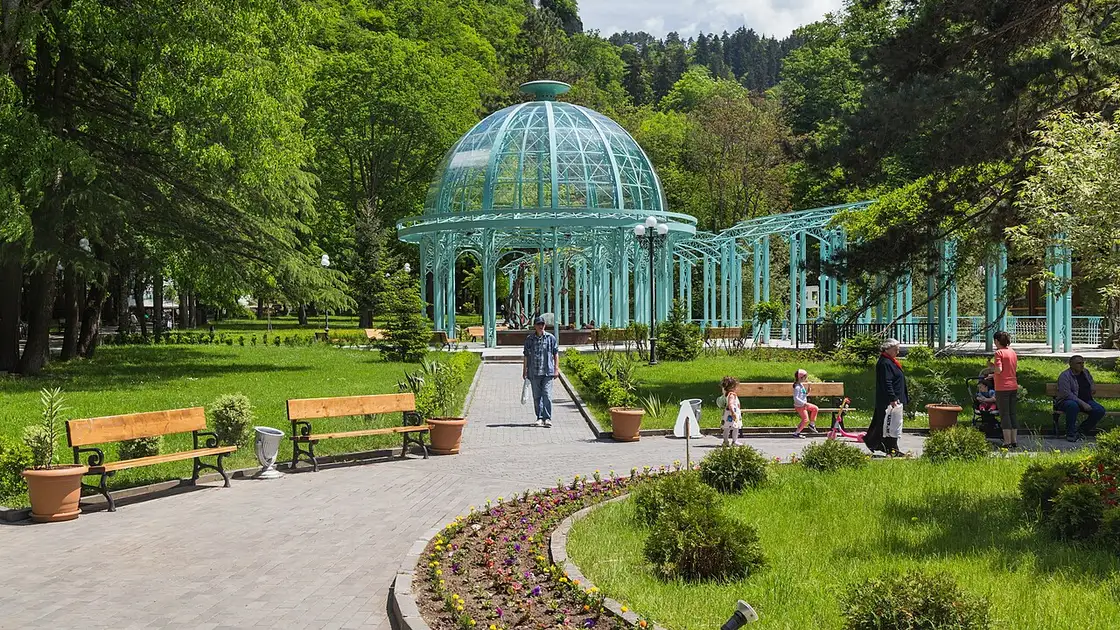
Borjomi is Georgia’s best-known spa resort, tucked into the green Borjomi gorge. People come for the mineral water that wells up right in the central park, for the cool of the pine forests, and for the unhurried resort rhythm of a park, a cable car and a Romanov legacy.
This page is about the resort itself - the park, the mineral springs and the cable car. For a full guide to the town as a base - where to stay, eat and what else to see nearby - see our Borjomi town guide.
Why the resort is famous
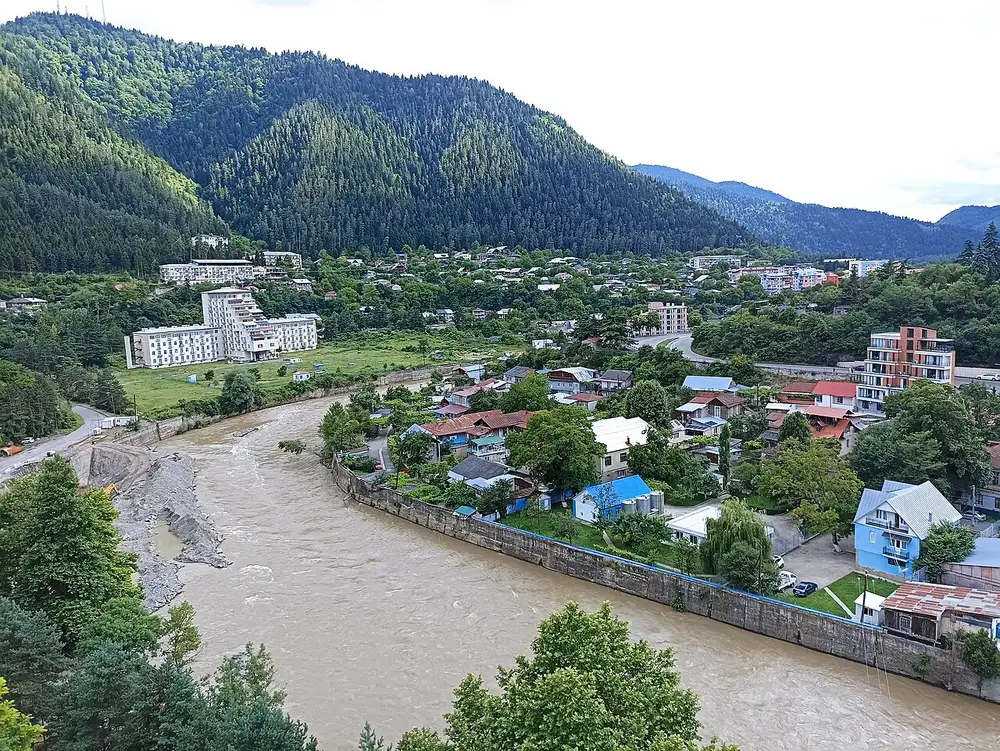
Borjomi lies in the Borjomi gorge in the Samtskhe-Javakheti region, about 160 km from Tbilisi and at an altitude of around 794 metres. It made its name with its mineral waters of volcanic origin and natural carbonation: bottling and exporting them from Georgia began in earnest back in the 1890s, and today “Borjomi” is one of the most recognisable Georgian brands.
Borjomi became a resort in the modern sense under the Romanovs. In 1871 the estate passed to Grand Duke Mikhail Nikolaevich, and his son, Grand Duke Nikolai, built a park and palace in nearby Likani in the 1890s. After 1921 the mansions were turned into sanatoriums, and Borjomi stayed a popular resort throughout the Soviet period.
What kind of water Borjomi is
It’s worth knowing what you’re actually drinking. Borjomi is a naturally carbonated sodium-bicarbonate mineral water of volcanic origin. It rises to the surface from deep underground under the pressure of natural carbon dioxide and, unlike many mineral waters, doesn’t cool on the way up - it emerges warm, at around 38-41 °C. It’s a fairly concentrated water: it carries more than sixty minerals and trace elements, and its saltiness and “soda” tang come precisely from the high bicarbonate and sodium content.
The water made its name in the 19th century. By the usual account, soldiers of the Kherson Grenadier Regiment came upon the springs in 1829, and in the second half of the century the Russian imperial family took to it too: under Grand Duke Mikhail, industrial bottling was set up in Borjomi, and by the 1890s “Borjomi” was known across the Russian Empire. Today the water is produced by IDS Borjomi and exported to around forty countries. There was a loud chapter in its history, too: in 2006 Russia banned imports of Georgian mineral water, and the ban stayed in place until 2013.
There’s a nice detail tied to the brand: a deer appears on the Borjomi label, and the signature greenish bottle is made in a recognisable “Georgian green”. By legend it was a deer that first led people to the healing spring - the producer keeps that story alive, and the deer has been the mark’s symbol for over a century. Another detail explains the taste: the water in these springs is thought to be very “old”, taking centuries to work its way through the rock and pick up its mineral load. That’s why the water from the tap in the park is noticeably brighter and saltier than you’d expect from a supermarket bottle: here it’s fresh, warm and not artificially carbonated. Many people come to Borjomi precisely to try the water “at the source” and compare it with the bottled version they know - and that’s a fair enough reason to make the trip.
What to see
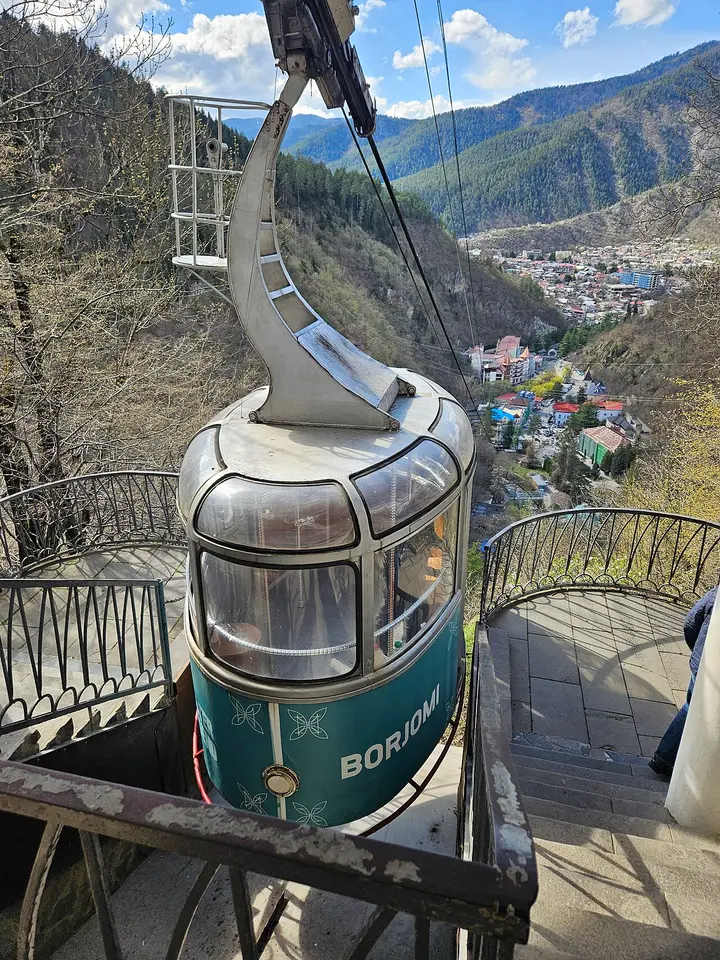
The heart of the resort is the central park with its mineral springs. Here stands an ornate drinking pavilion where warm mineral water flows from the tap, and along the river run avenues, footbridges and covered galleries. From the park you can ride the cable car up - from above, a panorama of the gorge and its green slopes opens out.
The park is laid out as one long green walk along the river: from the entrance with its fountain pavilion, the avenues lead deeper into the gorge, under the wooded slopes and past old resort buildings. In the evening the spring pavilion is lit up, and it’s one of the most recognisable images of Borjomi in photographs. The park was designed back in the resort era and has been the town’s main promenade ever since - it draws visitors coming for the water and local families out for an evening stroll in equal measure.
A little further on, in Likani, a park and palace built for the Romanov family survive. The palace went up in 1892-1895 to a design by the architect Leon Benois in a Moorish style rare for Georgia, as a summer residence for the imperial family. It stands in its park above the river, just west of the centre, and remains one of the most striking buildings in the gorge. And at the eastern edge of the town begins Borjomi-Kharagauli National Park - one of the largest in Georgia, with marked walking trails of varying length.
A local attraction in its own right is the narrow-gauge “Kukushka” railway, which runs from Borjomi up to mountain Bakuriani. It was built at the end of the 19th century, and one of the bridges along the way was designed by Gustave Eiffel’s firm; the line has been out of service since 2020, with a rebuild ordered in April 2026 and trains promised for January 2027. All of it - the park, the cable car, Likani and the Kukushka - adds up to the kind of unhurried resort day that makes Borjomi worth lingering over.
What to keep in mind for a visit
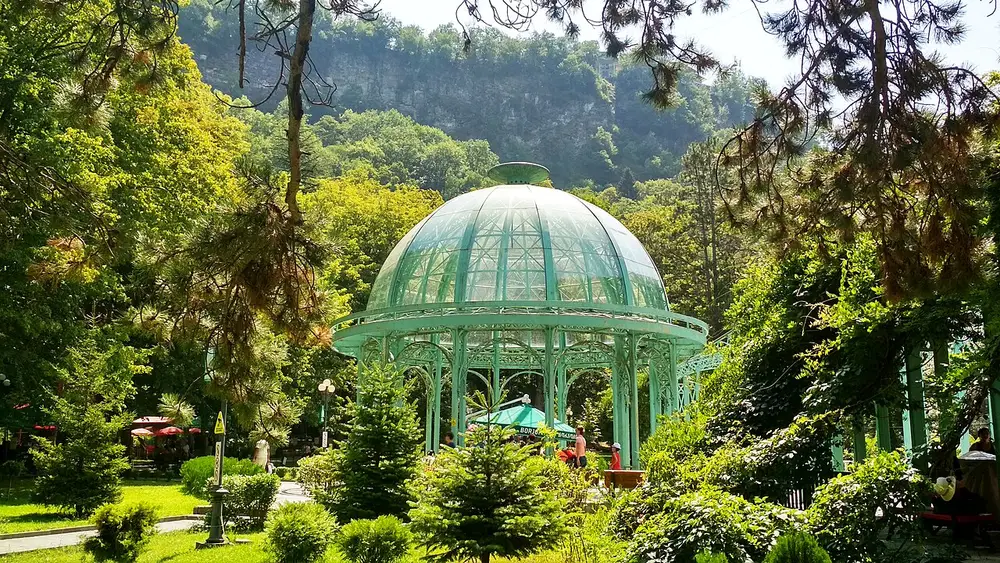
The mineral water from the park is drunk as a course of treatment - traditionally for problems of the stomach, liver and heart - but it’s worth trying simply for the experience: warm and slightly salty, it’s nothing like the chilled bottled version. You drink it right by the pavilion: the water is free, so fill a cup or bottle and taste it on the spot. Be ready for a taste that’s an acquired one - warm, salty mineral water doesn’t win everyone over on the first sip, and that’s fine. There’s no need to down it by the litre “for good measure”: this is a medicinal table water with real mineralisation, and in large amounts without a medical reason it does nothing for you.
Entry to the park costs a small, cheap fee (check the current price at the gate); inside, besides the spring, there are cafés, rides and a Ferris wheel, so a walk easily eats up half a day. The cable car lifts you from the park onto a plateau above the gorge with a viewpoint and a café - the easiest way to see Borjomi from above. Borjomi lies in the mountains, and even in summer it’s cooler in the shade of the gorge than on the plain, so a light warm layer won’t go amiss.
A couple of practical notes. Near the park entrance and along the main street there are plenty of kiosks and shops selling the same bottled Borjomi, local sweets and souvenirs, so it’s easy to take the water home “from the source”. The park avenues and the path to the cable car climb in places and run over uneven ground, so comfortable shoes will serve you better than smart ones. If you’re coming for the water’s health effects and have chronic conditions, it’s wiser to agree a drinking course with a doctor: this is a medicinal table water, not ordinary drinking water. And keep some cash on you - the entrance, cafés and rides in the park are easier to pay for in cash, and how money and currency exchange work in Georgia is something we cover separately.
When to go
The resort season in Borjomi is the warm half of the year, roughly May to October, and summer above all. While Tbilisi and the lowlands bake, up here in the shade of the pine gorge it’s noticeably cooler and easier to breathe - which is why the town and the park come alive in July and August. Autumn is good for the golden forest and fewer people. In winter the park and cable car run, but the evenings are cold and some of the terrace cafés are shut; at the same time winter is the season for neighbouring Bakuriani, easy to reach uphill from Borjomi. If you’ve come just for the water and a walk through the park, a few hours is enough; if you want to combine it with the surrounding mountains and trails, allow a day or two.
Getting there
Borjomi is an easy trip from Tbilisi - about 160 km to the west, roughly 2.5 hours by road. The train is slower at 4 h 12 min, and much cheaper. There are frequent marshrutkas (from the bus station by Didube metro) and a direct train; the train is slower but more scenic on the last stretch along the gorge, and it arrives at the ornate historic station. Driving is straightforward too. From Kutaisi it’s about 3 hours, from Batumi around 5. The central park with the springs is right in the middle of town, within walking distance of the station, so there’s no need to look for transport within Borjomi. If you arrive by car, the easiest thing is to leave it near the park entrance and continue on foot - the whole resort centre is compact and easily covered on a walk. For more on the town as a base - where to stay and eat - see our Borjomi town guide.
Nearby
South of Borjomi, in Akhaltsikhe, stands the restored Rabati Castle, and further along the Mtkvari valley lies the cave town of Vardzia. For trails, head into Borjomi-Kharagauli National Park; other places are in the things to see section.
Photos
On the map
The map loads on click - to keep the page lightweight.
The map didn’t load. Check your connection and refresh the page.
Distance
- Tbilisi ≈160 km · ~2.5 h train, marshrutka or car
- Kutaisi ≈175 km · ~3 h approximate
- Batumi ≈290 km · ~5 h approximate
Read also

What to see · 10 min read
Skiing in Georgia: Gudauri vs Bakuriani
Updated · September 5, 2026Gudauri or Bakuriani: 2025/26 day passes 70 vs 55 GEL, elevations, last season dates, who each resort suits and how to get there.

What to see · 7 min read
Svaneti travel guide: Mestia, Ushguli and towers
Verified · August 25, 2026Svaneti mapped: Mestia vs Ushguli, tower villages, season, and how to link town guides, the trek, and the road from Tbilisi.

What to see · 9 min read
Resorts near Batumi: Gonio, Kvariati & Tsikhisdziri
Updated · September 2, 2026Where to stay near Batumi for cleaner, quieter beaches: Gonio and its Roman fort, Kvariati for diving, and secluded clifftop Tsikhisdziri - how to choose.

What to see · 10 min read
Georgia with kids 2026: family beaches & resorts
Updated · July 18, 2026Georgia with kids: sandy, shallow beaches up north (Ureki, Shekvetili, Kobuleti), amusement parks, when to go and how to plan a family trip.