
Borjomi town: the spa resort and a mountain base
Borjomi spa town in its wooded gorge: the mineral-water park, the Likani palace, the old railway and a base for Bakuriani and Borjomi-Kharagauli.
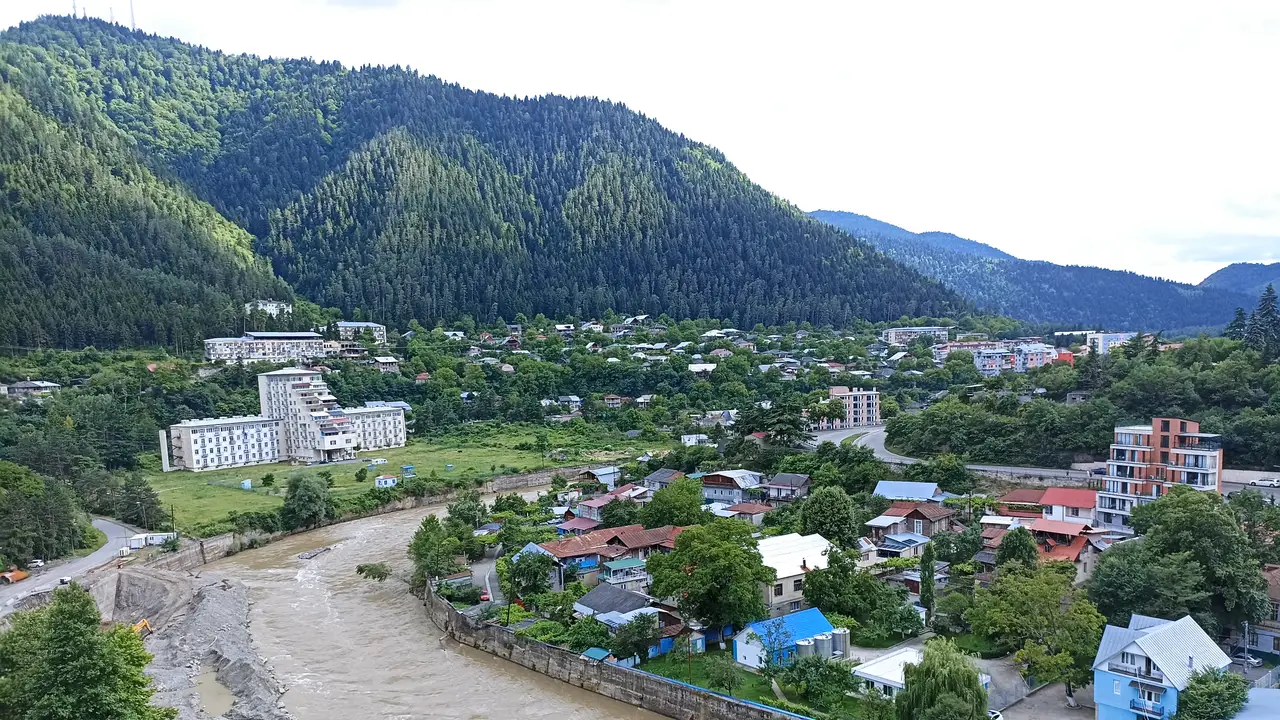
Borjomi is Georgia’s best-known spa town, strung out along the Mtkvari (Kura) river deep in a forested gorge in the Samtskhe-Javakheti region, about 160 km west of Tbilisi at around 800 metres. Its centrepiece is the free mineral spring in the central park, but what pulls people into staying rather than just passing through is the whole package: cool pine air, a slow resort pace, and - increasingly - a comfortable base for the mountains around it.
The name is familiar to anyone who has ever seen a green bottle of Borjomi: it’s arguably Georgia’s most recognisable export brand, and coming to the source is a pleasure in itself. But the town is more interesting than the water alone. It grew up where the district of Tori once stood, and made its name in the 19th century, when its springs first caught the attention of Russian soldiers and then the imperial family. Today it’s at once a working spa, a gateway to the mountains, and a place where a century of resort history shows at every turn - in the old station, the sanatoriums among the pines, and the palace at Likani.
Getting there and getting around
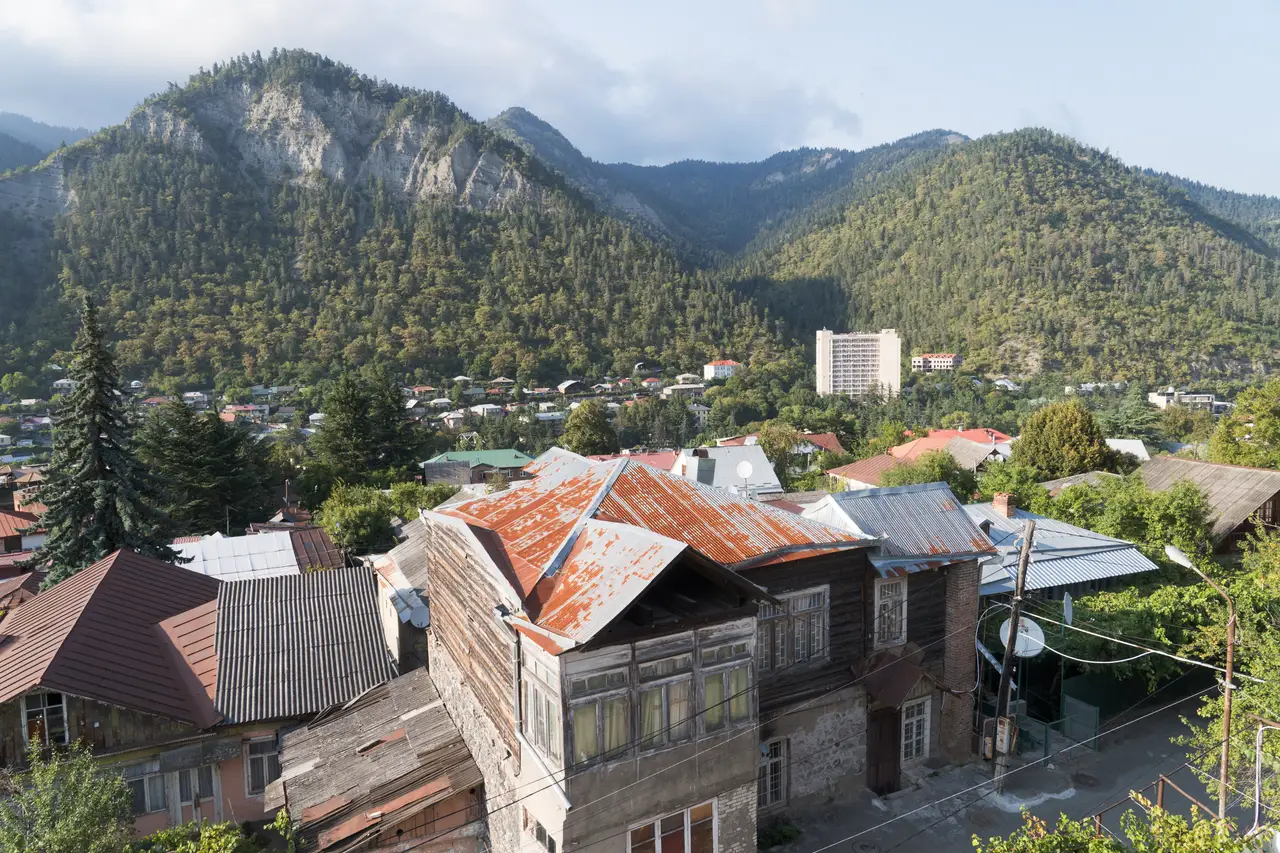
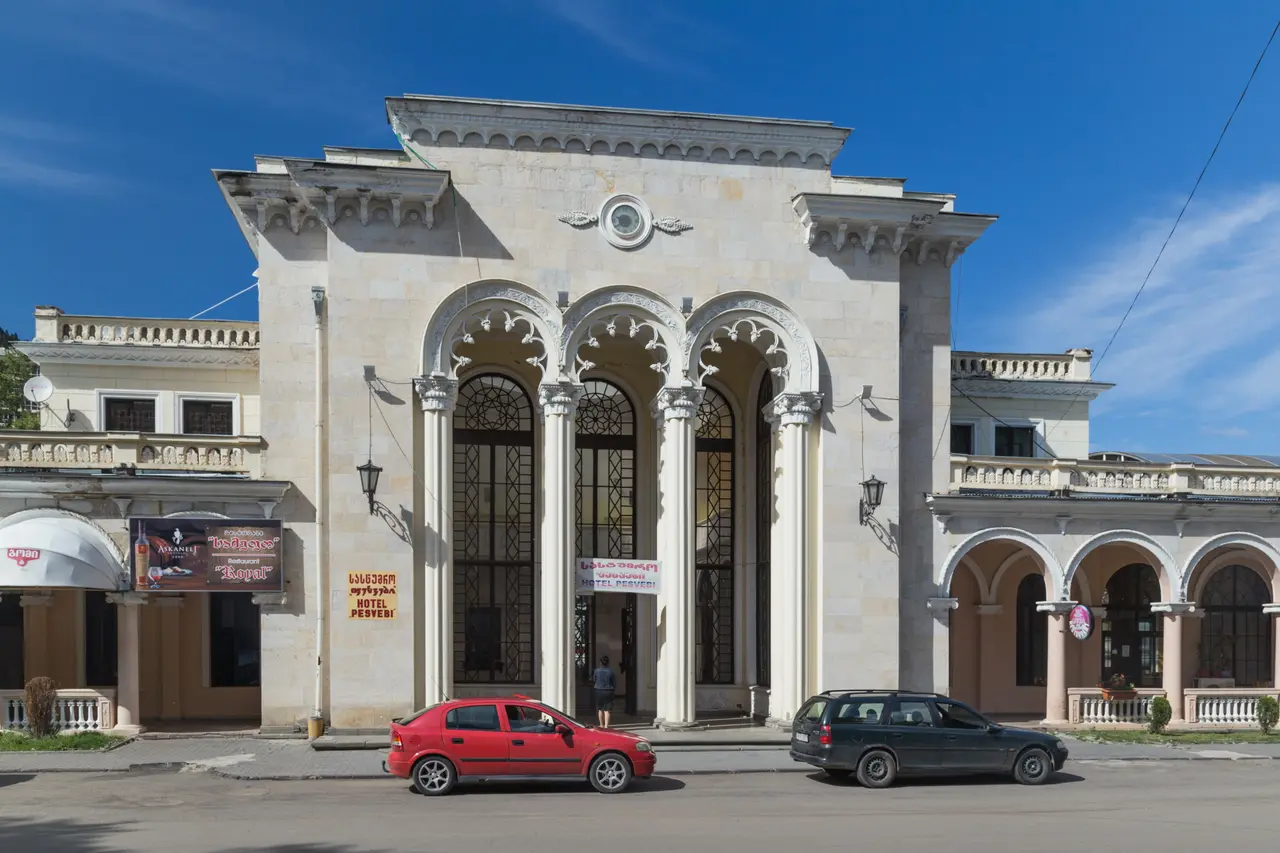
Borjomi is easy to reach: frequent marshrutkas and a direct train run from Tbilisi (about 2.5 hours by road; the train takes 4 h 12 min), and it’s a straightforward drive. Trains pull in at the town’s ornate old station - a relic of the resort’s late-19th-century heyday. The town stretches along the river, so it helps to know which end you’re staying at: the park, the station and most cafés are in the centre, and Likani lies a little to the west.
Marshrutkas from Tbilisi leave from the Didube bus station beside the metro of the same name and run slightly faster than the train, though the train wins if you’d rather watch the gorge scroll past for the final stretch than sit in a shared taxi. Distances within Borjomi itself are short: it’s about a ten-minute walk from the station to the entrance of the central park along the main street, Rustaveli, which is also where most of the cafés, exchange offices and shops are. You barely need a car in town, but one is handy if you plan to roam the region - to Akhaltsikhe, Vardzia or on into Kakheti. One practical point worth flagging: Borjomi is a valley boxed in by ridges, and mobile signal drops in places, so it pays to save your route and your accommodation address in advance.
Mineral water and the park
The heart of town is the central park, where warm, slightly salty mineral water flows from a drinking pavilion and a cable car lifts you to a viewpoint over the gorge - that side of Borjomi is covered in detail in our guide to the Borjomi park and its mineral waters. Entry to the park costs a small fee (check the price at the gate), and inside there are cafés, children’s rides and a Ferris wheel - which is why locals come here just to stroll for the evening rather than only to drink the water.
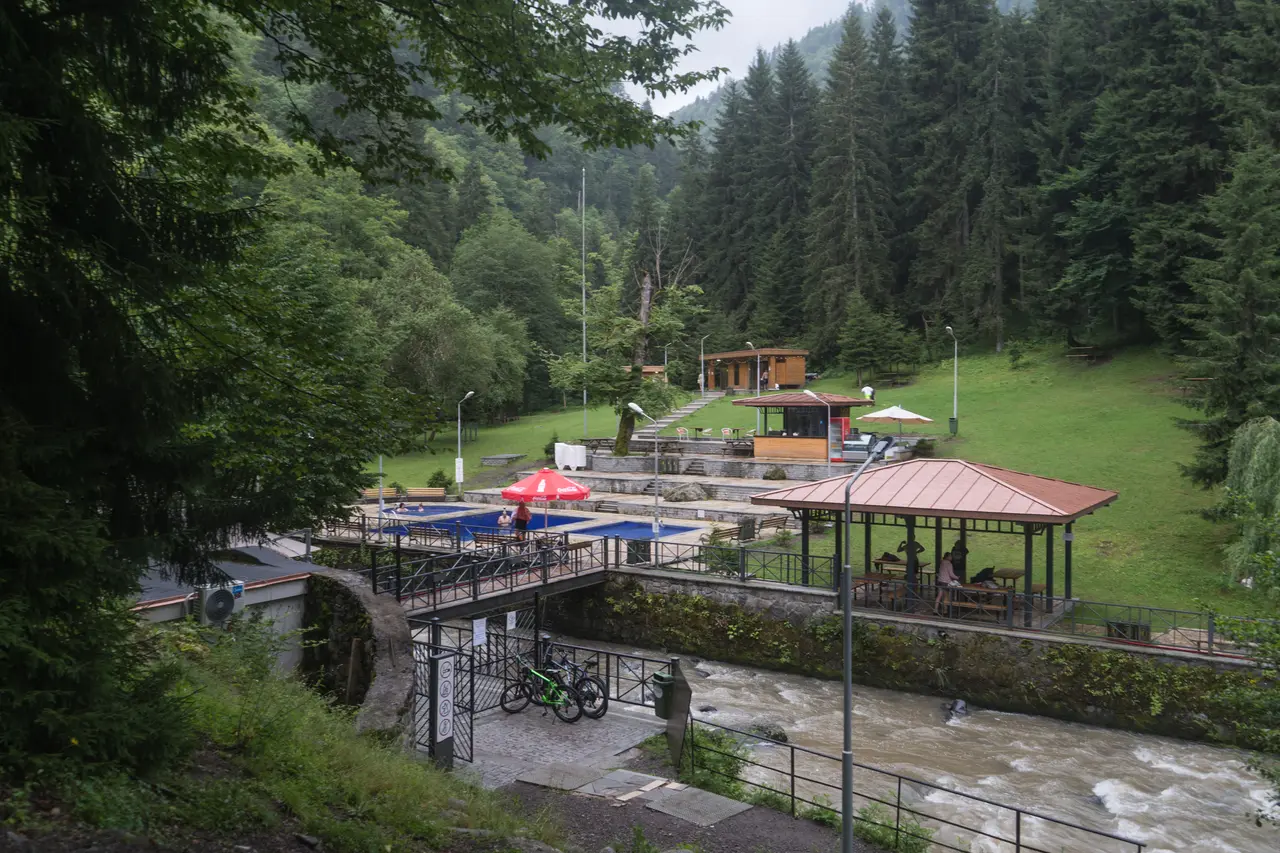
Further up the gorge, a forest path - about three kilometres each way from the far end of the park - leads to open-air warm mineral pools where you can bathe among the trees. The water is noticeably warmer than the mountain air, so people soak here even on cool days; bring a swimsuit, sandals and a towel, because there are no real changing rooms. It’s one of the nicest free walks from town, and it’s what turns Borjomi from a “stop for a bottle of water” into a place you want to linger. The cable car from the park lifts you onto a plateau above the gorge with the whole of Borjomi laid out below; there’s a viewpoint and a café at the top, and it’s the quickest way to see the town from above without the climb on foot.
The Romanov legacy: Likani
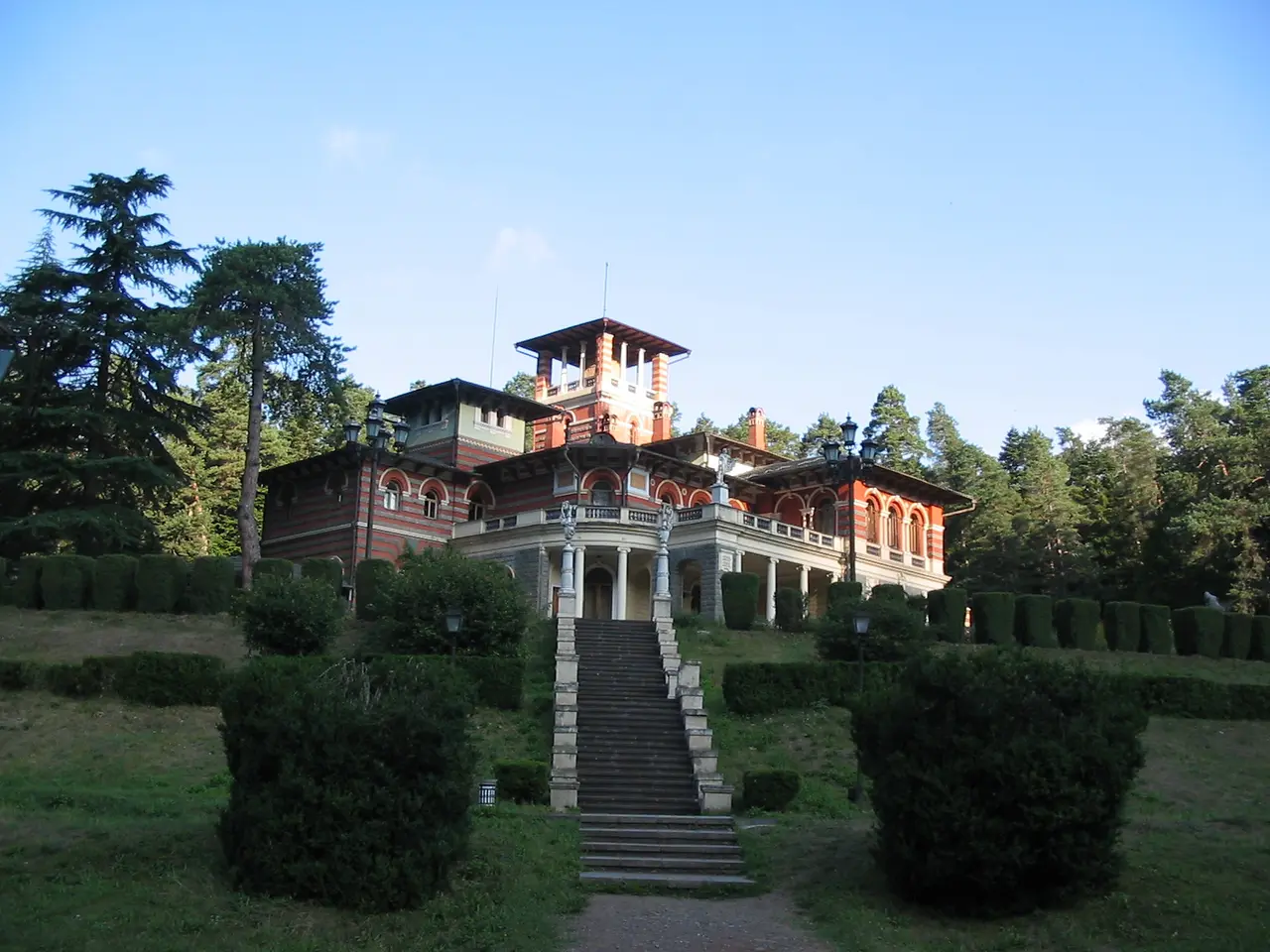
Borjomi became a fashionable resort under the Romanovs: Grand Duke Mikhail Nikolaevich took over the estate in 1871, and his son later built a palace and park a little west of town, at Likani - still one of the most photographed landmarks in the gorge (the fuller story, from the water to the palace, is in our Borjomi park and mineral waters guide). The town itself only got official status in 1918 and today counts around eleven thousand residents, which keeps it a snug spa town rather than a busy hub. The grand houses became sanatoriums after 1921, and the resort carried on drawing crowds straight through the Soviet decades - which is why pine groves around town are still dotted with ornate spa buildings.
A base for the mountains
Our Borjomi and Bakuriani weekend route strings mineral water, the narrow-gauge line and ski-town nights into two days.
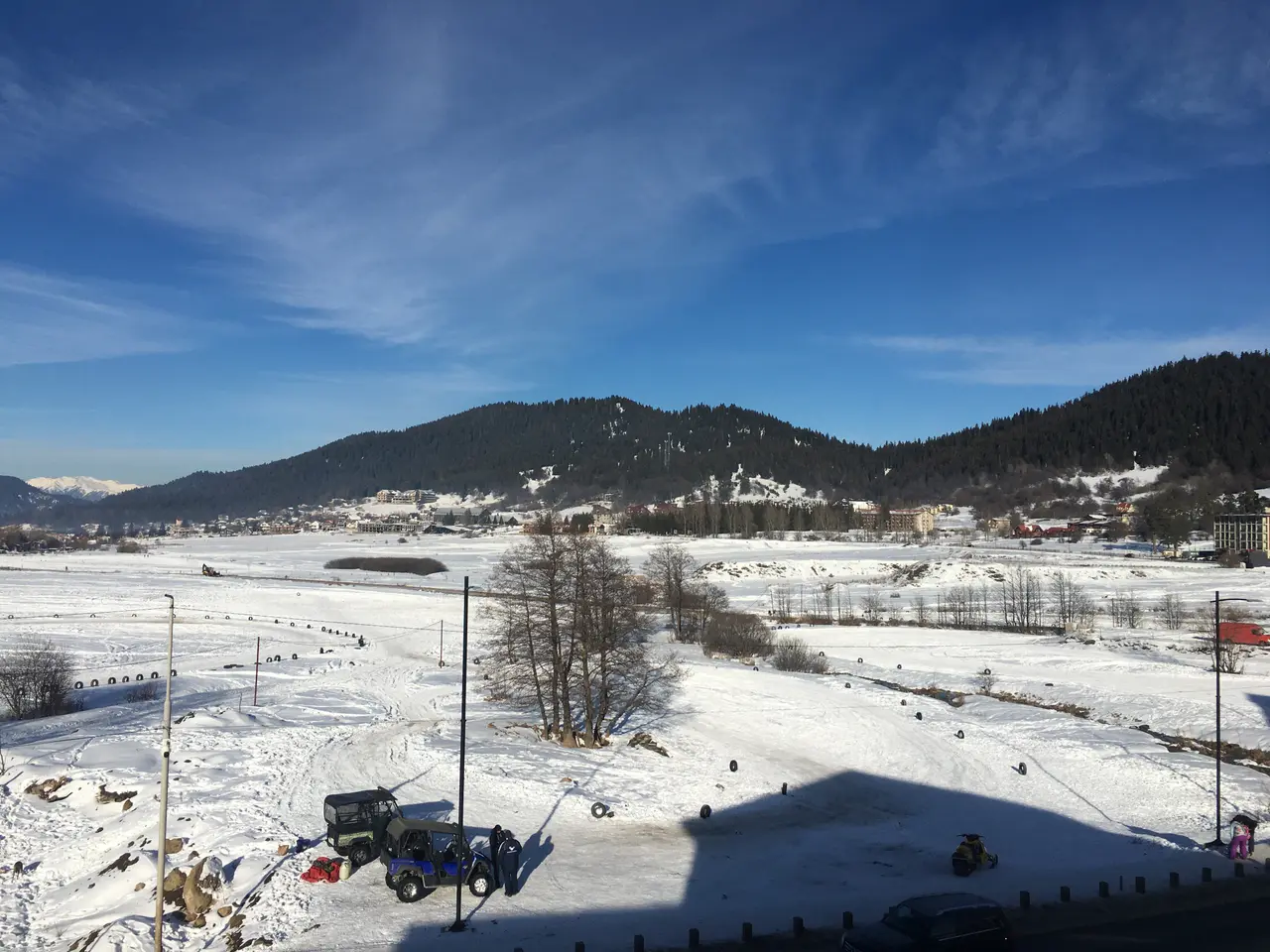
Borjomi works best as a base. A narrow-gauge mountain railway - the “Kukushka” - once climbed slowly through the forest to the ski resort of Bakuriani, much higher up: in winter it’s Georgia’s family ski town, in summer a cool green escape. And at the eastern edge of town begins Borjomi-Kharagauli National Park, one of the largest in Georgia, laced with marked walking trails of varying length.
The Kukushka itself is a sight in its own right, not just a way to reach Bakuriani. It’s a 900 mm narrow-gauge line about 37 km long, built between 1897 and 1901 while Georgia was still part of the Russian Empire; the first train ran in January 1902. It grinds up the mountains at an average of about 15 km/h, so the whole run to Bakuriani takes the same 2.5 hours or so - you ride it for the journey, not to save time. On the way the train crosses a lacy steel bridge near Tsagveri, designed by Gustave Eiffel’s firm. One thing to settle before you plan around it: the Kukushka has not carried passengers since 2020. Not the intermittent repair closures older pages describe - one continuous stop. The government ordered a full rebuild in April 2026 and put the return to service at January 2027, so for now it is something to photograph rather than ride; there’s always the road to Bakuriani as a fallback.
Where to stay and eat
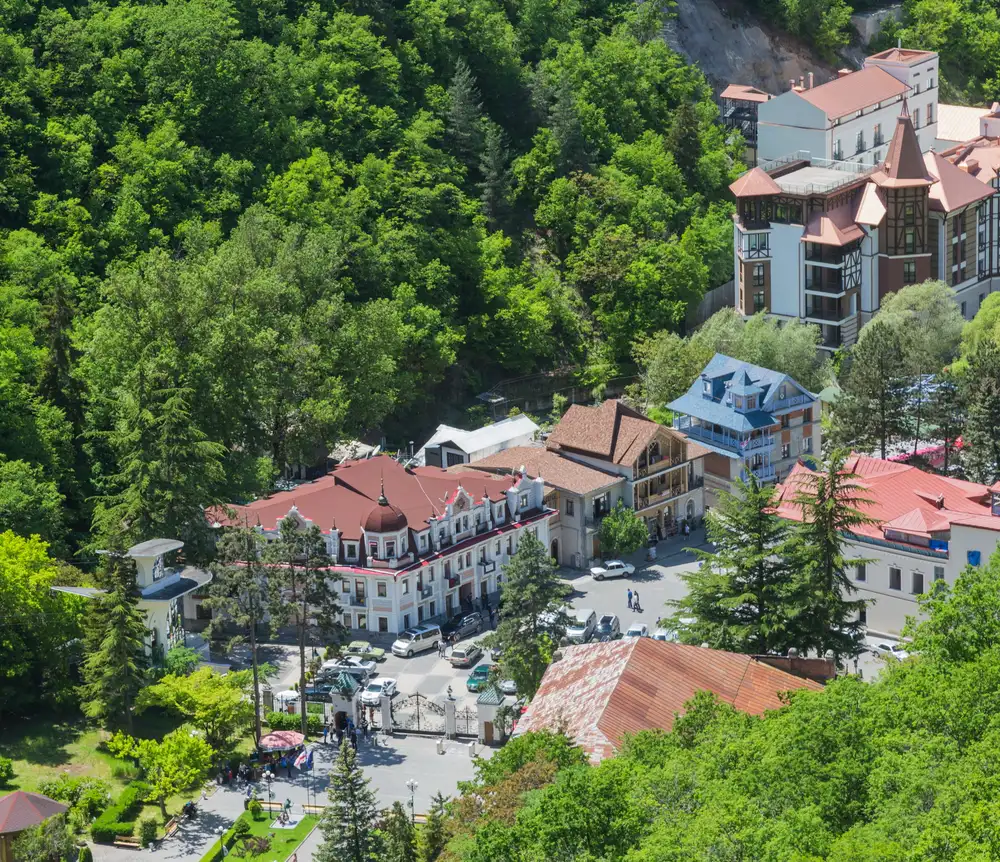
Borjomi has places to stay to suit a range of budgets. The resort era left the town with large Soviet-style sanatoriums that still run wellness programmes built around the mineral water and spa treatments; alongside them are newer hotels and dozens of family guesthouses, especially along the main street and up the slopes closer to the park. The logic is simple: if you’ve come for the town and the park, stay in the centre within walking distance of the springs; if you’re after quiet and forest, look for somewhere higher up the gorge or towards Likani. In high season, in July and August, the best places go early, so it’s worth booking ahead.
Eating in Borjomi is honest, hearty Georgian fare. Cafés along Rustaveli serve the familiar classics - khinkali, khachapuri, grilled meats, lobio - along with dishes typical of the mountain regions; portions are large and the bill is modest. Many places have terraces, which are lovely on a warm evening, but bear in mind that some close early and outside the season, and the choice narrows noticeably in winter. If you’re planning a late dinner, check the hours during the day. One practical detail: there are grocery shops and pharmacies right in the centre near the park and station, so anything you need for a walk is easy to pick up on the spot.
When to go, and for how long
Borjomi is good year-round, but for different reasons. Summer (June to September) is the main season: while Tbilisi and the lowlands swelter, up here at around 800 metres in the shade of the pine forest the air stays easy to breathe, so July and August fill the town with families and heat-refugees. Autumn is the prettiest time: the beech and conifer slopes of the gorge turn gold, and there are fewer visitors. In winter the town serves as the gateway to the ski slopes of Bakuriani, though café terraces start closing for the season and evenings turn properly cold. A day is enough for the town, a walk through the park and a ride up the cable car - but if you’re using Borjomi as a base for Bakuriani and at least one trail in the national park, allow two or three days, or you’ll spend the whole visit watching the roads head off into the mountains.
What to keep in mind
Borjomi sits high in the mountains, so pack a light layer even for a summer trip - the gorge holds shade and cool air long after the plain outside has warmed up. The park’s mineral water is worth a sip while you’re there, if only for the novelty; the taste, the etiquette and the full history are in our park and mineral waters guide. Keep some cash on you, too: cafés and hotels in Borjomi take cards, but small vendors, the park entrance and mountain guesthouses often want cash - how that works across the country is covered in our guide to money and currency exchange in Georgia.
Nearby
Akhaltsikhe and its restored Rabati Castle sit south of Borjomi, with the cave town of Vardzia further along the same valley road. Borjomi-Kharagauli National Park is the pick for hiking trails. The country’s other towns are in the cities section, and the full list of places is in things to see.
Photos
On the map
The map loads on click - to keep the page lightweight.
The map didn’t load. Check your connection and refresh the page.
Distance
- Tbilisi ≈160 km · ~2.5 h train, marshrutka or car
- Kutaisi ≈175 km · ~3 h approximate
- Batumi ≈290 km · ~5 h approximate
Read also

Cities · 10 min read
Ureki: black magnetic sand and a shallow sea
Updated · July 20, 2026Ureki, Guria's sandy resort: black magnetic sand, a shallow warm sea and easy family beaches. Where to stay, when to go and how to get there.

Cities · 12 min read
Batumi: beaches, boulevard, what to see and where to stay
 Verified · June 15, 2026
 Batumi, Georgia's Black Sea resort: beaches, the palm boulevard, Alphabet Tower, Piazza and skyscrapers. What to see, where to stay and how long.

Cities · 4 min read
Gori: Stalin Museum and the Uplistsikhe cave city
Updated · June 14, 2026Gori in Shida Kartli, where the Kura meets the Liakhvi: a hilltop fortress, the Stalin museum and the Uplistsikhe cave city nearby.

Cities · 8 min read
Kutaisi: what to see, where to eat, how to get there
 Verified · June 15, 2026
 Kutaisi - Georgia's third city and ancient capital of Colchis: Bagrati Cathedral, the Colchis Fountain, the Rioni. What to see in and around.